
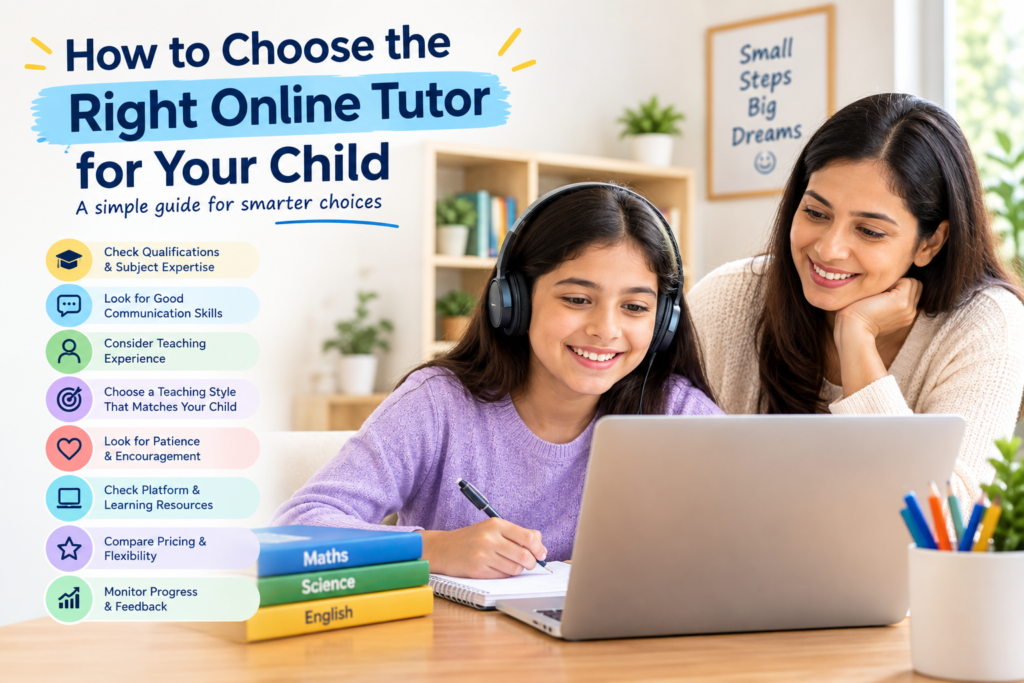
Choosing the right online tutor can make a major difference in your child’s academic journey. The right tutor can help your child understand difficult concepts, improve academic performance, build confidence, and develop better learning habits.
With so many online tutoring options available, parents may find it difficult to decide which tutor is best for their child. Qualifications, teaching experience, learning style, communication, class format, pricing, and flexibility are all important factors to consider.
This guide explains 9 practical tips for choosing the right online tutor for your child, so you can make a more informed decision and find a learning experience that matches your child’s individual needs.
Quick Answer: How Do You Choose the Right Online Tutor?
To choose the right online tutor, first identify your child’s learning goals and academic challenges. Then evaluate the tutor’s subject expertise, qualifications, teaching experience, communication skills, and teaching style.
Before making a final decision, take advantage of a demo class if available. Pay attention to how the tutor explains concepts, responds to questions, keeps your child engaged, and adapts the lesson to their learning level.
The best online tutor is not necessarily the most expensive or most qualified person. It is the tutor who can effectively understand your child’s needs and create a comfortable, personalized, and productive learning environment.
If you want to learn more about how GenieClasses supports students and families, you can learn more about GenieClasses and its approach to personalized online education.
Key Takeaways
Identify your child’s specific learning needs before choosing a tutor.
Check the tutor’s qualifications and subject expertise.
Consider the tutor’s experience with your child’s age and curriculum.
Choose a teaching style that matches your child’s learning preferences.
Decide whether one-on-one or group tutoring is more suitable.
Take a demo class before committing to regular lessons.
Look for clear communication and regular feedback.
Compare pricing, scheduling, and flexibility.
Monitor your child’s progress after tutoring begins.
Why Is Choosing the Right Online Tutor Important?
Every child learns differently. Some students understand new concepts quickly, while others need additional explanations, examples, practice, or individual attention.
A good online tutor can adapt lessons according to the student’s learning level and provide support where it is needed most.
The right tutor can help your child:
Understand difficult academic concepts.
Strengthen basic subject knowledge.
Improve problem-solving skills.
Prepare for tests and examinations.
Develop better study habits.
Become more confident in asking questions.
Improve academic performance.
Develop a more positive attitude toward learning.
Online tutoring can also provide greater flexibility because students can attend classes from home without travelling to a physical tuition centre.
GenieClasses offers online tuition with 1-on-1 live sessions and group classes, along with professionally qualified tutors and learning support. You can explore the available online learning options.
How to Choose the Right Online Tutor for Your Child? 9 Essential Tips
1. Identify Your Child’s Learning Needs
Before searching for an online tutor, determine why your child needs additional academic support.
Ask yourself:
Which subject does my child need help with?
Which topics are difficult for them?
Do they need help with homework?
Are they preparing for an examination?
Do they need stronger foundational concepts?
Do they need advanced learning beyond school?
Do they need more confidence in a particular subject?
For example, a student struggling with Mathematics may need additional help with fractions, algebra, equations, or problem-solving.
Another student may understand the concepts but need more practice to improve test performance.
Once you understand your child’s specific requirements, it becomes easier to find a tutor who can address those needs.
Tip: Write down two or three learning goals before contacting potential tutors.
2. Check the Tutor’s Qualifications and Subject Expertise
A tutor should have strong knowledge of the subject they teach. Relevant educational qualifications, certifications, and teaching experience can help parents evaluate a tutor’s expertise.
However, qualifications alone do not guarantee effective teaching.
A good tutor should also be able to explain complex concepts in simple language and adjust lessons according to the student’s level.
When evaluating an online tutor, consider:
Educational qualifications.
Subject-specific knowledge.
Teaching experience.
Experience with your child’s age group.
Familiarity with the relevant curriculum.
Experience helping students with similar learning goals.
GenieClasses allows students and parents to browse tutors and find a suitable match based on learning requirements. You can browse tutors on GenieClasses.
For example, tutor profiles on the platform provide information such as subjects taught, experience, qualifications, and teaching expertise, helping parents make a more informed choice.
3. Consider the Tutor’s Teaching Style
Every student has different learning preferences.
Some children learn better through diagrams and visual explanations, while others prefer discussions, examples, practice questions, or step-by-step explanations.
The right tutor should be able to adapt their teaching approach instead of using exactly the same method for every student.
Look for a tutor who:
Explains concepts clearly.
Encourages questions.
Uses practical examples.
Checks understanding regularly.
Adjusts lesson difficulty.
Encourages active participation.
Provides constructive feedback.
For example, a Science tutor might use diagrams and real-world examples to explain scientific concepts, while an English tutor may combine reading, grammar, vocabulary, and writing exercises.
A teaching style that matches your child’s learning preferences can make online classes more engaging and productive.
4. Decide Between One-on-One and Group Tutoring
Parents should also consider which type of online class is better for their child.
One-on-One Online Tutoring
One-on-one tutoring gives the student the tutor’s complete attention.
It can be particularly useful for children who:
Need personalized attention.
Have specific learning difficulties.
Need additional practice.
Are uncomfortable asking questions in a group.
Prefer learning at their own pace.
The tutor can spend additional time on difficult topics and move more quickly through concepts the student already understands.
Group Online Tutoring
Group classes can be useful for students who enjoy learning with other students.
Group learning can encourage:
Discussion.
Collaboration.
Classroom interaction.
Different approaches to problem-solving.
Peer learning.
GenieClasses provides both 1-on-1 live sessions and group classes, allowing families to consider the learning format that best fits their child. Explore GenieClasses to learn more about the available options.
There is no single format that is best for every child. Consider your child’s personality, confidence, learning goals, and academic needs before choosing between individual and group tutoring.
5. Take a Demo Class Before Making a Decision
A tutor’s profile can provide useful information, but a demo class gives parents a better idea of the actual learning experience.
During a demo class, observe how the tutor:
Explains difficult concepts.
Communicates with your child.
Encourages questions.
Checks understanding.
Maintains student attention.
Adjusts the lesson to the student’s level.
Also ask your child how they felt about the session.
Did they understand the lesson? Did they feel comfortable asking questions? Did they enjoy the learning experience?
GenieClasses provides a free demo class option, allowing students and parents to experience the teaching approach before continuing with regular learning. You can learn more and get started with GenieClasses.
A demo class can help you evaluate compatibility before committing to regular tutoring sessions.
6. Evaluate Communication and Student Engagement
Communication is one of the most important qualities of an effective online tutor.
Because online classes take place through a digital environment, the tutor needs to keep the student involved and attentive.
Look for a tutor who:
Communicates clearly.
Encourages students to participate.
Gives constructive feedback.
Allows students to ask questions.
Encourages independent thinking.
Creates a supportive learning environment.
Students should feel comfortable making mistakes and asking questions.
A good tutor should not simply provide answers. They should guide the student toward understanding the concept and solving problems independently.
7. Check the Online Learning Platform and Available Resources
The platform used for online tutoring can also affect the overall learning experience.
Before enrolling, check whether the platform provides useful tools and resources.
Important features may include:
Live online classes.
Interactive learning tools.
Digital worksheets.
Practice exercises.
Class recordings.
Progress tracking.
Learning materials.
Flexible scheduling.
Technical support.
GenieClasses highlights features such as customized worksheets, guided corrections, class recordings, AI-powered learning insights, and 24×7 support to support students throughout their learning journey.
Parents can also visit the GenieClasses FAQ section to find answers about lessons, trial sessions, scheduling, and other platform-related questions.
Parents should also make sure that their child has a reliable internet connection, suitable device, headphones if required, and a quiet learning environment.
8. Compare Pricing, Scheduling, and Flexibility
Cost is an important consideration when selecting an online tutor.
Tutoring fees can vary based on the tutor’s experience, qualifications, subject, class duration, and learning format.
However, parents should not choose a tutor based only on price.
Instead, compare the overall value of the tutoring service.
Before enrolling, check:
Cost per class or package.
Class duration.
Available timings.
Rescheduling options.
Cancellation policies.
Learning materials.
Demo class availability.
Any additional charges.
GenieClasses also provides flexible online learning options for students and tutors across different locations and time zones.
If you have questions about classes, scheduling, or the platform, you can contact GenieClasses for further assistance.
9. Monitor Your Child’s Progress
Choosing an online tutor is only the first step.
Parents should regularly monitor whether the tutoring sessions are helping their child achieve their learning goals.
Some signs of progress include:
Better understanding of difficult topics.
Improved homework performance.
Greater confidence.
Better test results.
More active participation.
Improved problem-solving ability.
Greater independence while studying.
Parents should also communicate regularly with the tutor about their child’s strengths and areas that need improvement.
Remember that every child learns at a different pace. Academic improvement may take time, especially when a student is working on foundational concepts.
Regular progress reviews can help parents and tutors make necessary adjustments to the learning plan.
Common Mistakes Parents Should Avoid When Choosing an Online Tutor
Choosing an online tutor becomes easier when you know what mistakes to avoid.
Choosing Only Based on Price
The cheapest tutor may not always provide the best learning experience. Similarly, a higher price does not automatically mean better teaching.
Consider teaching quality, experience, qualifications, and student compatibility along with cost.
Ignoring the Child’s Learning Style
A highly qualified tutor may still not be the right match if their teaching style does not suit your child.
Always consider how your child learns best.
Skipping the Demo Class
If a demo class is available, use it to evaluate the tutor before making a commitment.
Focusing Only on Qualifications
Qualifications are important, but teaching ability matters just as much.
The tutor should be able to communicate clearly and make difficult concepts easier to understand.
Expecting Immediate Results
Learning improvement takes time.
Students need consistent practice, feedback, and support before they can build stronger understanding and confidence.
Ignoring Your Child’s Feedback
Your child’s experience matters.
If they consistently feel uncomfortable or disengaged during lessons, discuss the issue with the tutor or consider a different teaching approach.
What Should Parents Look for in an Online Tutor?
Use this simple checklist before choosing an online tutor:
| Factor | What to Look For |
|---|---|
| Subject Knowledge | Strong understanding of the subject |
| Qualifications | Relevant education or certifications |
| Experience | Experience teaching the required age group |
| Teaching Style | Clear, engaging, and student-friendly |
| Communication | Open and supportive communication |
| Personalization | Lessons adapted to the student |
| Demo Class | Opportunity to evaluate teaching style |
| Flexibility | Convenient class timings |
| Learning Resources | Worksheets and practice materials |
| Progress Tracking | Regular feedback and performance monitoring |
| Cost | Clear and transparent pricing |
Explore Learning Options at GenieClasses
Finding the right tutor becomes easier when parents have access to a structured online learning platform.
GenieClasses is an online tutoring platform designed to help students and families discover personalized learning options.
The platform offers learning support across popular subjects including English, Mathematics, Science, Foreign Languages, Art & Design, Music, Tamil, and Technology & Computing.
Parents can explore GenieClasses and find learning options based on their child’s academic requirements.
GenieClasses also provides a dedicated About Us page where parents can learn more about the platform, its mission, and its approach to online education.
For students interested in additional skill-based learning, GenieClasses also offers workshops covering areas such as Creative Writing, Chess, Computer Science/AI, Calligraphy, and Art & Craft.
Frequently Asked Questions
1. How do I choose the right online tutor for my child?
Start by identifying your child’s learning goals and academic challenges. Then compare tutors based on qualifications, subject expertise, teaching experience, communication skills, and teaching style. A demo class can help you determine whether the tutor is a good fit.
2. What qualifications should an online tutor have?
An online tutor should have strong subject knowledge and relevant educational qualifications or teaching experience. Experience with your child’s age group and curriculum can also be valuable.
3. Is one-on-one online tutoring better than group tutoring?
It depends on the student. One-on-one tutoring provides personalized attention, while group classes can encourage collaboration and discussion. Choose the format that best suits your child’s learning needs.
4. Should my child take a demo class before choosing a tutor?
Yes. A demo class allows you to evaluate the tutor’s communication, teaching style, subject knowledge, and ability to engage your child.
5. How can I know if online tutoring is helping my child?
Look for improvements in understanding, homework completion, confidence, participation, problem-solving, and academic performance. Regular communication with the tutor can also help you track progress.
6. How often should my child attend online tutoring?
The ideal frequency depends on your child’s learning goals, school workload, subject difficulty, and current academic level. A tutor can help create a suitable schedule.
7. Is online tutoring suitable for younger children?
Yes. Online tutoring can be suitable for younger students when lessons are interactive, age-appropriate, and designed around their attention span and learning needs.
8. What should I look for in an online tutoring platform?
Look for qualified tutors, personalized learning options, reliable online classes, useful learning resources, flexible scheduling, clear pricing, and progress-tracking options.
For additional questions about GenieClasses, you can also visit the GenieClasses FAQ page.
Final Thoughts
Choosing the right online tutor for your child requires more than simply comparing tutor profiles and prices.
Parents should consider their child’s learning needs, academic goals, preferred learning style, tutor qualifications, teaching approach, communication, flexibility, and progress.
A good tutor should make your child feel comfortable asking questions, learning from mistakes, and improving their understanding step by step.
Start by identifying your child’s needs, explore suitable tutoring options, take a demo class, and monitor progress regularly.
If you are looking for personalized online learning support, explore GenieClasses and find an online learning solution that fits your child’s goals.
Give your child the right support to learn, grow, and succeed with confidence.