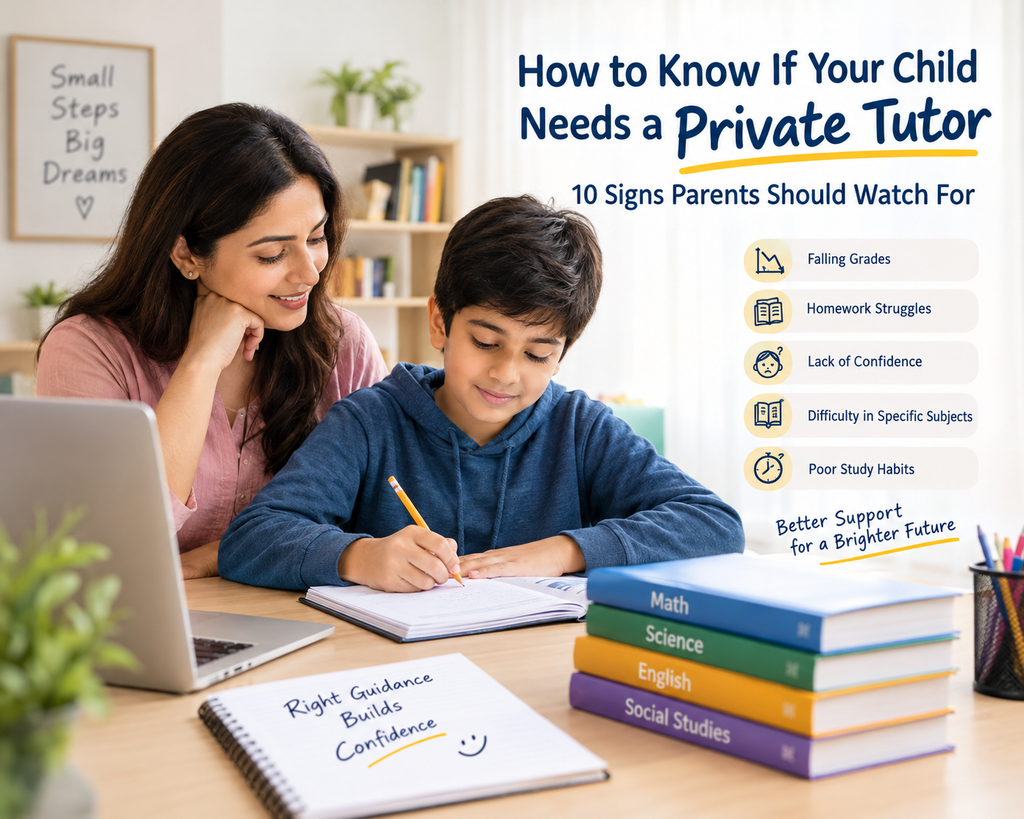
Every child learns differently. Some students understand new concepts quickly in a classroom, while others need more time, individual attention, or a different explanation. If your child is regularly struggling with schoolwork, losing confidence, or falling behind in certain subjects, you may wonder whether private tutoring could help.
A private tutor can provide personalized academic support based on a child’s learning pace, strengths, and weaknesses. For parents looking for flexible and focused academic assistance, finding the best online tuition class can be a practical option because students can learn from home while receiving one-to-one or small-group guidance.
But how do you know when tutoring is actually necessary?
Here are some important signs that may indicate your child could benefit from a private tutor.
What Is a Private Tutor?
A private tutor is an educator who provides additional academic instruction outside regular school hours. Unlike a traditional classroom, tutoring allows the learning experience to focus specifically on one student’s needs.
A tutor may help a child:
- Understand difficult school subjects
- Complete homework more effectively
- Prepare for tests and examinations
- Improve weak academic areas
- Build better study habits
- Gain confidence in the classroom
- Learn at a comfortable pace
Private tutoring does not necessarily mean that a child is performing poorly. Even strong students may work with tutors when they want to strengthen their understanding or prepare for important examinations.
10 Signs Your Child May Need a Private Tutor
1. Your Child Frequently Struggles With Homework
Homework should reinforce what students learn at school. However, if your child regularly spends hours on assignments, becomes frustrated, or cannot begin without parental help, it may indicate that some concepts are not clear.
A tutor can identify the exact areas causing difficulty and explain them using simpler examples and personalized instruction.
2. Grades Are Consistently Falling
A single low test score does not necessarily mean your child needs tutoring. However, a consistent decline in grades can be a sign that academic challenges are becoming more difficult to manage.
If your child’s performance is dropping despite regular school attendance and homework, additional academic support may be useful.
3. Your Child Has Difficulty Understanding Specific Subjects
Some students may perform well in English but struggle with mathematics. Others may find science, reading, writing, or another subject challenging.
When difficulties are concentrated in one particular subject, a private tutor can provide targeted support instead of repeating material the child already understands.
4. Your Child Has Lost Confidence
Academic struggles can affect a student’s confidence.
A child who once participated actively may begin avoiding questions, refusing to answer in class, or saying things such as “I’m not good at math” or “I can’t understand this.”
A supportive tutor can create a less intimidating learning environment where the child can ask questions, make mistakes, and gradually develop confidence.
5. Your Child Is Falling Behind the Class
Teachers have to support many students at once, which can make individualized instruction difficult.
If your child is consistently behind classmates or has missed important foundational concepts, personalized tutoring can help close those learning gaps.
The goal should not simply be to finish more worksheets. Effective tutoring should help the student understand the concepts behind the work.
6. You Are Spending Too Much Time Helping With Schoolwork
Parents naturally want to support their children, but becoming the primary teacher every evening can create unnecessary stress for both the parent and child.
If homework regularly turns into arguments, frustration, or long study sessions, professional academic support may make the process easier.
A tutor can take responsibility for explaining difficult concepts while parents continue providing encouragement and emotional support.
7. Your Child Is Preparing for an Important Examination
Examinations often require more than simply understanding individual chapters.
Students may need help with:
- Revision planning
- Practice questions
- Time management
- Exam strategies
- Identifying weak topics
- Reviewing mistakes
A tutor can create a structured study plan based on the student’s current level and examination goals.
8. Your Child Needs a Different Learning Pace
Every student learns at a different speed.
Some children understand a concept after one explanation, while others need several examples before it becomes clear. In a busy classroom, lessons generally have to move according to the overall class schedule.
Private tutoring gives students more flexibility. A tutor can slow down, repeat explanations, provide additional practice, or move ahead when the student is ready.
9. Your Child Has Difficulty Maintaining a Study Routine
Knowing what to study is only one part of academic success. Students also need consistency.
If your child frequently procrastinates, forgets assignments, struggles to organize revision, or studies only immediately before examinations, tutoring may provide useful structure.
A good tutor can help students develop sustainable study habits rather than relying on last-minute preparation.
10. Your Child Wants Additional Academic Support
Parents should not wait for poor grades before considering tutoring.
Sometimes students themselves recognize that they want more practice or deeper explanations. A motivated student may benefit from tutoring to strengthen foundational knowledge, explore challenging topics, or prepare for advanced academic goals.
Does Every Child Who Struggles Need a Private Tutor?
No. Not every academic difficulty requires private tutoring.
First, parents should try to understand the reason behind the problem. The issue could be related to unclear concepts, lack of practice, difficulty concentrating, poor study habits, missed lessons, or another factor.
Parents can speak with the child’s teacher to understand whether the problem is temporary or ongoing.
If additional academic instruction is appropriate, tutoring can then be considered as one possible solution.
How to Choose the Best Online Tuition Class for Your Child
If you decide that tutoring could help, choosing the right program is important.
When comparing an online tuition class, parents should consider:
Qualified and Experienced Tutors
Look for tutors who understand the relevant school curriculum and have experience teaching students at your child’s academic level.
Personalized Learning
The best online tuition class should not treat every student exactly the same. Look for an approach that considers the child’s current knowledge, learning speed, and academic goals.
Interactive Lessons
Online tutoring should involve more than watching a teacher speak. Questions, examples, practice exercises, feedback, and discussion can make online learning more effective.
Flexible Scheduling
Parents should choose a schedule that fits naturally into the child’s school and extracurricular routine.
Progress Tracking
Regular feedback can help parents understand whether their child’s academic performance and confidence are improving.
Comfortable Learning Environment
Children should feel comfortable asking questions. A supportive tutor can make a significant difference in how confidently a student participates.
Online Tutoring vs. Traditional Private Tutoring
Online tutoring has become increasingly popular because students can access lessons from home.
Traditional tutoring may require travel to a tutor’s location, while online classes can provide greater scheduling flexibility. Online platforms can also make it easier to access tutors who may not be available locally.
However, the quality of teaching matters more than the format itself. Parents should focus on tutor expertise, personalized attention, curriculum alignment, communication, and measurable progress.
How Can Parents Tell If Tutoring Is Working?
Parents should look beyond grades alone.
Positive signs can include:
- Better understanding of difficult concepts
- More confidence when answering questions
- Improved homework independence
- Better study habits
- Reduced academic frustration
- More consistent test performance
- Greater willingness to participate in learning
Progress may take time, especially if a student has significant learning gaps. Regular communication between parents, students, and tutors can help identify what is working and what needs to change.
Frequently Asked Questions
How do I know if my child really needs a private tutor?
Consistent academic struggles, falling grades, difficulty understanding specific subjects, low confidence, homework frustration, and poor study habits can all indicate that additional tutoring may be beneficial.
At what age should a child start private tutoring?
There is no single ideal age. Tutoring can be useful whenever a student needs additional academic support, whether in primary school, middle school, or secondary school.
Is online tutoring effective for school students?
Online tutoring can be effective when lessons are interactive, personalized, curriculum-aligned, and taught by a qualified tutor. The student’s engagement and consistency also play an important role.
How many tutoring sessions does a child need each week?
The ideal frequency depends on the student’s needs, subject difficulty, academic goals, and existing school workload. Some students may need occasional support, while others may benefit from regular weekly sessions.
What should parents look for in the best online tuition class?
Parents should consider tutor qualifications, personalized instruction, interactive teaching, curriculum compatibility, scheduling flexibility, student feedback, and progress tracking.
Final Thoughts
Recognizing that your child needs additional academic support is not a sign of failure. Every student has different strengths, learning preferences, and challenges.
If your child is struggling with homework, losing confidence, falling behind, or finding a particular subject difficult, a private tutor may provide the focused support they need. For families seeking flexible learning from home, an effective best online tuition class can offer personalized instruction while fitting more easily into a student’s daily routine.
The most important goal is not simply to improve marks. It is to help your child understand concepts, develop better learning habits, become more independent, and feel confident about their ability to learn.Every child learns differently. Some students understand new concepts quickly in a classroom, while others need more time, individual attention, or a different explanation. If your child is regularly struggling with schoolwork, losing confidence, or falling behind in certain subjects, you may wonder whether private tutoring could help.
A private tutor can provide personalized academic support based on a child’s learning pace, strengths, and weaknesses. For parents looking for flexible and focused academic assistance, finding the best online tuition class can be a practical option because students can learn from home while receiving one-to-one or small-group guidance.
But how do you know when tutoring is actually necessary?
Here are some important signs that may indicate your child could benefit from a private tutor.
What Is a Private Tutor?
A private tutor is an educator who provides additional academic instruction outside regular school hours. Unlike a traditional classroom, tutoring allows the learning experience to focus specifically on one student’s needs.
A tutor may help a child:
- Understand difficult school subjects
- Complete homework more effectively
- Prepare for tests and examinations
- Improve weak academic areas
- Build better study habits
- Gain confidence in the classroom
- Learn at a comfortable pace
Private tutoring does not necessarily mean that a child is performing poorly. Even strong students may work with tutors when they want to strengthen their understanding or prepare for important examinations.
10 Signs Your Child May Need a Private Tutor
1. Your Child Frequently Struggles With Homework
Homework should reinforce what students learn at school. However, if your child regularly spends hours on assignments, becomes frustrated, or cannot begin without parental help, it may indicate that some concepts are not clear.
A tutor can identify the exact areas causing difficulty and explain them using simpler examples and personalized instruction.
2. Grades Are Consistently Falling
A single low test score does not necessarily mean your child needs tutoring. However, a consistent decline in grades can be a sign that academic challenges are becoming more difficult to manage.
If your child’s performance is dropping despite regular school attendance and homework, additional academic support may be useful.
3. Your Child Has Difficulty Understanding Specific Subjects
Some students may perform well in English but struggle with mathematics. Others may find science, reading, writing, or another subject challenging.
When difficulties are concentrated in one particular subject, a private tutor can provide targeted support instead of repeating material the child already understands.
4. Your Child Has Lost Confidence
Academic struggles can affect a student’s confidence.
A child who once participated actively may begin avoiding questions, refusing to answer in class, or saying things such as “I’m not good at math” or “I can’t understand this.”
A supportive tutor can create a less intimidating learning environment where the child can ask questions, make mistakes, and gradually develop confidence.
5. Your Child Is Falling Behind the Class
Teachers have to support many students at once, which can make individualized instruction difficult.
If your child is consistently behind classmates or has missed important foundational concepts, personalized tutoring can help close those learning gaps.
The goal should not simply be to finish more worksheets. Effective tutoring should help the student understand the concepts behind the work.
6. You Are Spending Too Much Time Helping With Schoolwork
Parents naturally want to support their children, but becoming the primary teacher every evening can create unnecessary stress for both the parent and child.
If homework regularly turns into arguments, frustration, or long study sessions, professional academic support may make the process easier.
A tutor can take responsibility for explaining difficult concepts while parents continue providing encouragement and emotional support.
7. Your Child Is Preparing for an Important Examination
Examinations often require more than simply understanding individual chapters.
Students may need help with:
- Revision planning
- Practice questions
- Time management
- Exam strategies
- Identifying weak topics
- Reviewing mistakes
A tutor can create a structured study plan based on the student’s current level and examination goals.
8. Your Child Needs a Different Learning Pace
Every student learns at a different speed.
Some children understand a concept after one explanation, while others need several examples before it becomes clear. In a busy classroom, lessons generally have to move according to the overall class schedule.
Private tutoring gives students more flexibility. A tutor can slow down, repeat explanations, provide additional practice, or move ahead when the student is ready.
9. Your Child Has Difficulty Maintaining a Study Routine
Knowing what to study is only one part of academic success. Students also need consistency.
If your child frequently procrastinates, forgets assignments, struggles to organize revision, or studies only immediately before examinations, tutoring may provide useful structure.
A good tutor can help students develop sustainable study habits rather than relying on last-minute preparation.
10. Your Child Wants Additional Academic Support
Parents should not wait for poor grades before considering tutoring.
Sometimes students themselves recognize that they want more practice or deeper explanations. A motivated student may benefit from tutoring to strengthen foundational knowledge, explore challenging topics, or prepare for advanced academic goals.
Does Every Child Who Struggles Need a Private Tutor?
No. Not every academic difficulty requires private tutoring.
First, parents should try to understand the reason behind the problem. The issue could be related to unclear concepts, lack of practice, difficulty concentrating, poor study habits, missed lessons, or another factor.
Parents can speak with the child’s teacher to understand whether the problem is temporary or ongoing.
If additional academic instruction is appropriate, tutoring can then be considered as one possible solution.
How to Choose the Best Online Tuition Class for Your Child
If you decide that tutoring could help, choosing the right program is important.
When comparing an online tuition class, parents should consider:
Qualified and Experienced Tutors
Look for tutors who understand the relevant school curriculum and have experience teaching students at your child’s academic level.
Personalized Learning
The best online tuition class should not treat every student exactly the same. Look for an approach that considers the child’s current knowledge, learning speed, and academic goals.
Interactive Lessons
Online tutoring should involve more than watching a teacher speak. Questions, examples, practice exercises, feedback, and discussion can make online learning more effective.
Flexible Scheduling
Parents should choose a schedule that fits naturally into the child’s school and extracurricular routine.
Progress Tracking
Regular feedback can help parents understand whether their child’s academic performance and confidence are improving.
Comfortable Learning Environment
Children should feel comfortable asking questions. A supportive tutor can make a significant difference in how confidently a student participates.
Online Tutoring vs. Traditional Private Tutoring
Online tutoring has become increasingly popular because students can access lessons from home.
Traditional tutoring may require travel to a tutor’s location, while online classes can provide greater scheduling flexibility. Online platforms can also make it easier to access tutors who may not be available locally.
However, the quality of teaching matters more than the format itself. Parents should focus on tutor expertise, personalized attention, curriculum alignment, communication, and measurable progress.
How Can Parents Tell If Tutoring Is Working?
Parents should look beyond grades alone.
Positive signs can include:
- Better understanding of difficult concepts
- More confidence when answering questions
- Improved homework independence
- Better study habits
- Reduced academic frustration
- More consistent test performance
- Greater willingness to participate in learning
Progress may take time, especially if a student has significant learning gaps. Regular communication between parents, students, and tutors can help identify what is working and what needs to change.
Frequently Asked Questions
How do I know if my child really needs a private tutor?
Consistent academic struggles, falling grades, difficulty understanding specific subjects, low confidence, homework frustration, and poor study habits can all indicate that additional tutoring may be beneficial.
At what age should a child start private tutoring?
There is no single ideal age. Tutoring can be useful whenever a student needs additional academic support, whether in primary school, middle school, or secondary school.
Is online tutoring effective for school students?
Online tutoring can be effective when lessons are interactive, personalized, curriculum-aligned, and taught by a qualified tutor. The student’s engagement and consistency also play an important role.
How many tutoring sessions does a child need each week?
The ideal frequency depends on the student’s needs, subject difficulty, academic goals, and existing school workload. Some students may need occasional support, while others may benefit from regular weekly sessions.
What should parents look for in the best online tuition class?
Parents should consider tutor qualifications, personalized instruction, interactive teaching, curriculum compatibility, scheduling flexibility, student feedback, and progress tracking.
Final Thoughts
Recognizing that your child needs additional academic support is not a sign of failure. Every student has different strengths, learning preferences, and challenges.
If your child is struggling with homework, losing confidence, falling behind, or finding a particular subject difficult, a private tutor may provide the focused support they need. For families seeking flexible learning from home, an effective best online tuition class can offer personalized instruction while fitting more easily into a student’s daily routine.
The most important goal is not simply to improve marks. It is to help your child understand concepts, develop better learning habits, become more independent, and feel confident about their ability to learn.
Learn more about GenieClasses and our approach to personalized online learning on our page.
Need help choosing the right tutoring program? Get in touch with GenieClasses through our page.