
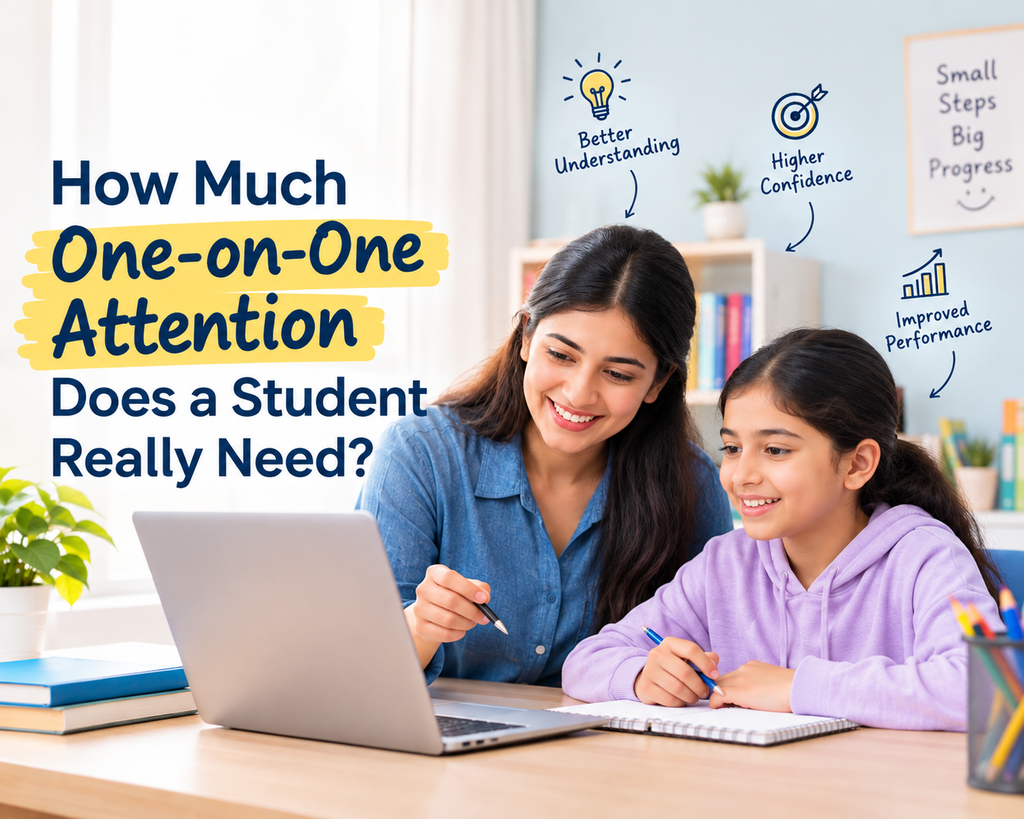
Every student learns differently. Some children understand new concepts quickly, while others need additional explanations, practice, and encouragement. This is why one-on-one attention plays an important role in a student’s academic development. But how much individual attention does a student actually need to learn effectively?
The answer depends on the student’s age, learning style, academic goals, confidence level, and understanding of different subjects. While some students benefit from occasional individual support, others may need regular personalized guidance to overcome learning difficulties and improve their performance.
For parents exploring the best online tuition class, understanding the right balance between independent learning, classroom teaching, and individual attention can help them make a more informed decision.
What Is One-on-One Attention in Education?
One-on-one attention means giving a student personalized guidance based on their individual learning needs. Instead of following only a general teaching plan, a tutor focuses on the student’s strengths, weaknesses, questions, and progress.
This approach can include explaining difficult concepts again, identifying knowledge gaps, providing customized practice questions, and giving feedback on assignments.
For example, a student who struggles with mathematics may need additional help understanding fractions or algebra. Another student may understand the concepts but need support with problem-solving speed and exam preparation.
Personalized attention helps tutors address these differences rather than expecting every student to learn at the same pace.
How Much Individual Attention Does a Student Need?
There is no single amount of individual attention that works for every student. The ideal level depends on how independently the student can learn and where they need additional support.
1. Students Who Understand Concepts Quickly
Students who regularly understand lessons, complete assignments independently, and perform well in assessments may not need intensive one-on-one tutoring.
They can benefit from occasional doubt-clearing sessions, revision support, and guidance on more advanced topics. The goal is to strengthen their understanding without making them unnecessarily dependent on a tutor.
2. Students Who Need Help With Difficult Subjects
Some students perform well in certain subjects but struggle with others. They may understand English easily but find mathematics or science challenging.
For these students, targeted individual attention can help identify the exact concepts causing difficulty. A tutor can then focus on those areas instead of spending equal time on topics the student already understands.
3. Students Who Lack Confidence
Students sometimes hesitate to ask questions in a classroom because they fear making mistakes or being judged by their classmates.
Individual sessions can provide a more comfortable environment where students feel encouraged to express doubts. With patient explanations and positive feedback, they can gradually develop confidence and participate more actively in their learning.
4. Students Preparing for Examinations
During examination preparation, students may need focused attention on revision, practice papers, time management, and commonly misunderstood concepts.
The required support depends on the examination schedule and the student’s current preparation level. A personalized study plan can help prioritize weaker topics while maintaining regular revision of stronger subjects.
Signs That Your Child Needs More Individual Attention
Parents can look for several signs that their child may benefit from additional academic support.
- Repeated difficulties with the same topic: The student continues to struggle even after classroom explanations.
- Incomplete homework: Assignments take unusually long because the student cannot work through questions independently.
- Fear of asking questions: The student avoids discussing doubts or admitting confusion.
- Declining academic performance: Test results or classroom participation show a consistent downward trend.
- Poor study habits: The student struggles to organize revision, manage time, or follow a study routine.
- Low confidence: The child believes they cannot improve, even when they are making progress.
These signs do not automatically mean that a student needs more tutoring hours. Sometimes, a different explanation, improved study routine, or conversation with the schoolteacher can resolve the problem.
Is One-on-One Online Tuition Better Than Group Learning?
Both individual tutoring and group learning can be effective. The better option depends on the student’s requirements.
One-on-one tutoring allows the teacher to adapt explanations, pace, and practice activities to a particular student. It can be especially useful when a child has specific learning gaps or needs frequent doubt-clearing.
Group learning, on the other hand, provides opportunities to hear different perspectives, participate in discussions, and learn alongside peers. It may also be a suitable choice for students who are comfortable asking questions in a group.
Parents considering the best online tuition class should evaluate whether their child needs personalized instruction, collaborative learning, or a combination of both.
How Online Tuition Makes Personalized Learning Easier

Online tuition can make individual academic support more convenient for families. Students can learn from home, connect with tutors remotely, and use digital resources to review difficult concepts.
Here are some ways online tutoring can support personalized learning:
Flexible Learning Pace
A tutor can spend more time explaining a challenging topic and move forward when the student demonstrates understanding.
Focused Doubt-Clearing
Students can ask questions directly and receive explanations related to their specific difficulties.
Progress Tracking
Regular assessments, homework reviews, and feedback can help parents understand which areas are improving and which need more practice.
Convenient Scheduling
Online sessions can often be arranged around school hours and other commitments, making it easier to maintain a consistent learning routine.
However, the effectiveness of online tuition depends on the tutor’s teaching quality, the student’s participation, and a suitable learning environment.
How Parents Can Decide the Right Amount of Tutoring
Parents do not need to choose an intensive schedule immediately. A practical approach is to start by understanding the child’s current academic needs.
- Identify learning gaps: Review recent tests, homework, and feedback from schoolteachers.
- Set clear goals: Decide whether the priority is improving subject understanding, building confidence, or preparing for examinations.
- Start with a manageable schedule: Choose sessions that fit the child’s needs and daily routine.
- Review progress regularly: Check whether the student is becoming more independent and confident.
- Adjust the support: Increase, reduce, or refocus tutoring based on actual progress rather than assumptions.
Parents searching for the best online tuition class should look for qualified tutors who communicate clearly, encourage questions, and provide feedback on student progress.
What Should Parents Look for in an Online Tutor?
The amount of attention a student receives matters, but the quality of that attention matters just as much.
A suitable tutor should be able to explain concepts clearly, recognize learning difficulties, adapt teaching methods, and provide constructive feedback. Patience is especially important because students may need to hear an explanation more than once before understanding it.
Parents should also check whether the tutor sets realistic goals, monitors progress, and encourages independent problem-solving instead of simply giving students the answers.
A good tutoring arrangement should gradually help a student become more capable of learning independently.
Frequently Asked Questions (FAQs)
1. How much one-on-one attention does a school student need?
There is no fixed amount. Students who understand lessons independently may need occasional guidance, while those struggling with particular subjects may benefit from more regular individual support. The schedule should be adjusted according to progress and learning needs.
2. Is one-on-one tuition necessary for every student?
No. Many students succeed with classroom teaching, independent study, and occasional doubt-clearing. Individual tuition is most useful when it addresses a specific academic need or learning goal.
3. Can online tuition improve a student’s confidence?
Yes, personalized online tuition can help students feel more comfortable asking questions and practising difficult concepts. Its impact depends on the tutor’s approach, the student’s engagement, and consistent feedback.
4. How can parents identify the best online tuition class for their child?
Parents should compare teaching quality, subject expertise, personalization, scheduling, communication, and progress monitoring. A suitable class should match the child’s academic needs rather than simply offer more teaching hours.
5. Should tutoring hours increase before exams?
Not necessarily. Some students need additional revision, while others benefit more from focused practice and better time management. Any increase in sessions should account for the student’s workload, rest, and existing preparation.
6. How do parents know whether tutoring is working?
Look for improved understanding, more independent homework completion, increased confidence, fewer repeated mistakes, and progress toward the goals set with the tutor. Marks are useful indicators, but they are not the only measure of learning.
Conclusion
One-on-one attention can make a meaningful difference in a student’s education when it is matched to their individual needs. The objective is not to provide the maximum number of tutoring hours, but to ensure that the student receives the right guidance at the right time.
By identifying learning gaps, setting realistic goals, and reviewing progress regularly, parents can build a more effective learning plan for their children.
If you are exploring the best online tuition class, prioritize personalized teaching, supportive tutors, clear communication, and a learning approach that builds long-term confidence and independence. The right support should help students understand concepts better and gradually take greater responsibility for their own learning.
Learn more about GenieClasses, our teaching approach, and our commitment to helping students succeed by visiting our About Us page.
For more information about our online tuition classes and personalized learning support, visit our Contact Us page to connect with GenieClasses.