
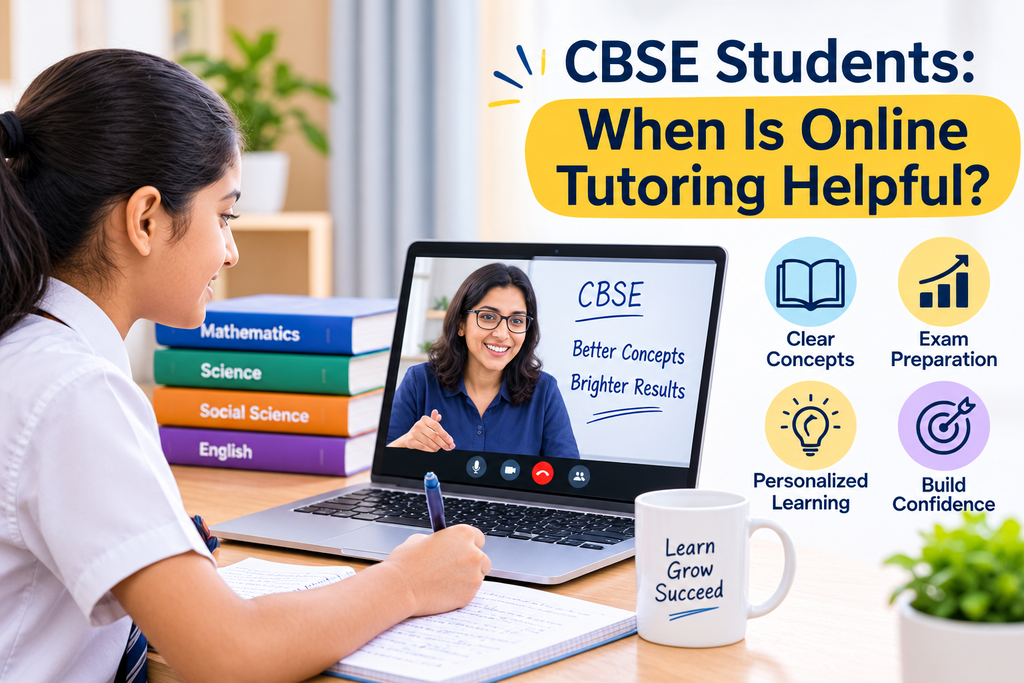
Every CBSE student learns differently. Some understand classroom lessons quickly, while others need more time, additional practice, or a different explanation to grasp the same concept. As students move into higher classes, subjects can become more challenging, and managing homework, school tests, projects, and exam preparation may feel overwhelming.
This is where online tutoring can make a difference. With individual attention, structured practice, and flexible learning options, students can receive support that complements their regular school education.
But does every student need a tutor? Not necessarily. The real question is: When is online tutoring helpful for CBSE students, and how can parents identify the right time to seek extra academic support?
Quick Answer: When Should CBSE Students Consider Online Tutoring?
Online tutoring can be helpful when a student struggles to understand classroom lessons, repeatedly makes mistakes in a subject, needs additional exam practice, or lacks confidence while answering questions independently.
It can also benefit students who want to strengthen their fundamentals, improve time management, revise difficult chapters, or prepare for important school examinations.
The goal is not to replace school learning. It is to provide targeted support that helps students understand concepts more clearly and become independent learners.
Key Takeaways
- Online tutoring can help students address specific learning gaps.
- Regular practice and timely feedback can improve conceptual understanding.
- Personalised sessions may help students learn at a comfortable pace.
- Extra guidance can support revision, homework, and exam preparation.
- Parents should evaluate teaching quality, communication, and their child’s progress before choosing a tutor.
1. When a Student Struggles to Understand Classroom Lessons
One of the most common reasons to consider online tutoring is difficulty understanding lessons at school.
In a classroom, teachers must follow a timetable and teach a group of students. A child who misses an important explanation or needs additional examples may find it difficult to keep up with the next chapter.
For example, a student who does not understand fractions in mathematics may later struggle with percentages, ratios, and algebra. Similarly, gaps in basic grammar can affect writing and reading comprehension.
Online tutoring can help by allowing the student to revisit challenging concepts, ask questions freely, and practise until the topic becomes clearer.
Parents should consider additional support when their child regularly says, “I understand it in class, but I cannot solve the questions at home.”
2. When Fundamental Concepts Need Improvement
Strong fundamentals are essential for success in the CBSE curriculum. As students progress from primary classes to middle school and secondary school, new concepts often build on previously learned material.
If the basics are unclear, memorising answers may offer temporary relief but can make more advanced topics difficult.
A tutor can identify these learning gaps and revisit the concepts that need attention. Instead of immediately moving to difficult questions, the student can begin with simpler examples and gradually progress to more challenging exercises.
This approach can be particularly useful in:
- Mathematics: Fractions, algebra, geometry, equations, and word problems.
- Science: Fundamental principles, numerical problems, diagrams, and scientific reasoning.
- English: Grammar, vocabulary, reading comprehension, and structured writing.
- Social Science: Understanding concepts, organising information, and writing clear answers.
The aim is to develop genuine understanding rather than depend entirely on memorisation.
3. When Exam Preparation Becomes Stressful
School examinations can be challenging when students have several chapters to revise within a limited period. Some may understand the material but struggle to organise their preparation or manage their time during tests.
Online tutoring can provide a more structured revision routine. Depending on the student’s needs, sessions may focus on reviewing important concepts, solving practice questions, discussing previous mistakes, and strengthening weaker areas.
Students can also practise explaining answers in their own words and solving questions within a set time.
For CBSE students preparing for board examinations, additional guidance can help them organise revision and practise according to their school’s syllabus and examination requirements.
However, tutoring works best when it is combined with consistent self-study, adequate rest, and realistic study goals.
4. When a Student Needs Individual Attention
Every student has a different learning pace. Some understand a topic after one explanation, while others benefit from visual examples, repeated practice, or step-by-step demonstrations.
In a personalised online session, a tutor may be able to adapt explanations and exercises to the student’s current level.
For example, if a student understands the formula but struggles to apply it to word problems, the tutor can focus on interpreting questions and selecting the correct steps rather than repeating the entire chapter.
Parents exploring the best online tuition class should look beyond general promises and check whether the teaching approach matches their child’s actual learning needs.
A suitable tutor should encourage questions, explain mistakes patiently, and help the student gradually become more independent.
5. When Homework Takes Too Long
Homework is intended to reinforce classroom learning. However, when students regularly spend excessive time on assignments because they cannot understand the questions, the problem may be more than poor time management.
Online tutoring can help students identify where they are getting stuck. A tutor can explain the underlying concept, demonstrate a similar problem, and guide the student through the reasoning process.
The goal should be to teach students how to solve questions independently, not simply provide answers for copying.
Parents can observe whether their child is becoming more confident with similar questions over time. If homework becomes easier because the student understands the concepts better, the support is serving its purpose.
6. When Students Want to Improve Beyond Their Current Performance
Online tutoring is not only for students who are falling behind. Students who already perform well may also benefit from targeted academic guidance.
They might want to practise more challenging questions, strengthen analytical skills, explore topics in greater depth, or prepare for school-level competitions.
For these learners, tutoring can provide structured enrichment without making their existing school workload unnecessarily heavy.
The key is to establish a clear goal. Additional classes should support the student’s interests and academic development rather than create pressure to study constantly.
7. When Flexible Learning Can Help a Busy Schedule
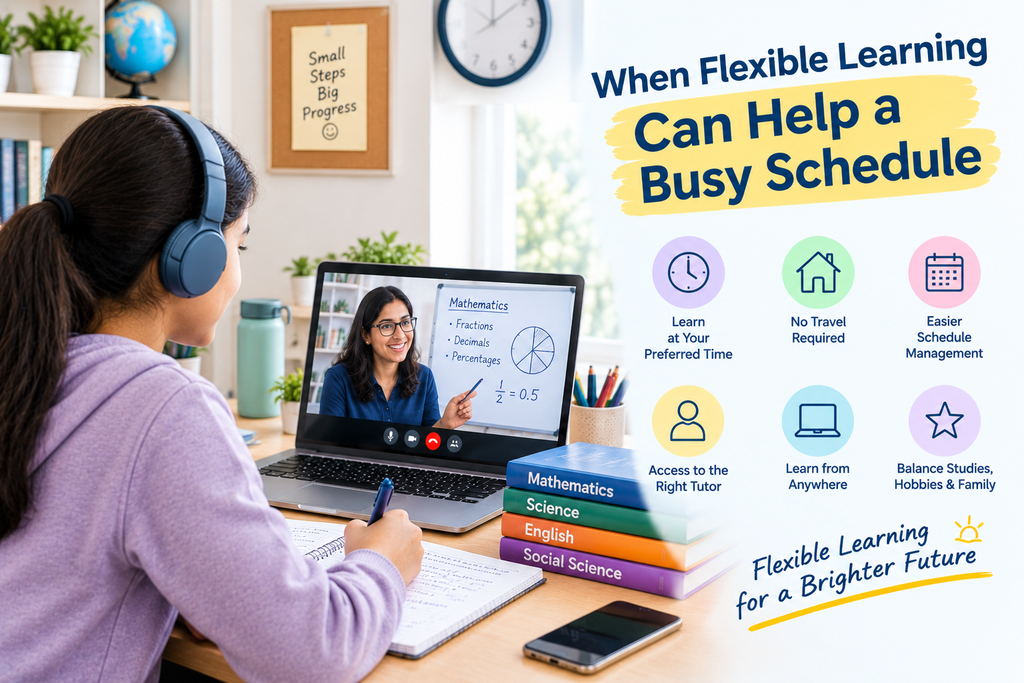
CBSE students often balance school, homework, extracurricular activities, and family commitments. Travelling to a physical tuition centre can add to an already busy day.
Online classes can reduce travel time and allow families to explore tutors based on subject requirements and scheduling needs.
When evaluating an online learning platform, parents should check the tutor’s qualifications, teaching experience, session format, available learning resources, and suitability for the student’s class level.
GenieClasses offers options including one-to-one live sessions and group classes, allowing families to explore learning formats that suit their requirements.
You can explore online tuition options at GenieClasses to learn more about available subjects and tutors.
8. How Can Parents Tell Whether Online Tutoring Is Working?
Enrolling in tutoring is only the first step. Parents should also observe whether the support is helping their child develop stronger learning habits.
Look for these signs:
- The student can explain concepts in their own words.
- Similar questions become easier to solve independently.
- Repeated mistakes begin to decrease.
- Homework requires less assistance.
- The student feels more comfortable asking questions.
- Revision becomes more organised and consistent.
Marks can be one useful indicator, but they should not be the only measure of progress. Improved understanding, confidence, and independent problem-solving are also important.
Parents should communicate regularly with the tutor, review practice work, and adjust learning goals when necessary.
9. How to Choose the Right Online Tutor for a CBSE Student
The effectiveness of tutoring depends significantly on the quality of teaching and the match between the tutor and student.
Before enrolling, consider the following factors:
Subject knowledge: Does the tutor understand the relevant CBSE class level and syllabus?
Clear explanations: Can the tutor explain difficult topics in simple, age-appropriate language?
Personalised support: Will the tutor identify the student’s learning gaps and adapt lessons accordingly?
Practice and feedback: Does the learning plan include exercises, corrections, and opportunities to revisit mistakes?
Communication: Can parents understand what the student is learning and where further work is needed?
Trial session: If available, use a demo or trial lesson to assess whether the teaching style suits your child.
Parents can also read what makes a good online tutor for school students for a more detailed checklist.
Frequently Asked Questions
1. Is online tutoring useful for CBSE students?
Yes. Online tutoring can help CBSE students clarify difficult concepts, practise questions, address learning gaps, and prepare for examinations. Its effectiveness depends on the tutor’s teaching approach, the student’s participation, and consistent practice.
2. Which CBSE students need online tutoring?
Students who struggle with particular subjects, need help with fundamental concepts, require structured revision, or want additional academic challenges may benefit. Students who are already performing well can also use tutoring for enrichment.
3. Is online tutoring suitable for CBSE Classes 9 and 10?
It can be useful for Classes 9 and 10, when students encounter more demanding concepts and begin preparing for important examinations. A suitable tutor can help them revise systematically, practise questions, and strengthen subject understanding.
4. Can online tutoring help improve CBSE exam performance?
It may support better performance by helping students understand concepts, identify mistakes, and practise regularly. However, results are not guaranteed and also depend on self-study, attendance, preparation, and individual learning needs.
5. How many online tuition sessions should a CBSE student attend each week?
There is no single ideal number. The frequency depends on the student’s class, subject difficulty, existing workload, and learning goals. Parents should choose a manageable schedule that leaves enough time for schoolwork, independent practice, and rest.
6. How should parents choose the best online tuition class?
Compare tutor qualifications, subject expertise, teaching style, personalisation, practice resources, scheduling, and opportunities to assess a demo session. The right choice should address the child’s needs rather than rely on marketing claims alone.
Final Thoughts
Online tutoring can be helpful for CBSE students when it addresses a clear learning need. Whether a child is struggling with mathematics, finding science concepts confusing, preparing for examinations, or looking for additional practice, the right support can make learning more structured and manageable.
Parents do not need to wait until a student receives low marks to seek help. Recognising difficulties early and choosing an appropriate learning plan can help children build stronger fundamentals and greater confidence.
The most effective tutoring focuses on understanding, practice, feedback, and gradual independence—not simply completing more lessons.
If you are exploring the best online tuition class for your child, start by identifying the subjects or concepts where support is needed, then compare tutors and teaching approaches carefully.
Learn more about our mission, teaching approach, and commitment to student success on our About Us page.
Have questions about online tuition or need help choosing the right learning support for your child? Visit our Contact Us page to get in touch with the GenieClasses team.