Finding the right online tutor can have a significant impact on a school student’s academic performance, confidence, and overall learning experience. But what actually makes a good online tutor?
A good online tutor is more than someone who simply knows a subject. They should be able to explain concepts clearly, understand a student’s individual learning needs, encourage questions, provide constructive feedback, and make online lessons engaging.
With online education becoming an increasingly popular option for school students, parents have many tutoring choices available. However, choosing the right tutor requires looking beyond qualifications and experience.
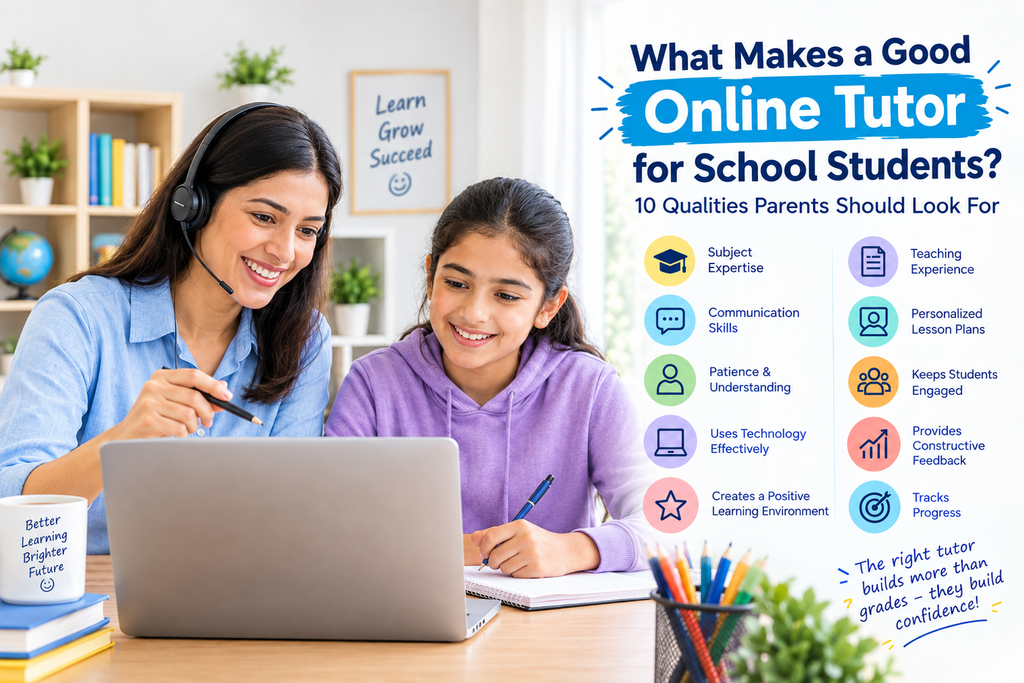
In this guide, we explore 10 important qualities that make a good online tutor for school students and explain what parents should look for before choosing an online tutor.
Quick Answer: What Makes a Good Online Tutor?
A good online tutor should have strong subject knowledge, relevant teaching experience, excellent communication skills, patience, adaptability, and the ability to keep students engaged during online lessons.
The best tutors understand that every student learns differently. They adjust their teaching methods according to the student’s academic level, learning pace, strengths, and areas that need improvement.
Parents should also look for tutors who provide regular feedback, encourage independent thinking, use appropriate digital learning tools, and create a comfortable environment where students feel confident asking questions.
A free trial or demo class can be an excellent way to determine whether a tutor is a good match for your child before committing to regular lessons.
Key Takeaways
- A good online tutor needs strong subject knowledge and teaching skills.
- Communication is essential for effective online learning.
- Tutors should adapt lessons to each student’s learning needs.
- Patience and encouragement can help students build confidence.
- Interactive lessons are more engaging than one-way lectures.
- Good tutors encourage students to ask questions and think independently.
- Regular feedback helps students understand their progress.
- Technology should be used to improve, not complicate, learning.
- A demo class can help parents evaluate tutor-student compatibility.
- The right tutor should support both academic progress and student confidence.
Why Does a Good Online Tutor Matter for School Students?
School students often have different academic strengths and weaknesses.
One student may understand Mathematics quickly but struggle with English. Another may perform well in Science but need additional support with problem-solving or examination preparation.
In a traditional classroom, teachers may have limited time to focus on every individual student. Online tutoring can provide additional support and allow students to receive more personalized attention.
A good online tutor can help students:
- Understand difficult concepts.
- Strengthen foundational knowledge.
- Complete academic practice more effectively.
- Prepare for examinations.
- Improve problem-solving skills.
- Build confidence.
- Develop better study habits.
- Become more independent learners.
GenieClasses focuses on personalized and supportive online education, with professionally qualified tutors and options including 1-on-1 live sessions and group classes. Explore GenieClasses online learning options.
10 Qualities of a Good Online Tutor for School Students
1. Strong Subject Knowledge
The foundation of good tutoring is strong subject knowledge.
A tutor should have a thorough understanding of the subject they teach and be able to explain concepts at the student’s current academic level.
However, knowing a subject and teaching a subject are two different skills.
A good tutor should be able to break complicated topics into smaller, easier-to-understand parts.
For example, instead of simply giving a student the formula for solving an algebra problem, an effective Mathematics tutor should explain:
- What the formula means.
- Why it works.
- How to use it.
- When to use it.
- How to avoid common mistakes.
Strong subject knowledge combined with effective teaching skills can help students develop a deeper understanding rather than simply memorizing answers.
2. Excellent Communication Skills
Communication is particularly important in online tutoring.
Since the tutor and student are interacting through a screen, the tutor needs to explain concepts clearly and make sure the student is following the lesson.
A good online tutor should:
- Speak clearly.
- Explain concepts in simple language.
- Ask questions regularly.
- Listen carefully to the student.
- Encourage students to express their doubts.
- Confirm understanding before moving forward.
Good communication also means knowing when to slow down.
If a student does not understand something, the tutor should be willing to explain the concept in another way rather than simply repeating the same explanation.
Parents can learn more about how GenieClasses works and how students can connect with tutors by visiting the GenieClasses FAQ page.
3. Ability to Personalize Lessons
One of the biggest advantages of online tutoring is the possibility of personalized learning.
A good tutor should not treat every student in exactly the same way.
Instead, they should consider:
- The student’s current academic level.
- Learning speed.
- Strengths.
- Weaknesses.
- School curriculum.
- Academic goals.
- Preferred learning approach.
For example, a student who already understands a topic may benefit from advanced questions, while another student may need additional explanations and practice.
Personalized lessons allow tutors to focus their time where it can provide the greatest benefit.
GenieClasses is designed around personalized online education and helping students find tutors that match their learning needs. Learn more about GenieClasses.
4. Patience and Understanding
Not every student understands a concept immediately.
Some children need the same concept explained several times before they feel comfortable applying it independently.
A good tutor should remain patient and supportive when a student makes mistakes.
Instead of saying that an answer is simply wrong, an effective tutor can ask:
“What step did you take to reach this answer?”
This approach helps identify where the student is struggling and gives the tutor an opportunity to correct the misunderstanding.
Patience can also help students feel comfortable asking questions.
When children are not afraid of making mistakes, they are more likely to participate actively in lessons.
5. Ability to Keep Students Engaged
Online learning can become challenging when students lose focus.
A good tutor should make lessons interactive rather than relying entirely on long explanations.
Depending on the subject and age of the student, tutors can use:
- Questions and answers.
- Real-world examples.
- Diagrams.
- Digital whiteboards.
- Practice problems.
- Short activities.
- Discussions.
- Interactive exercises.
For example, a Science tutor can explain a concept using everyday examples, while a language tutor can use conversations and practical exercises.
The goal is to make the student an active participant rather than a passive listener.
6. Encourages Questions and Independent Thinking
A good tutor should not simply provide answers to every question.
Instead, they should encourage students to think about the problem and develop their own solutions.
For example, if a student asks for the answer to a Mathematics problem, the tutor might guide them with questions such as:
- What information do we already have?
- Which formula could help?
- What should we calculate first?
- Why do you think this step is correct?
This approach develops problem-solving skills and encourages independent thinking.
Over time, students can become more confident in solving problems without relying entirely on someone else.
7. Provides Constructive Feedback
Feedback plays an important role in student development.
A good tutor should regularly tell students:
- What they are doing well.
- Which areas need improvement.
- What mistakes they are making.
- How they can improve.
- What they should practice next.
Feedback should be constructive rather than discouraging.
Instead of simply saying:
“Your answer is wrong.”
A tutor can explain what went wrong and show the student how to approach the problem correctly.
Regular feedback helps students understand their progress and gives them clear goals for improvement.
GenieClasses provides features designed around practice and progress, including customized worksheets and guided corrections. Explore the GenieClasses learning platform.
8. Uses Technology Effectively
An online tutor should know how to use technology to improve the learning experience.
However, technology should support learning rather than distract from it.
Useful online teaching tools can include:
- Digital whiteboards.
- Screen sharing.
- Online worksheets.
- Educational videos.
- Interactive exercises.
- Digital presentations.
- Class recordings.
- Online practice activities.
A good tutor knows when to use these tools and when a simple explanation is more effective.
GenieClasses provides a smart online learning environment with interactive learning tools, class recording access, and AI-powered learning insights designed to support students throughout their learning journey.
9. Tracks Student Progress
A good tutor should understand that tutoring is an ongoing process.
They should regularly evaluate whether the student is improving and identify areas that require additional attention.
Progress can be monitored through:
- Practice exercises.
- Homework.
- Quizzes.
- Assignments.
- Test performance.
- Class participation.
- Student confidence.
- Understanding of difficult concepts.
Tracking progress allows tutors to adjust their teaching strategy when necessary.
For example, if a student continues to make the same type of mistake, the tutor may need to revisit the underlying concept rather than simply giving more questions.
Parents should also communicate with tutors regularly to understand how their child is progressing.
10. Creates a Positive Learning Environment
Perhaps one of the most important qualities of a good tutor is the ability to make students feel comfortable.
Students should feel that they can:
- Ask questions.
- Make mistakes.
- Express confusion.
- Try new approaches.
- Discuss difficult topics.
- Ask for additional explanations.
A positive learning environment can help students develop confidence and a healthier attitude toward education.
A tutor should encourage progress without creating unnecessary pressure.
The ultimate goal should be to help students become more confident, capable, and independent learners.
What Should Parents Look for During an Online Tutor Demo Class?
A demo class is one of the easiest ways to evaluate whether a tutor is suitable for your child.
During the session, parents should pay attention to several things.
Does the Tutor Explain Clearly?
Notice whether the tutor uses language that your child can understand.
Does the Tutor Ask Questions?
A good tutor should involve the student instead of talking for the entire session.
Does the Tutor Listen?
The tutor should pay attention to the student’s answers and questions.
Does the Tutor Adapt?
If your child does not understand something, see whether the tutor tries another explanation.
Is Your Child Comfortable?
After the session, ask your child how they felt.
Did they enjoy the lesson? Did they understand the explanation? Did they feel comfortable asking questions?
GenieClasses offers free trial sessions that allow students to experience a tutor’s teaching approach before continuing with lessons. Students can select a tutor and book a free trial through the platform. Learn more about trial sessions through GenieClasses FAQs.
One-on-One vs Group Tutoring: Which Is Better?
The right format depends on the student.
One-on-One Tutoring
One-on-one tutoring can be useful for students who need personalized attention.
Benefits include:
- Individualized lessons.
- Flexible learning pace.
- More time for questions.
- Focused support.
- Personalized practice.
Group Tutoring
Group classes can benefit students who enjoy interacting with other learners.
Benefits may include:
- Classroom discussion.
- Collaborative learning.
- Peer interaction.
- Different approaches to solving problems.
- Social learning.
GenieClasses offers both 1-on-1 live sessions and group classes, giving families different options based on their learning preferences. Explore GenieClasses.
What Are the Signs of a Good Online Tutor?
Parents can look for these signs:
- Your child feels comfortable asking questions.
- The tutor explains concepts clearly.
- Lessons are organized and structured.
- The tutor adapts to your child’s learning level.
- Your child participates actively.
- The tutor provides regular feedback.
- Difficult concepts become easier over time.
- Your child becomes more confident.
- The tutor encourages independent thinking.
- Progress is regularly monitored.
If several of these qualities are present, the tutor may be a strong fit for your child.
Common Mistakes Parents Should Avoid
Choosing a Tutor Only Because of Price
A lower price does not necessarily mean better value.
Parents should consider teaching quality, experience, communication, and compatibility along with cost.
Looking Only at Qualifications
Qualifications are important, but teaching ability matters just as much.
A tutor should be able to communicate knowledge effectively.
Skipping the Trial Class
A trial class can reveal how the tutor actually teaches and interacts with your child.
Expecting Instant Academic Improvement
Learning takes time.
Students need consistent lessons, practice, feedback, and encouragement.
Ignoring Your Child’s Opinion
Your child’s comfort and engagement are important.
If a student consistently dislikes the lessons or feels uncomfortable with the tutor, parents should investigate why.
How GenieClasses Supports Effective Online Learning
Finding a good tutor becomes easier when students and parents have access to a structured online tutoring platform.
GenieClasses focuses on making quality education accessible, personalized, and supportive for learners.
The platform currently highlights:
- Professionally qualified tutors.
- 1-on-1 live sessions.
- Group classes.
- Free demo classes.
- Customized worksheets.
- Guided corrections.
- Class recordings.
- AI-powered learning insights.
- 24×7 support.
GenieClasses also allows students to explore popular subjects including English, Mathematics, Science, Foreign Languages, Art & Design, Tamil, Music, and Technology & Computing.
Parents can browse GenieClasses to explore available learning options and find a tutor according to their child’s requirements.
For students who want to develop skills beyond their regular school subjects, GenieClasses also offers practical workshops such as Creative Writing, Chess, Computer Science/AI, Calligraphy, and Art & Craft. Explore GenieClasses workshops.
Frequently Asked Questions
What makes a good online tutor for school students?
A good online tutor should have strong subject knowledge, effective communication skills, patience, adaptability, and the ability to keep students engaged. They should also provide personalized lessons and constructive feedback.
What skills should an online tutor have?
Important skills include subject expertise, communication, patience, adaptability, digital teaching skills, time management, problem-solving, and the ability to understand individual student needs.
How can parents evaluate an online tutor?
Parents can review the tutor’s qualifications and experience, observe a demo or trial class, ask their child for feedback, and monitor academic progress after lessons begin.
Is one-on-one tutoring better for school students?
One-on-one tutoring can be particularly helpful for students who need personalized attention or additional support. However, group classes may be better for students who enjoy collaborative learning.
How important is communication in online tutoring?
Communication is extremely important. A tutor needs to explain concepts clearly, listen to students, encourage questions, and provide constructive feedback.
Should an online tutor give homework?
Homework can be useful when it reinforces concepts taught during the lesson. However, the amount should be appropriate for the student’s age, workload, and learning goals.
How often should parents check their child’s progress?
Parents should communicate with the tutor regularly and review progress periodically. The exact frequency can depend on the child’s goals and learning requirements.
What should a student do if they do not understand the tutor?
Students should feel comfortable asking the tutor to explain the concept again using a different example or approach. A good tutor should encourage questions and clarification.
Final Thoughts
A good online tutor is not simply someone who knows a subject well.
The best tutors combine subject expertise, communication, patience, personalization, engagement, feedback, and technology to create an effective learning experience.
For school students, the right tutor should make difficult concepts easier to understand while helping them become more confident and independent learners.
Parents should take time to understand their child’s needs, evaluate potential tutors, attend a trial class, and monitor progress over time.
If you are looking for qualified online tutors and personalized learning options, explore GenieClasses and find a learning experience designed around your child’s goals.
The right tutor can do more than improve grades—they can help a student develop the confidence and skills to become a lifelong learner.