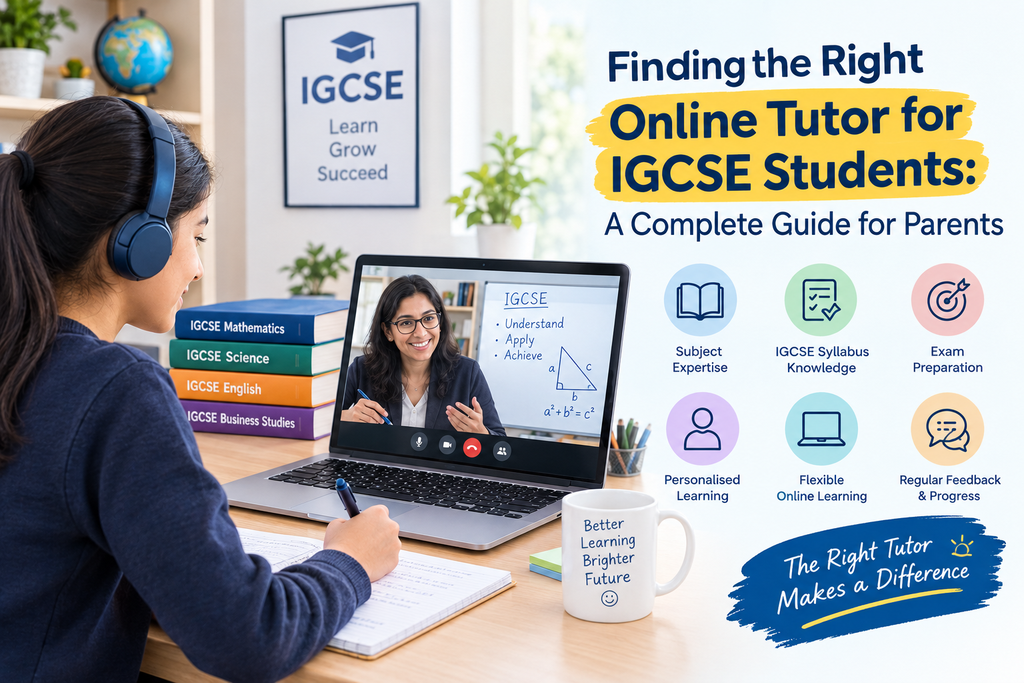
The International General Certificate of Secondary Education (IGCSE) is an internationally recognized qualification that encourages students to develop subject knowledge, analytical thinking, problem-solving abilities, and independent learning skills. However, its demanding syllabus and subject-specific assessment requirements can sometimes make studying challenging.
For students who need additional academic support, an experienced online tutor can make learning more structured, interactive, and manageable. The right tutor can explain difficult concepts, identify knowledge gaps, provide targeted practice, and help students develop effective examination techniques.
But how can parents identify a tutor who genuinely suits their child’s academic needs? Choosing the best online tuition class involves more than comparing prices or selecting someone with impressive qualifications. It requires evaluating subject expertise, teaching methods, communication skills, flexibility, and the ability to support the student’s specific IGCSE syllabus.
This guide explains what parents should consider when finding the right online tutor for IGCSE students.
1. Look for IGCSE-Specific Subject Expertise
IGCSE subjects require different approaches to teaching and assessment. A tutor who teaches mathematics effectively may not necessarily be the right person for English Literature, Chemistry, Biology, or Business Studies.
Parents should look for tutors who understand the subject their child is studying and are familiar with the relevant IGCSE syllabus.
What should parents check?
- Subject knowledge and relevant teaching experience.
- Familiarity with the student’s examination board and syllabus.
- Understanding of assessment objectives and question formats.
- Experience explaining challenging topics at the student’s level.
- Ability to identify and correct common misconceptions.
For example, an IGCSE Mathematics tutor should help students understand mathematical principles and apply them to unfamiliar problems. A Chemistry tutor should explain scientific concepts clearly while helping learners practise calculations, equations, and structured responses.
Before enrolling, ask the tutor which syllabus and examination board they teach, such as Cambridge IGCSE or Pearson Edexcel International GCSE, where applicable.
2. Choose a Tutor Who Understands the IGCSE Syllabus
IGCSE courses can differ according to the examination board, subject, syllabus version, and assessment structure. Therefore, parents should ensure that the tutor’s teaching plan matches the student’s actual course requirements.
An effective tutor should be able to explain which topics need attention, how the assessment is structured, and what skills students need to demonstrate in examinations.
Why syllabus alignment matters
A syllabus-aligned learning plan helps students:
- Focus on the topics required for their course.
- Understand the relevant assessment objectives.
- Practise appropriate question types.
- Identify areas that require additional revision.
- Avoid spending too much time on unrelated material.
Parents should share the student’s subject list, syllabus code where available, and examination timeline before lessons begin. This gives the tutor a clearer picture of the learner’s needs and helps them plan relevant sessions.
3. Evaluate the Tutor’s Teaching Style
Subject expertise is important, but the ability to explain concepts clearly is equally valuable. Even a knowledgeable tutor may not be the right fit if the student’s learning style and the tutor’s teaching approach do not work well together.
A good online tutor encourages questions, uses examples, checks understanding, and adjusts explanations when a concept is difficult.
Signs of effective online teaching
Look for a tutor who:
- Breaks complex topics into manageable steps.
- Uses diagrams, worked examples, and interactive explanations.
- Encourages students to solve problems independently.
- Provides constructive feedback instead of simply giving answers.
- Revisits difficult concepts when necessary.
A trial lesson can help parents and students evaluate these qualities before committing to a longer course.
When comparing options for the best online tuition class, consider whether the student feels comfortable asking questions and can explain what they have learned after the session.
4. Check Experience With IGCSE Exam Preparation
Understanding a topic and applying it under examination conditions are two different skills. IGCSE students need both subject knowledge and familiarity with the way questions are presented and marked.
A suitable tutor should incorporate exam preparation into the learning plan, particularly as assessments approach.
Important exam preparation methods
Past-paper practice: Students can become familiar with question styles and learn how to approach different types of problems.
Mark-scheme analysis: Reviewing mark schemes helps learners understand how answers are assessed and where marks may be awarded.
Timed practice: Working within time limits helps students develop pacing and prioritization skills.
Mistake analysis: Reviewing incorrect answers allows students to identify recurring problems and strengthen their understanding.
Revision planning: A realistic schedule helps students balance revision across subjects and prioritize weaker areas.
Parents should ask how the tutor combines concept teaching with examination practice. The aim should be to build understanding and exam confidence rather than rely solely on memorization.
5. Prioritize Personalized Learning
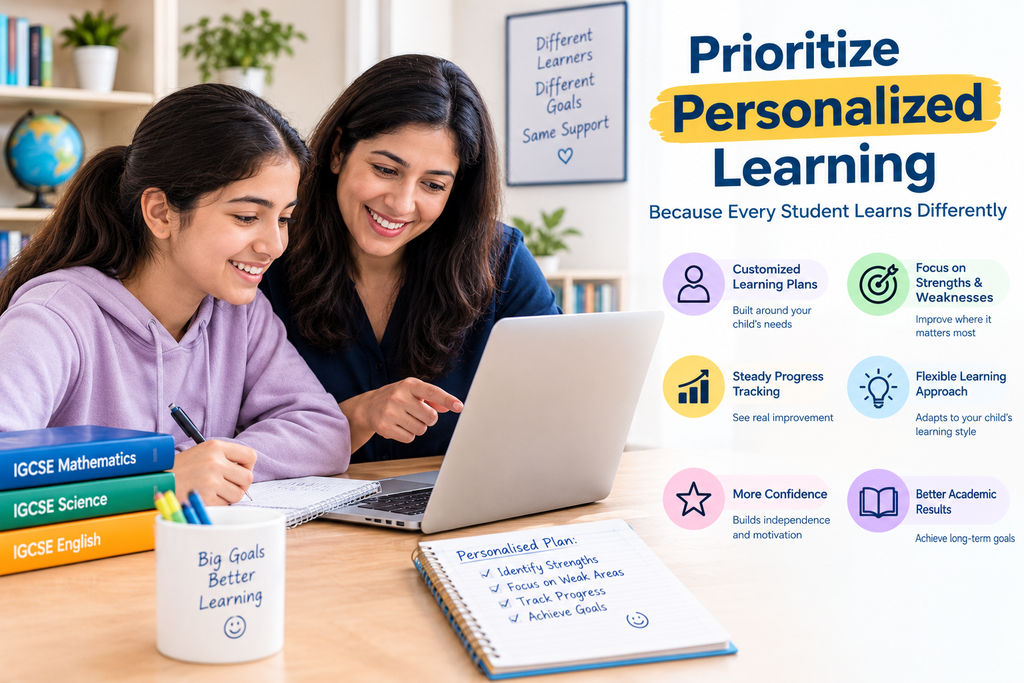
Every student has different strengths, weaknesses, and academic goals. Some may struggle with foundational concepts, while others understand the material but lose marks because of incomplete explanations, calculation errors, or poor time management.
Personalized tuition helps address these differences.
An effective tutor may begin with a short assessment or discussion to understand the student’s current performance. Based on the findings, the tutor can develop a learning plan that prioritizes the most important areas.
What a personalized plan may include
- An initial assessment of subject knowledge.
- Weekly learning objectives.
- Targeted worksheets and practice questions.
- Regular revision of previously covered topics.
- Feedback on written answers and problem-solving methods.
- Periodic progress reviews with the student and parents.
Personalized support can make learning more focused and help students use their study time more effectively.
6. Consider the Benefits of Online IGCSE Tuition
Online tuition gives students access to tutors without requiring travel to a physical classroom. This can be especially useful for families with busy schedules or students who need support in subjects not easily available locally.
Depending on the tutor and platform, online lessons may include digital whiteboards, shared worksheets, interactive discussions, and recorded sessions.
Benefits of online learning
Flexible scheduling: Families may be able to arrange lessons around school, extracurricular activities, and revision time.
Access to subject specialists: Students can explore tutors beyond their immediate geographical area.
Focused attention: One-to-one tuition can allow the tutor to concentrate on an individual student’s questions and progress.
Convenient revision: Digital materials and available session recordings can help students revisit important concepts.
When evaluating the best online tuition class, parents should also check the quality of the internet connection, the availability of learning materials, the tutor’s punctuality, and the platform’s communication features.
7. Review Communication, Feedback, and Progress Tracking
A productive tutoring arrangement should include clear communication about learning goals and progress. Parents need to understand what their child is studying, which areas are improving, and where further support may be necessary.
A tutor who provides regular feedback can help students take greater responsibility for their learning.
Questions parents should ask
- How will progress be measured?
- Will the tutor provide feedback after lessons?
- How will weak areas be identified?
- How frequently will the learning plan be reviewed?
- How can parents raise concerns or discuss changing needs?
Progress should be assessed through meaningful indicators, such as improved understanding, more accurate answers, stronger explanations, and better performance on practice questions. Grades may provide useful information, but they are not the only measure of learning.
8. Compare Availability, Fees, and Overall Value
Cost is an important consideration, but choosing a tutor based only on the lowest fee may not meet a student’s needs. Parents should compare the complete learning experience, including teaching quality, lesson length, preparation, feedback, and scheduling flexibility.
Before enrolling, clarify the fee structure, cancellation policy, lesson frequency, and any additional costs.
Also, check whether the tutor’s availability aligns with the student’s timetable, especially during revision periods.
The best online tuition class for one student may not be the best choice for another. The right option is one that balances teaching quality, affordability, subject requirements, and the student’s comfort with the learning process.
9. Explore Online Tutoring Options With GenieClasses
GenieClasses helps families explore online tutoring options and find learning support suited to their needs. Its platform offers access to tutors, one-to-one live sessions, group classes, practice resources, and learning features designed to support students.
Parents looking for IGCSE support can begin by identifying the student’s subjects, examination board, academic goals, and areas of difficulty. They can then explore relevant tutors and discuss whether the tutor’s experience and teaching approach are appropriate.
To learn more about the platform, visit the GenieClasses homepage. You can also explore the About Us page to understand its educational approach or use the Contact Us page to get in touch with the team.
Before selecting a tutor, confirm their experience with the specific IGCSE subject and syllabus, and use a trial lesson where available to assess whether the teaching style suits your child.
Frequently Asked Questions (FAQs)
1. How do I find the right online tutor for IGCSE students?
Start by identifying your child’s subjects, examination board, learning difficulties, and academic goals. Shortlist tutors with relevant subject expertise, ask about their IGCSE teaching experience, and evaluate their teaching style through a trial lesson where available.
2. What qualifications should an IGCSE online tutor have?
Look for strong subject knowledge, relevant teaching qualifications or experience, and familiarity with the student’s IGCSE syllabus. The ability to explain concepts clearly and provide useful feedback is also important.
3. Is online tuition effective for IGCSE exam preparation?
Online tuition can support IGCSE preparation when lessons include clear explanations, syllabus-aligned teaching, regular practice, feedback, and examination-style questions. Effectiveness depends on the quality of instruction and the student’s participation and practice.
4. Should I choose one-to-one or group tuition for IGCSE?
One-to-one tuition may be useful for students who need individualized attention or help with specific weaknesses. Group tuition can provide a collaborative learning environment. The right format depends on the student’s needs, learning preferences, and budget.
5. When should students start IGCSE tuition?
Students can begin whenever they need additional support. Starting early may allow more time to strengthen foundational knowledge, address difficult topics, and build a consistent revision routine. Students preparing for upcoming examinations may benefit from a focused plan based on their remaining time.
6. How can I assess whether an online tutor is suitable?
Observe whether the tutor explains concepts clearly, encourages questions, understands the syllabus, provides constructive feedback, and sets appropriate learning goals. A trial session, where available, can help you assess the student’s comfort and engagement.
Conclusion
Finding the right online tutor for IGCSE students requires careful consideration of subject expertise, syllabus familiarity, teaching style, exam preparation, personalized support, and communication. The goal is not simply to arrange additional lessons but to help students develop a stronger understanding of their subjects and become more confident, independent learners.
Parents should compare tutors thoughtfully, discuss expectations before enrolling, and review progress regularly. With the right support and consistent effort, students can approach challenging topics more systematically and prepare more effectively for their assessments.
If you are exploring the best online tuition class for your child’s IGCSE journey, start by identifying their learning needs and finding a tutor whose expertise and teaching approach align with those goals. Explore the available options at GenieClasses and take the next step toward a more structured learning experience.