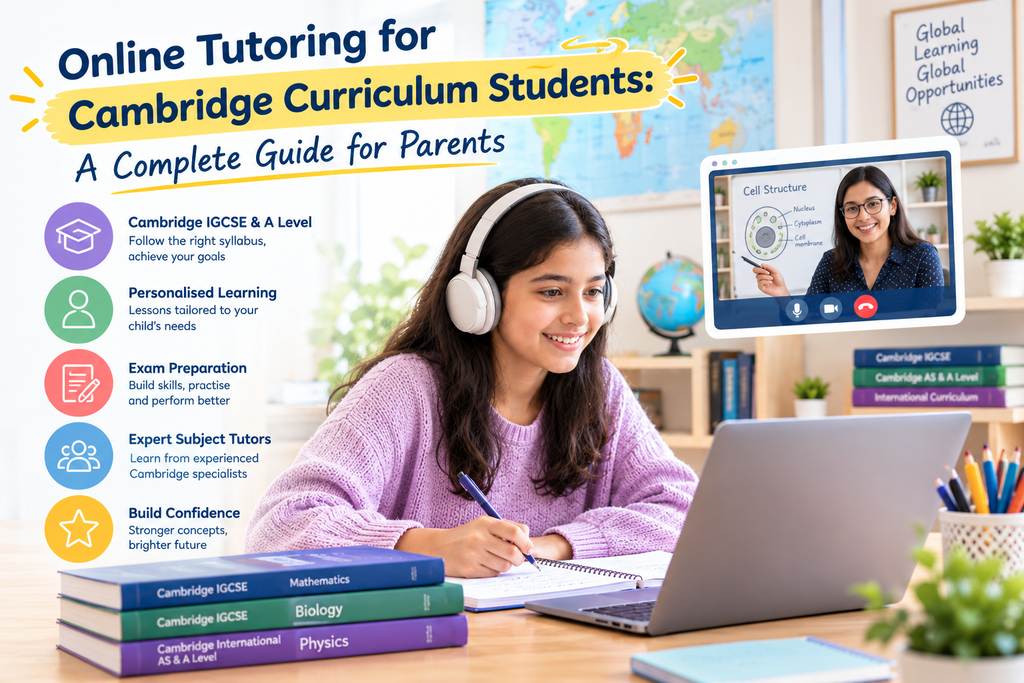
The Cambridge curriculum is designed to encourage students to think independently, understand concepts deeply, and apply their knowledge to real-world situations. From Cambridge Primary and Lower Secondary to IGCSE and International AS & A Level, students encounter different learning expectations as they progress through school.
Although this approach helps students develop valuable academic skills, some learners may need additional guidance to understand complex topics, improve examination techniques, or manage their study schedules.
This is where online tutoring can provide useful support. With subject-focused lessons, personalised explanations, and opportunities for regular practice, students can work on specific learning needs alongside their school education.
In this guide, we explain when online tutoring can help Cambridge curriculum students, what parents should look for in a tutor, and how to choose suitable academic support.
Quick Answer: Is Online Tutoring Helpful for Cambridge Curriculum Students?
Yes. Online tutoring can help Cambridge curriculum students clarify difficult concepts, practise analytical questions, strengthen subject knowledge, and prepare more systematically for assessments.
It may be especially useful for students who need additional explanations, struggle to apply concepts independently, or want focused preparation for Cambridge IGCSE and A Level examinations.
The most effective tutoring complements school lessons rather than replacing them. It should follow the student’s syllabus, address specific learning gaps, and encourage independent thinking.
Key Takeaways
- Cambridge students often benefit from understanding concepts rather than relying only on memorisation.
- Personalised tutoring can help identify and address subject-specific learning gaps.
- Regular practice can strengthen problem-solving, analytical thinking, and examination skills.
- Parents should choose tutors familiar with the relevant Cambridge stage, subject, and syllabus.
- Consistent feedback and independent study remain essential for academic progress.
1. Understanding the Cambridge Curriculum and Its Learning Approach
Cambridge International Education offers learning programmes for different age groups, including Cambridge Primary, Lower Secondary, IGCSE, and International AS & A Level.
The learning expectations vary by stage and subject. However, many Cambridge courses emphasise conceptual understanding, application of knowledge, analytical thinking, and the ability to communicate ideas clearly.
For example, a student studying mathematics may need to explain a method and apply it to an unfamiliar problem. In science, students may need to interpret data, evaluate evidence, or explain experimental results.
Simply memorising textbook definitions may not be enough for these types of questions.
Online tutoring can provide additional opportunities to discuss concepts, work through examples, and practise applying knowledge in different situations.
2. When Students Need Help Understanding Difficult Concepts
A student may understand a teacher’s explanation during class but struggle to solve questions independently later.
This can happen when a topic requires several connected skills. For example, a learner may understand basic algebra but find multi-step equations challenging. Another student may know scientific definitions but struggle to interpret graphs or experimental data.
A tutor can identify the exact point where the student becomes confused and explain the topic using simpler examples, diagrams, or step-by-step demonstrations.
This targeted approach can be more useful than repeatedly revising an entire chapter without identifying the underlying problem.
Parents considering the best online tuition class should look for tutors who encourage questions and adapt their explanations to the student’s needs instead of using the same teaching method for everyone.
3. Preparing for Cambridge IGCSE and A Level Examinations
Cambridge IGCSE and International AS & A Level courses require students to develop subject knowledge and apply it according to the requirements of their individual subjects.
Students may need support with syllabus coverage, revision planning, structured answers, numerical problems, or interpreting examination questions.
Online tutoring can help students organise their preparation by focusing on:
- Revising challenging topics before examinations.
- Practising questions that reflect the relevant syllabus and assessment objectives.
- Understanding command words such as describe, explain, compare, and evaluate.
- Reviewing mistakes and identifying patterns.
- Improving time management during timed practice.
- Developing clear, logically organised answers.
Parents should ensure that tutors use the correct syllabus and examination materials for the student’s course and examination session.
For additional guidance, students should consult the official Cambridge International website: https://www.cambridgeinternational.org/
Tutoring can support preparation, but progress also depends on regular independent practice, attendance, and the student’s individual learning needs.
4. Developing Critical Thinking and Independent Learning Skills
One important reason families consider additional academic support is to help students move beyond memorising information.
Cambridge students may need to analyse a situation, interpret evidence, compare ideas, or justify a conclusion. These skills develop through practice and thoughtful feedback.
A tutor can ask students to explain why an answer is correct, compare different methods, and identify evidence that supports their conclusions.
For instance, rather than simply giving a student the solution to a mathematics problem, a tutor can guide the learner through the reasoning process. In English, a tutor may help a student support an interpretation with relevant evidence from a text.
Over time, this approach can encourage students to approach unfamiliar questions with greater confidence and independence.
5. Getting Personalised Support in Different Subjects
Students may perform well in one subject while finding another more demanding. Personalised tutoring allows them to focus on their specific areas of difficulty.
Mathematics
Students may need help with algebra, geometry, functions, statistics, or multi-step problem-solving. A tutor can identify gaps in understanding and provide targeted exercises.
Physics, Chemistry, and Biology
Depending on the course and level, students may need support with scientific concepts, calculations, diagrams, practical-related questions, or interpreting data.
English Language and Literature
Tutoring can help students develop reading comprehension, vocabulary, essay structure, textual analysis, and evidence-based writing.
Business, Economics, and Other Subjects
Students may benefit from practising application-based questions, analysing case studies, explaining relationships between concepts, and structuring longer responses.
The important factor is to find a tutor who understands the requirements of the specific subject and Cambridge course.
6. Managing Schoolwork, Revision, and Extracurricular Activities
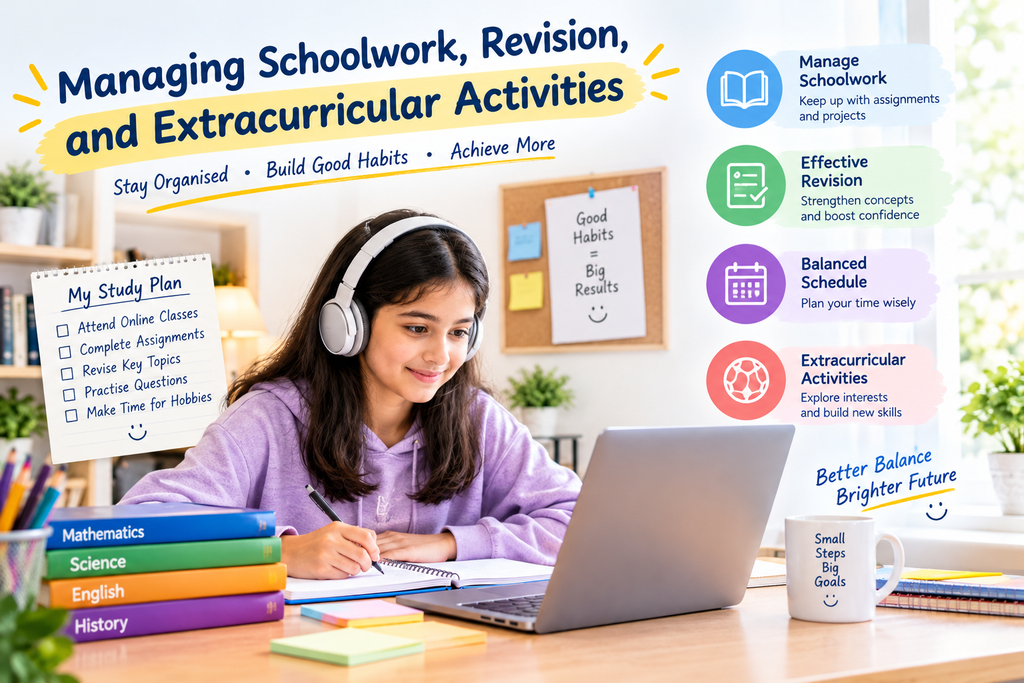
Cambridge students may balance regular lessons, assignments, projects, revision, and extracurricular interests. Without a realistic schedule, academic tasks can become stressful.
Online sessions can reduce travel time and make it easier for families to coordinate additional lessons around existing commitments.
A tutor may also help the student create a manageable study plan that divides larger tasks into smaller steps. For example, a weekly plan could include reviewing one difficult concept, completing a set of practice questions, and revisiting previous mistakes.
However, additional classes should not leave students without enough time for independent learning, sleep, and other activities.
A balanced routine is generally more sustainable than an overloaded timetable.
7. How to Choose the Right Online Cambridge Tutor
The tutor’s subject knowledge and teaching approach can significantly influence the value of online lessons.
Before enrolling, parents should consider the following factors.
Knowledge of the Cambridge syllabus: Ask whether the tutor has experience with the student’s particular stage, subject, and examination requirements.
Clear explanations: The tutor should be able to explain difficult ideas in a way the student understands.
Personalised teaching: Lessons should address the student’s learning gaps rather than simply repeat school material.
Practice and feedback: Students should have opportunities to solve questions, discuss mistakes, and improve their reasoning.
Progress communication: Parents should understand what the student is working on and which areas need further attention.
Suitable learning format: Consider whether one-to-one lessons or group classes better match the student’s needs, budget, and preferred learning environment.
A demo session, when available, can help families assess the teaching style before making a decision.
You can also read our guide on what makes a good online tutor for school students for more practical selection tips.
8. How GenieClasses Can Support Personalised Learning
Finding suitable academic support begins with understanding the student’s goals, preferred learning style, and subject requirements.
GenieClasses provides an online platform where families can explore tutors and learning options. Its offerings include one-to-one live sessions, group classes, customised worksheets, and guided corrections.
Depending on the student’s needs and the tutor selected, these learning resources can help reinforce concepts and provide opportunities for additional practice.
Before enrolling, parents should confirm that the selected tutor teaches the student’s specific Cambridge subject and level.
Explore the GenieClasses homepage to learn more about available subjects and tutors.
To understand the platform’s mission and approach to learning, visit the About Us page.
Frequently Asked Questions
1. Is online tutoring suitable for Cambridge curriculum students?
Yes. Online tutoring can help students clarify concepts, practise questions, address learning gaps, and prepare for assessments. Its effectiveness depends on the tutor’s suitability, the student’s participation, and regular independent study.
2. Can online tutoring help Cambridge IGCSE students prepare for exams?
It can support IGCSE preparation through syllabus-based revision, practice questions, feedback, and examination technique. Students should work with tutors who understand the requirements of their particular subjects and examination sessions.
3. What should parents look for in a Cambridge online tutor?
Parents should check subject expertise, familiarity with the relevant Cambridge syllabus, clarity of explanation, teaching experience, personalised support, and the quality of feedback and practice materials.
4. Is one-to-one tutoring better than group classes?
It depends on the student. One-to-one tutoring offers more individual attention, while group classes can provide structured learning and opportunities to discuss ideas with other learners. Parents should choose the format that best fits their child’s needs.
5. Can online tutoring improve critical thinking skills?
Tutoring can help students practise analytical thinking when lessons involve explaining reasoning, interpreting evidence, comparing approaches, and solving unfamiliar problems. Students need regular opportunities to apply these skills independently.
6. How often should Cambridge students attend online tutoring?
There is no universal schedule. The ideal frequency depends on the student’s goals, current understanding, school workload, and examination timeline. A realistic schedule should leave enough time for independent practice and rest.
7. How can parents check whether tutoring is helping?
Look for improvements in conceptual understanding, independent problem-solving, the quality of written answers, and the student’s ability to explain ideas. Assessment results can also provide useful feedback, but they should not be the only measure of progress.
Final Thoughts
The Cambridge curriculum encourages students to understand ideas deeply, apply knowledge, and develop independent thinking skills. When a student finds particular topics challenging or needs structured examination preparation, online tutoring can provide additional guidance.
The right tutor should understand the relevant syllabus, identify learning gaps, encourage questions, and help the student become a more confident independent learner.
Parents exploring the best online tuition class should focus on teaching quality, syllabus suitability, personalised support, and a manageable learning schedule. Consistent practice and constructive feedback are just as important as the lessons themselves.
If you are exploring online academic support, start by identifying your child’s subject requirements and learning goals. Then compare suitable tutors and teaching formats before making a decision.
Learn more about our mission, teaching approach, and commitment to helping students succeed by visiting our About Us page.
Have questions or need help finding the right online tutor for your child? Visit our Contact Us page to connect with the GenieClasses team.