
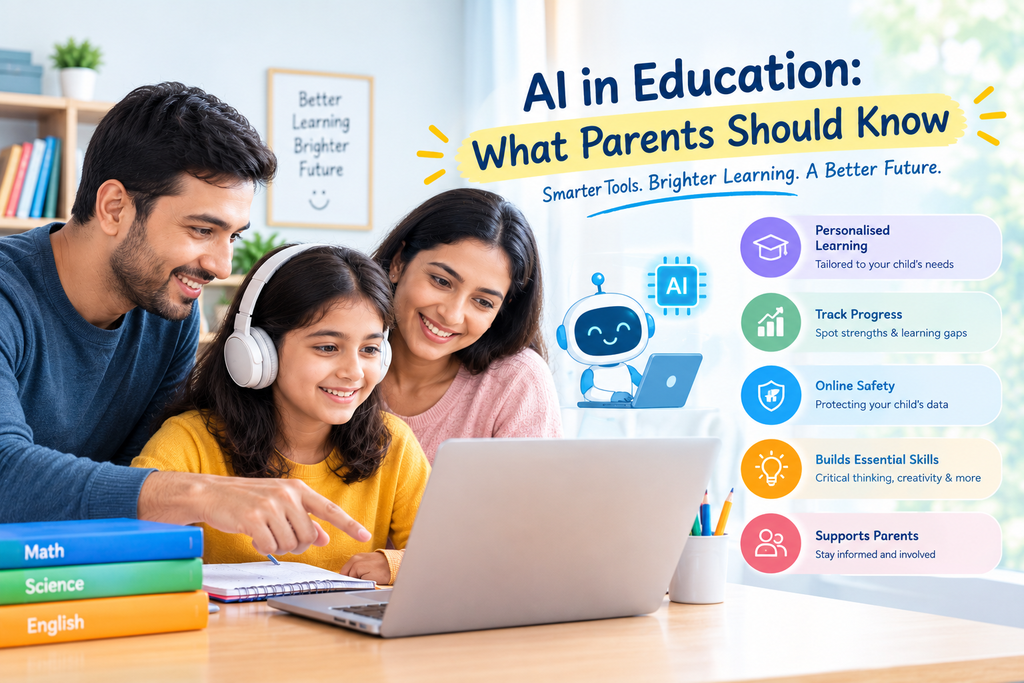
Artificial intelligence (AI) is becoming an important part of modern education. From personalised learning platforms to automated feedback and digital study assistants, AI tools are changing how students access information, practise skills, and understand difficult concepts. These technologies can offer valuable support, but parents also need to understand their limitations.
For families exploring AI in Education: What Parents Should Know, the most important point is that technology should support a child’s learning rather than replace teachers, independent thinking, or meaningful parent involvement.
When used thoughtfully, AI can help students practise at their own pace, identify learning gaps, and receive additional explanations. However, concerns about inaccurate information, privacy, screen time, and overdependence must also be considered.
This guide explains how AI works in education, its potential benefits and risks, and practical steps parents can take to help children use it responsibly.
What Is AI in Education?
AI in education refers to the use of artificial intelligence technologies to support teaching, learning, assessment, and educational planning. These systems analyse information, recognise patterns, generate explanations, and provide recommendations based on their design and available data.
For example, an AI-powered learning platform might identify that a student repeatedly struggles with fractions and suggest additional practice questions. A writing assistant might help a learner identify grammatical errors, while an educational chatbot might explain a scientific concept in simpler language.
Common applications include:
- Personalised learning: Adjusting practice activities to suit a student’s needs and progress.
- Instant feedback: Helping learners recognise errors and review their answers.
- Study assistance: Explaining concepts, generating practice questions, and summarising material.
- Progress tracking: Organising information about performance over time.
- Teacher support: Helping educators prepare resources and identify areas that may need additional attention.
AI capabilities vary between tools, and their recommendations should be reviewed rather than accepted automatically.
How Is AI Changing the Way Children Learn?
AI is influencing several aspects of a student’s educational experience. Understanding these changes helps parents decide when the technology is useful and when human guidance is necessary.
1. Personalised Learning Experiences
Every child learns differently. Some students understand mathematical concepts quickly but need more support with writing, while others benefit from visual examples, repetition, or step-by-step explanations.
AI-powered tools can offer different explanations and practice activities based on a learner’s responses. This may help students work through difficult topics without feeling pressured to follow the same pace as everyone else.
However, personalisation is only useful when the content is appropriate for the student’s age, curriculum, and learning objectives. Parents and teachers should review whether the suggested activities actually improve understanding.
2. Faster Feedback and More Practice
Traditional homework feedback may arrive after a student has moved on to another topic. Certain AI tools can provide immediate responses, explain possible mistakes, and offer additional exercises.
For example, a student learning grammar might receive suggestions about sentence structure, while a learner practising algebra might be prompted to review a particular step.
This feedback can make practice more interactive. Nevertheless, AI-generated answers may contain mistakes, so students should compare important information with textbooks, teacher guidance, and reliable educational sources.
3. Support for Independent Learning
AI can help children explore questions beyond their classroom lessons. They might ask for a simpler explanation of a science concept, request examples of a grammar rule, or create a revision quiz before an examination.
The goal should be to encourage curiosity and problem-solving rather than provide shortcuts for completing assignments.
Parents can encourage children to attempt a question independently first, use AI for guidance when needed, and then explain the answer in their own words. This approach helps develop understanding instead of encouraging copy-and-paste habits.
4. Better Visibility Into Learning Progress
Some educational platforms organise assessment results, practice performance, and recurring mistakes into progress summaries. These insights may help parents and tutors identify topics that deserve additional attention.
For example, repeated errors in fractions could indicate that a child needs to revisit foundational concepts before moving to more advanced mathematics.
Such information is most useful when combined with teacher observations, discussions with the child, and regular assessments. AI-generated reports cannot always explain why a student is struggling or how they feel about learning.
What Are the Benefits of AI in Education for Students?
When selected carefully and used with appropriate guidance, AI tools can offer several potential benefits.
- Flexible practice: Students can revisit difficult concepts and practise at a convenient pace.
- Different explanations: Complex topics can be presented through examples, simpler language, or step-by-step guidance.
- More learning resources: Students can access quizzes, revision prompts, and supplementary practice activities.
- Earlier identification of difficulties: Some systems can highlight repeated errors or declining performance.
- Support for diverse learning needs: Appropriate tools may offer alternative formats and learning aids for students with different needs.
- Improved study organisation: AI can assist with revision schedules, topic lists, and study plans.
AI can also complement personalised tutoring. Families looking for the best online tuition class should consider how a tutor uses technology to support genuine understanding, provides feedback, and adapts lessons to a student’s needs.
The quality of teaching remains essential. Technology alone cannot guarantee better academic outcomes.
What Risks Should Parents Know About?
Understanding the risks is an important part of responsible technology use. UNESCO’s guidance on generative AI in education highlights the importance of age-appropriate use, privacy protection, human oversight, and responsible educational design. Read the UNESCO guidance on generative AI in education and research.
1. Incorrect or Misleading Information
AI tools can produce answers that sound convincing but are incomplete, outdated, or incorrect. A child may not have enough subject knowledge to recognise these mistakes.
What parents can do: Encourage children to verify important answers using school materials, trusted websites, and teacher guidance. Ask them to explain why an answer makes sense rather than simply accepting it.
2. Data Privacy and Online Safety
Some platforms collect information about users, including account details, interactions, or learning activity. Parents should understand what information a tool collects and how it is stored or shared.
What parents can do:
- Check the platform’s privacy policy and age requirements.
- Avoid entering a child’s full name, address, school details, passwords, or other sensitive information into AI tools.
- Use appropriate parental controls and account settings.
- Choose educational platforms with clear safety and data-handling practices.
3. Overdependence on Technology
If children use AI to solve every problem, write every assignment, or complete their homework without thinking, they may miss opportunities to develop essential skills.
What parents can do: Ask children to attempt tasks independently before seeking assistance. Use AI to provide hints, examples, and explanations rather than simply supplying completed answers.
4. Too Much Screen Time
AI-based learning often involves digital devices. Long periods of screen use may reduce time for physical activity, reading printed books, outdoor play, sleep, and face-to-face interaction.
What parents can do: Establish a balanced routine that includes breaks, offline activities, exercise, and adequate sleep.
5. Limited Emotional Understanding
AI tools may respond to questions, but they do not replace the empathy, encouragement, and personal understanding that a skilled teacher can provide.
Children may need reassurance, motivation, or help managing exam stress—needs that require thoughtful human support.
How Can Parents Help Children Use AI Responsibly?
Parents do not need advanced technical knowledge to guide their children. A few consistent habits can make AI-assisted learning more productive and safer.
Create Clear Rules for AI Use
Explain when AI is acceptable and when independent work is expected. For example, using an AI tool to practise vocabulary may be appropriate, while submitting AI-generated homework as entirely original work may violate school rules.
Encourage honesty about how technology is used.
Choose Age-Appropriate Tools
Not every AI platform is suitable for every child. Review age restrictions, content controls, privacy practices, and educational purpose before allowing children to use a tool independently.
For younger learners, supervised activities and teacher-approved resources are particularly important.
Focus on Understanding, Not Just Marks
Ask questions such as:
- Can you explain this concept without looking at the answer?
- What did you learn from your mistake?
- Can you solve a similar problem on your own?
- Which part of the explanation was most helpful?
These conversations help parents assess whether a child is learning or merely obtaining answers.
Maintain Communication With Teachers and Tutors
Teachers and tutors can help determine whether an AI tool supports the curriculum and the student’s current learning goals. They can also identify misunderstandings that a digital system may overlook.
Families comparing the best online tuition class options should look for qualified tutors who communicate clearly, provide individual attention, and use educational technology thoughtfully rather than relying on it as a substitute for teaching.
Can AI Replace Teachers or Online Tutors?
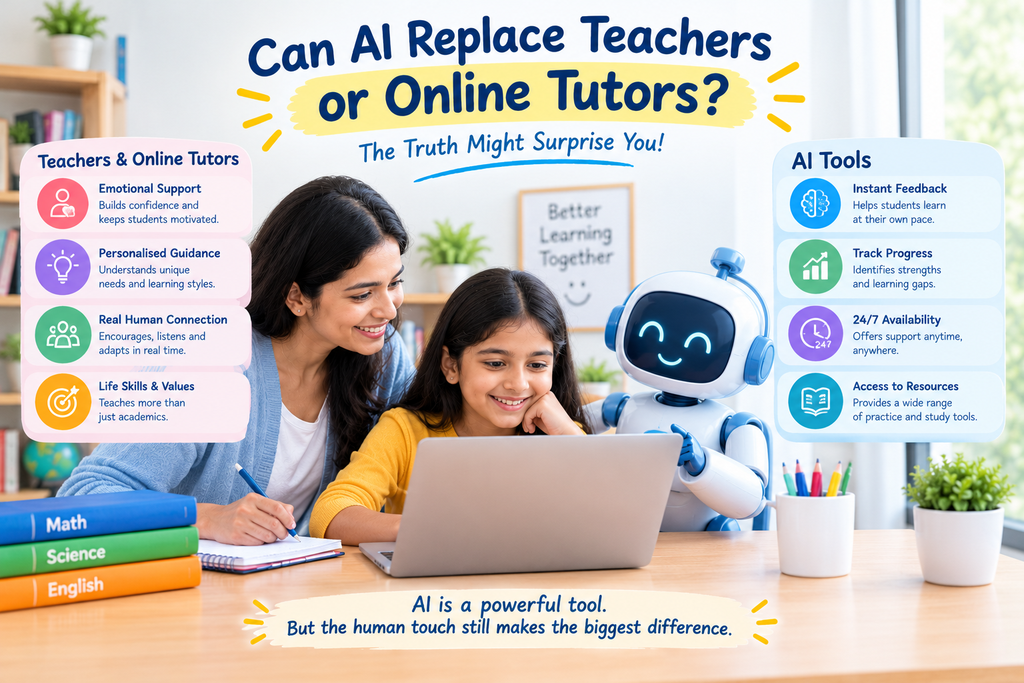
No. AI can assist with explanations, practice, feedback, and educational planning, but it should not be treated as a complete replacement for teachers or tutors.
Human educators interpret a student’s needs in context. They can notice when a learner lacks confidence, adjust their teaching approach, encourage persistence, and explain difficult ideas in ways that respond to the child’s questions.
A balanced learning approach combines useful technology with human guidance. For instance, a student might use an AI tool to practise a topic before a lesson, discuss misunderstandings with a tutor, and complete independent exercises afterwards.
At GenieClasses, families can explore online learning support and consider how personalised tutoring can complement a child’s schoolwork. The right approach depends on the learner’s needs, curriculum, goals, and preferred way of learning.
How to Choose AI-Supported Learning for Your Child
Before introducing a new tool or educational service, parents can use this checklist.
| What to check | Questions parents should ask |
|---|---|
| Educational value | Does the tool help my child understand concepts or simply provide answers? |
| Curriculum alignment | Is the content suitable for my child’s grade and school curriculum? |
| Accuracy | Can the information be checked against reliable sources? |
| Privacy and safety | Are age requirements, data practices, and safety controls clear? |
| Human guidance | Can a teacher or tutor review progress and address misunderstandings? |
| Progress measurement | Is improvement assessed through understanding and independent work, not just activity scores? |
| Balanced use | Does the tool leave enough time for offline learning, rest, and play? |
Choosing the best online tuition class or educational platform means looking beyond technology features. Parents should evaluate teaching quality, communication, lesson personalisation, and whether the approach helps children become confident and independent learners.
What Does the Future of AI in Education Look Like?
AI is likely to remain part of the educational landscape as digital learning tools develop. Students may encounter more adaptive practice systems, automated feedback, language-learning assistants, and tools that help educators organise learning resources.
However, the most valuable use of AI will depend on how responsibly it is introduced. Schools, families, educators, and technology providers all have a role in protecting student privacy and ensuring that technology serves meaningful educational goals.
Parents should remain curious without feeling pressured to adopt every new tool. A simple, reliable resource that supports a child’s learning goals may be more useful than a complicated platform with many unnecessary features.
The priority should always be the child’s understanding, wellbeing, creativity, and ability to think independently.
Frequently Asked Questions (FAQs)
1. What is AI in education?
AI in education means using artificial intelligence to support activities such as personalised practice, feedback, study assistance, assessment, and learning planning. Its effectiveness depends on the quality of the tool and how it is used.
2. Is AI good for children’s learning?
AI can support learning by providing additional explanations, practice questions, and feedback. However, it should be age-appropriate, used responsibly, and combined with independent thinking and human guidance.
3. At what age should children start using AI learning tools?
There is no single age that suits every tool. Parents should check each platform’s age requirements, consider the child’s maturity, and provide supervision. Follow the applicable terms of service and school guidance.
4. Can AI help students improve their academic performance?
AI may help students practise difficult topics and recognise recurring mistakes. However, improved performance is not guaranteed. Regular assessment, consistent effort, quality teaching, and suitable learning resources remain important.
5. What are the biggest risks of AI in education?
Important risks include inaccurate information, privacy concerns, inappropriate content, overdependence on automated answers, bias, and excessive screen time. Parents can reduce these risks through careful tool selection and active guidance.
6. Can AI replace teachers and tutors?
No. AI can provide supplementary learning support, but teachers and tutors offer human judgement, encouragement, personalised explanations, and an understanding of a child’s wider educational needs.
7. How can parents check whether their child is learning with AI?
Ask children to explain concepts in their own words, solve similar questions independently, and describe what they learned from mistakes. Compare these observations with school assessments and feedback from teachers.
8. How can online tutoring complement AI-based learning?
Online tutoring can provide structured lessons, subject-specific explanations, individual feedback, and accountability. When appropriate, AI tools can supplement these sessions with additional practice and revision.
Conclusion
AI is creating new opportunities for students to learn, practise, and explore ideas. It can make some educational activities more flexible and help learners receive additional support, but it also introduces responsibilities around accuracy, privacy, screen time, and independent thinking.
For parents researching AI in Education: What Parents Should Know, the best starting point is a balanced approach: choose age-appropriate tools, verify important information, set clear boundaries, and stay involved in the child’s learning journey.
When technology is combined with skilled teaching, meaningful feedback, and personalised support, it can become a useful part of a child’s education rather than a substitute for genuine learning.
Explore GenieClasses to learn more about online learning support. You can also visit the About Us page to learn about the platform or Contact Us to discuss your child’s learning needs.