
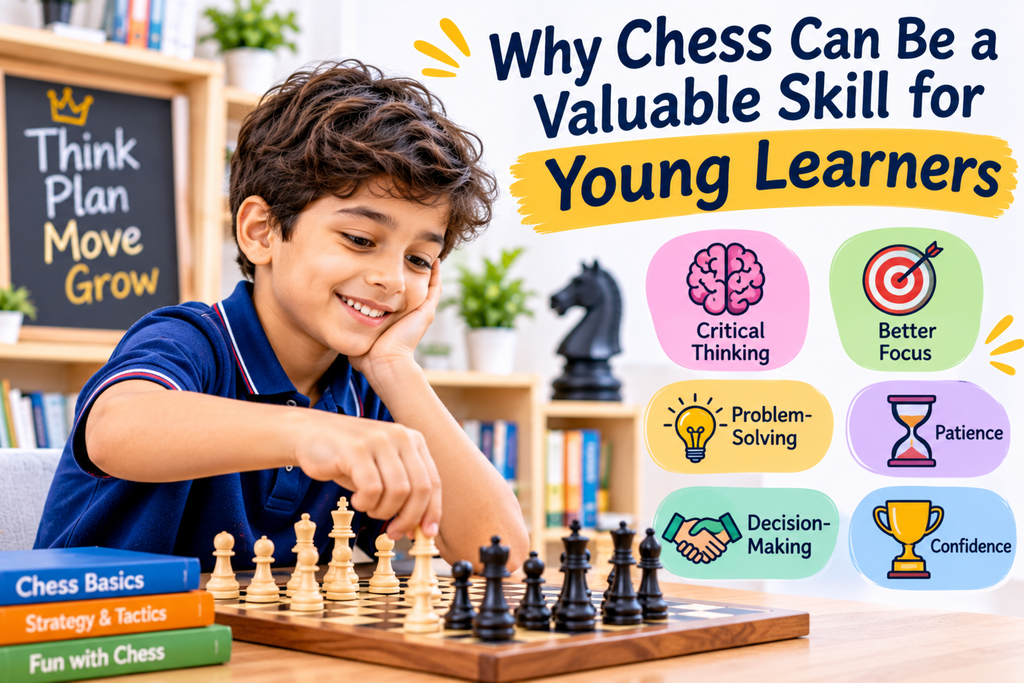
Children develop important skills not only through school subjects but also through activities that encourage them to think, explore, and make decisions independently. Chess is one such activity. It is more than a board game because it encourages young learners to observe situations, plan their moves, recognise patterns, and consider possible outcomes.
When children learn chess, they gradually understand that every move has a purpose. They learn to think before acting, consider different possibilities, and respond to changing situations. These experiences can support skills that are useful in both academic learning and everyday life.
Parents often explore different extracurricular activities, such as music, sports, coding, and online art classes, to help children discover their interests. Chess can be another valuable option for students who enjoy puzzles, strategy, and problem-solving.
What Makes Chess a Valuable Learning Activity?
Chess is a strategy-based game played between two players on a board containing 64 squares. Each player controls 16 pieces with different movement rules and aims to checkmate the opponent’s king.
Although the rules may initially seem challenging, children can learn them gradually through demonstrations and regular practice. As they become familiar with the game, they begin exploring strategies, planning moves, and understanding how their decisions affect the position on the board.
Chess combines learning with enjoyment, making it an engaging activity for children who like challenges.
7 Benefits of Learning Chess for Young Learners
1. Develops Critical Thinking Skills
Chess encourages children to examine the board before making a move. They need to consider which pieces are available, what their opponent might do, and how different decisions could affect the game.
This process encourages analytical thinking. Students learn to evaluate situations instead of choosing the first option that comes to mind.
For example, before moving a knight, a child might consider whether the move protects another piece or creates an opportunity to attack.
2. Improves Concentration and Attention
A chess game requires players to pay attention to the entire board. Missing a small detail can change the direction of the game.
Regular practice can encourage children to focus on individual tasks, observe patterns, and remain attentive. These habits may also be useful when completing school assignments or solving challenging questions.
3. Strengthens Problem-Solving Abilities
Every chess position presents a different challenge. Children need to identify problems, explore possible moves, and choose a suitable response.
For instance, if an opponent threatens one of their pieces, students must think about how to protect it or create a better position.
This encourages a step-by-step approach to problem-solving that can also be applied to mathematics, science, and everyday situations.
4. Teaches Patience and Planning
Chess teaches children that quick decisions are not always the best decisions. Sometimes, waiting, observing, and preparing a strategy can lead to better results.
Young players gradually learn to think several moves ahead rather than focusing only on immediate outcomes.
These experiences can encourage patience, planning, and a more thoughtful approach to challenges.
5. Builds Decision-Making Confidence
During a chess game, players have to make decisions independently. They cannot rely on someone else to choose every move.
As children practise, they learn to compare possible options and take responsibility for their decisions. Even when a move does not work as expected, they can review what happened and try a different approach next time.
This can help them become more comfortable making decisions in other learning situations.
6. Encourages Learning From Mistakes
Losing a chess game can be disappointing, especially for beginners. However, reviewing a game helps children understand where they made mistakes and how they could improve.
Instead of viewing mistakes as failures, students can learn to treat them as opportunities to develop better strategies.
Parents and teachers can support this process by encouraging reflection rather than focusing only on winning.
7. Encourages Creativity and Strategic Thinking
Although chess follows specific rules, players can explore many different strategies. They need to think creatively, recognise opportunities, and sometimes find unexpected ways to respond to an opponent’s moves.
This combination of structure and creativity makes chess an interesting learning activity.
Children can also explore other creative interests, such as drawing, storytelling, music, and online art classes, to develop different forms of expression and imagination.
How Chess Practice Can Support Skill Development
Chess involves several connected stages of thinking. Children observe the board, analyse possible moves, plan strategies, make decisions, and review the results. Regular practice gives them opportunities to develop different skills.
| Chess Activity | Skill Children Practise |
|---|---|
| Observing the chessboard | Concentration and attention |
| Analysing possible moves | Critical thinking |
| Planning a strategy | Logical reasoning and planning |
| Choosing a move | Decision-making |
| Responding to an opponent | Problem-solving |
| Reviewing a completed game | Learning from mistakes |
| Exploring different strategies | Creativity and flexible thinking |
How Can Parents Introduce Chess to Children?
Children do not need to understand advanced strategies when they first start playing chess. A gradual introduction can make the experience more enjoyable and manageable.
Here are some practical suggestions for parents:
- Start with the basics: Introduce the chessboard and explain how each piece moves.
- Use short practice sessions: Begin with simple games instead of expecting children to play for long periods.
- Teach through examples: Demonstrate common moves and explain why certain decisions are useful.
- Encourage questions: Let children ask why a move works or what might happen next.
- Focus on learning: Appreciate thoughtful decisions and improvements rather than only celebrating wins.
- Make practice enjoyable: Use beginner-friendly puzzles and friendly games to maintain interest.
Parents can also balance chess with other extracurricular activities. A child who enjoys creative expression might explore online art classes, while another may prefer music, sports, or coding.
Can Chess Help Children With Their School Studies?
Chess can complement school education by giving students opportunities to practise observation, planning, logical reasoning, and problem-solving.
For example, students may use similar thinking habits when solving mathematics problems, organising a science project, or evaluating different answers in a classroom activity.
However, chess should not be considered a replacement for regular academic learning. Its benefits depend on the child’s interest, practice, and the way the activity is introduced.
The aim should be to make chess a positive addition to a balanced learning routine.
How to Balance Chess With Other Learning Activities
Children have different interests, energy levels, and school responsibilities. Parents should choose extracurricular activities that fit comfortably into their daily schedules.
A balanced routine may include:
- Schoolwork and homework.
- Outdoor play and physical activity.
- Chess practice or other skill-based activities.
- Reading and creative hobbies.
- Sufficient rest and family time.
Activities such as online art classes can provide a creative alternative to strategy-based games, allowing children to explore visual expression alongside logical thinking.
The best routine is one that gives children enough time to learn, play, relax, and enjoy their interests without feeling overloaded.
Can Online Learning Support Children’s Skill Development?
Online learning can help children explore different subjects and interests through structured lessons and digital resources. Depending on the subject and teaching approach, students may participate in guided activities, interactive exercises, and personalised learning sessions.
Parents interested in creative development can also explore online art classes as an opportunity for children to practise drawing, painting, and visual expression.
At GenieClasses, parents can explore personalised academic learning support designed around students’ educational needs and learning goals.
To understand more about the platform, visit the About Us page or connect through the Contact Us page.
Frequently Asked Questions
1. What is the best age for children to start learning chess?
Children can begin exploring basic chess rules when they are interested and able to understand simple instructions. The appropriate starting age varies, but beginner-friendly lessons can make learning accessible.
2. How does chess improve problem-solving skills?
Chess encourages children to examine a situation, consider possible moves, compare options, and choose a strategy. Regular practice gives them opportunities to develop these thinking habits.
3. Can chess improve concentration in children?
Chess requires players to observe the board and pay attention to their opponent’s moves. Practising regularly can encourage focused attention, although results vary between children.
4. How often should children practise chess?
Short and consistent practice sessions can be a good starting point. Parents can adjust the frequency according to the child’s interest, age, and school schedule.
5. Does chess help children perform better in mathematics?
Chess involves patterns, logical reasoning, and planning, which have similarities to some mathematical thinking processes. However, learning chess does not guarantee improved mathematics grades.
6. Is chess suitable for children who are beginners?
Yes. Children can start with basic piece movements, simple puzzles, and short games. They can gradually explore more advanced strategies as their understanding develops.
7. Should parents encourage chess alongside other extracurricular activities?
Yes, provided the child’s routine remains balanced. Chess can be combined with creative activities, sports, music, and other hobbies according to the child’s interests and available time.
Conclusion
Chess can be a valuable learning activity for young children because it encourages them to think carefully, solve problems, make decisions, and learn from mistakes. Through regular practice, students get opportunities to develop patience, concentration, and strategic thinking.
Parents should introduce chess in an enjoyable and supportive way, allowing children to learn at their own pace. It is equally important to balance chess with schoolwork, physical activities, rest, and other interests.
Whether children enjoy strategy games, creative hobbies, music, or online art classes, opportunities to explore different skills can make their learning journey more engaging. The goal is to help every child discover activities that encourage curiosity, confidence, and lifelong learning.
Explore personalised learning opportunities with GenieClasses and support your child’s journey of learning and development.