
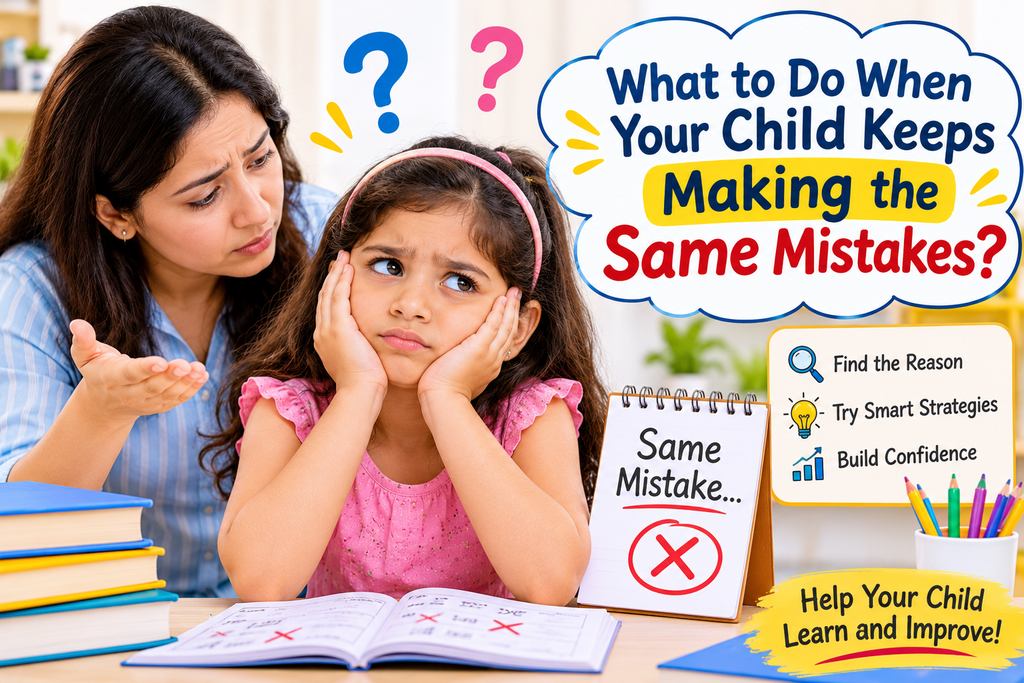
Have you noticed that your child keeps making the same mistakes in Mathematics, Science, English, or other subjects, even after you have explained the concepts several times? Perhaps they understand the lesson during study sessions but repeat similar errors in homework, worksheets, or examinations. This can be confusing and frustrating for parents who want to see their children make steady academic progress.
Repeated mistakes are not always a sign that a child is not studying enough. Sometimes, they indicate gaps in conceptual understanding, ineffective revision habits, difficulty concentrating, or a lack of confidence. Identifying the actual reason is important before deciding how to help.
Many parents experience Student Learning Problems when their children struggle to apply previously taught concepts or learn from their errors. The good news is that with patience, consistent guidance, and suitable learning strategies, children can gradually develop better academic habits.
So, why do children repeat the same mistakes? How can parents identify the underlying issues? And what practical steps can help children improve?
Let’s explore!
Quick Answer: What Should Parents Do When Their Child Keeps Making the Same Mistakes?
When children repeatedly make similar academic mistakes, parents should first identify why the errors are happening instead of simply asking them to study harder.
Here are some practical steps:
- Identify frequently repeated mistakes.
- Understand whether the child has misunderstood the concept.
- Encourage children to solve questions independently.
- Use an error notebook to track mistakes.
- Practise similar questions regularly.
- Avoid scolding or comparing children.
- Provide personalised academic guidance.
- Review progress consistently.
The goal should be to help children understand their mistakes and learn how to avoid repeating them.
1. Why Do Children Keep Making the Same Mistakes in Their Studies?
Before correcting repeated errors, parents need to understand what causes them. Different children may experience different learning difficulties, even when they study the same subject.
Here are some common reasons.
1. Lack of Conceptual Understanding
Sometimes, children memorise formulas, definitions, or answers without fully understanding the underlying concepts.
For example, a child may remember a Mathematics formula but struggle to apply it when a question is presented differently.
What parents can do:
- Ask children to explain concepts in their own words.
- Use practical examples from everyday life.
- Encourage them to solve different types of questions.
- Check whether they understand the steps rather than memorising answers.
2. Rushing Through Questions
Some children understand the topic but make mistakes because they rush through their homework or examination papers.
They may skip instructions, overlook important details, or make calculation errors.
What parents can do:
- Encourage children to read questions carefully.
- Teach them to check their answers before submitting.
- Provide short practice exercises.
- Encourage accuracy before speed.
3. Ineffective Revision Habits
Reading the same chapter repeatedly does not always help children remember information.
Without regular revision and independent practice, they may forget important concepts and repeat earlier mistakes.
What parents can do:
- Create a simple weekly revision schedule.
- Encourage active recall.
- Use flashcards and practice worksheets.
- Revisit previously difficult topics regularly.
4. Difficulty Concentrating During Study Sessions
Distractions, long study hours, and an uncomfortable learning environment can affect concentration.
Children may understand a concept during a lesson but fail to remember important details while completing their homework independently.
What parents can do:
- Create a quiet study space.
- Divide study sessions into manageable periods.
- Allow short breaks between activities.
- Reduce unnecessary screen distractions.
5. Fear of Making Mistakes
Some children become nervous when they answer incorrectly. They may avoid asking questions or hesitate to attempt unfamiliar problems.
This can make it difficult for them to recognise and correct their learning gaps.
What parents can do:
- Appreciate effort rather than focusing only on marks.
- Encourage children to ask questions.
- Treat mistakes as learning opportunities.
- Build confidence through achievable practice activities.
2. How Can Parents Identify the Type of Mistakes Their Child Is Making?
Not every mistake has the same cause. Some errors happen because children misunderstand concepts, while others result from carelessness, weak memory, or insufficient practice.
Parents should observe their child’s work carefully before deciding which improvement strategy to follow.
Understanding Common Learning Mistakes
| Type of Mistake | Possible Reason | Suggested Solution |
|---|---|---|
| Repeating calculation errors | Weak fundamentals or rushing | Practise calculations step by step |
| Forgetting definitions | Insufficient revision | Use active recall and flashcards |
| Writing incomplete answers | Poor answer presentation | Practise structured writing |
| Misunderstanding questions | Not reading instructions carefully | Highlight important keywords |
| Applying incorrect formulas | Conceptual confusion | Revise concepts with examples |
| Making spelling mistakes | Limited writing practice | Encourage regular reading and writing |
This simple comparison can help parents recognise patterns in their child’s academic performance.
3. How Can an Error Notebook Help Children Avoid Repeating Mistakes?
One of the most useful techniques for improving academic performance is maintaining an error notebook.
Instead of correcting a mistake and immediately moving to the next question, children should record what went wrong and understand how to solve it correctly.
How to Create a Mistake Notebook
Children can divide their notebooks into four simple sections:
| Section | What to Record |
|---|---|
| Original Question | The question answered incorrectly |
| My Mistake | What went wrong |
| Correct Method | The right answer and explanation |
| Practice Again | A similar question to solve independently |
For example, if a child repeatedly makes mistakes while solving fractions, they can record the incorrect method, understand the correct steps, and practise three or four similar questions.
Remember: The purpose of an error notebook is not to collect mistakes but to help children recognise patterns and improve gradually.
4. What Are the Best Ways to Help Children Learn From Their Mistakes?
Children need more than repeated explanations. They need opportunities to practise, reflect, and apply what they have learned.
Here are some effective strategies parents can introduce at home.
A. Encourage Independent Problem-Solving
Avoid immediately providing the correct answer whenever your child gets a question wrong.
Instead, ask guiding questions such as:
- Which step do you think went wrong?
- Can you explain how you reached this answer?
- Is there another way to solve this question?
- What would you do differently next time?
These questions encourage children to think independently and develop problem-solving abilities.
B. Use Small and Regular Practice Sessions
Long study sessions can sometimes make children tired and less attentive.
Short, focused practice sessions can help them revisit difficult concepts without feeling overwhelmed.
For example:
- 15 minutes of concept revision.
- 15 minutes of question practice.
- 5 minutes of reviewing mistakes.
The timings can be adjusted according to the child’s age, attention span, and learning requirements.
C. Use Real-Life Examples
Practical examples can make difficult concepts easier to understand.
For example, parents can teach fractions using pieces of fruit, explain measurements while cooking, or introduce basic calculations through shopping activities.
Connecting lessons with everyday situations can help children understand how academic concepts work in real life.
D. Celebrate Small Improvements
Children may not correct every mistake immediately, so parents should recognise gradual progress.
Appreciate when they:
- Identify an error independently.
- Solve a previously difficult question correctly.
- Complete homework with fewer mistakes.
- Remember a concept without additional help.
Positive encouragement can motivate children to continue improving.
5. How Can Parents Create a Learning Routine to Reduce Repeated Mistakes?
A consistent learning routine helps children revise concepts, practise regularly, and recognise areas that need improvement.
Parents do not need to create a complicated timetable. A simple daily routine can make learning more organised.
Sample Daily Learning Routine
| Activity | Suggested Time | Purpose |
|---|---|---|
| Revise previous lessons | 10 minutes | Refresh memory |
| Learn a new concept | 20 minutes | Strengthen understanding |
| Solve practice questions | 15 minutes | Apply knowledge |
| Review mistakes | 10 minutes | Identify learning gaps |
| Quick self-assessment | 5 minutes | Check improvement |
Parents can adjust this routine according to their child’s age, school schedule, and attention span.
Consistency is more important than studying for long hours occasionally.
6. When Should Parents Consider Additional Academic Support?
Sometimes, children continue making similar mistakes even after regular practice and parental guidance. This may indicate that they need a different teaching approach or additional academic support.
Parents should consider seeking help when:
- The child repeatedly struggles with the same concepts.
- Homework takes much longer than expected.
- The child cannot solve questions independently.
- Examination performance does not reflect classroom understanding.
- The child avoids difficult subjects.
- Confidence gradually decreases.
These signs may indicate underlying Student Learning Problems that require closer attention.
A qualified tutor can help identify specific learning gaps, explain difficult concepts differently, and provide practice according to the child’s academic needs.
For further guidance, read What Parents Should Expect From a One-on-One Online Class. It explains how personalized teaching, individual attention, and regular feedback can support children’s learning.
You can also explore What Makes a Good Online Tutor for School Students? to understand which qualities parents should consider when selecting a tutor.
7. Can Online Tutoring Help Children Overcome Repeated Mistakes?
Yes. Online tutoring can provide additional support to children who need help understanding concepts, improving accuracy, and developing better study habits.
A suitable tutor can:
- Identify topics where the child needs additional support.
- Explain difficult concepts using simpler examples.
- Provide customised practice worksheets.
- Correct mistakes with step-by-step explanations.
- Encourage independent problem-solving.
- Monitor learning progress through regular practice.
Parents searching for the best online tuition class should consider teaching quality, personalised attention, regular feedback, and opportunities for independent practice.
How GenieClasses Supports Children’s Learning
GenieClasses offers online learning opportunities designed to support students through personalised and interactive teaching.
Its learning features include:
- Professionally qualified tutors.
- One-on-one live sessions.
- Group classes.
- Free demo classes.
- Customised worksheets.
- Guided corrections.
- Class recording access.
- AI-powered learning insights.
These features can help students revisit difficult topics, understand their mistakes, and practise concepts at their own pace.
Parents can visit the GenieClasses Home Page to explore available subjects and learning options.
To understand the platform’s educational approach, visit the About Us page. For questions about classes, tutors, or learning options, parents can reach out through the Contact Us page.
8. What Should Parents Avoid When Children Keep Repeating Mistakes?
While helping children improve, parents should also avoid certain common reactions that may negatively affect their confidence.
| Avoid Doing This | Try This Instead |
|---|---|
| Scolding children for mistakes | Explain the correct approach patiently |
| Comparing them with classmates | Focus on individual improvement |
| Forcing long study hours | Encourage short, focused sessions |
| Giving answers immediately | Allow independent thinking |
| Focusing only on marks | Appreciate learning progress |
| Ignoring repeated errors | Identify the underlying reason |
Remember, children need encouragement and guidance to develop stronger learning habits. A supportive environment can make it easier for them to accept mistakes and work towards improvement.
Frequently Asked Questions
1. Why Does My Child Keep Making the Same Mistakes in Studies?
Children may repeat mistakes because of weak conceptual understanding, insufficient practice, poor concentration, ineffective revision, or difficulty applying concepts independently.
2. How Can I Stop My Child From Repeating Mistakes?
Identify recurring errors, explain the correct methods, encourage independent practice, and maintain an error notebook. Regular revision can also help children remember what they have learned.
3. Should Parents Correct Every Mistake Immediately?
Not necessarily. Give children an opportunity to identify their mistakes independently. Ask guiding questions and help them understand where they went wrong.
4. Can Repeated Mistakes Affect a Child’s Confidence?
Yes. Repeated academic difficulties can sometimes make children feel frustrated or discouraged. Parents should provide encouragement and appreciate small improvements.
5. How Can Teachers Help Students Avoid Repeated Mistakes?
Teachers can identify learning gaps, explain difficult concepts using different methods, provide targeted exercises, and give constructive feedback.
6. When Should Parents Consider Online Tutoring?
Parents can consider online tutoring when children need additional explanations, personalised attention, regular practice, or support with specific academic difficulties.
7. Is Making Mistakes a Normal Part of Learning?
Absolutely. Mistakes are a natural part of the learning process. What matters is whether children understand their errors and gradually improve through practice.
Final Thoughts: Help Your Child Learn From Every Mistake
When children repeatedly make the same mistakes, the solution is not always more homework or longer study hours. Parents need to understand the reasons behind these errors and provide the right kind of guidance.
By encouraging independent thinking, maintaining an error notebook, practising regularly, and creating a positive learning environment, parents can help children develop stronger academic habits.
Every child learns differently, and improvement takes time. Instead of focusing only on incorrect answers, celebrate the effort children make to understand and correct them.
If your child is experiencing Student Learning Problems, personalised guidance and consistent practice can help address learning gaps and build academic confidence.
Parents looking for the best online tuition class should choose learning support that focuses on conceptual clarity, individual attention, and continuous improvement.
Because every mistake can become a learning opportunity when children receive the right guidance, patience, and encouragement.