
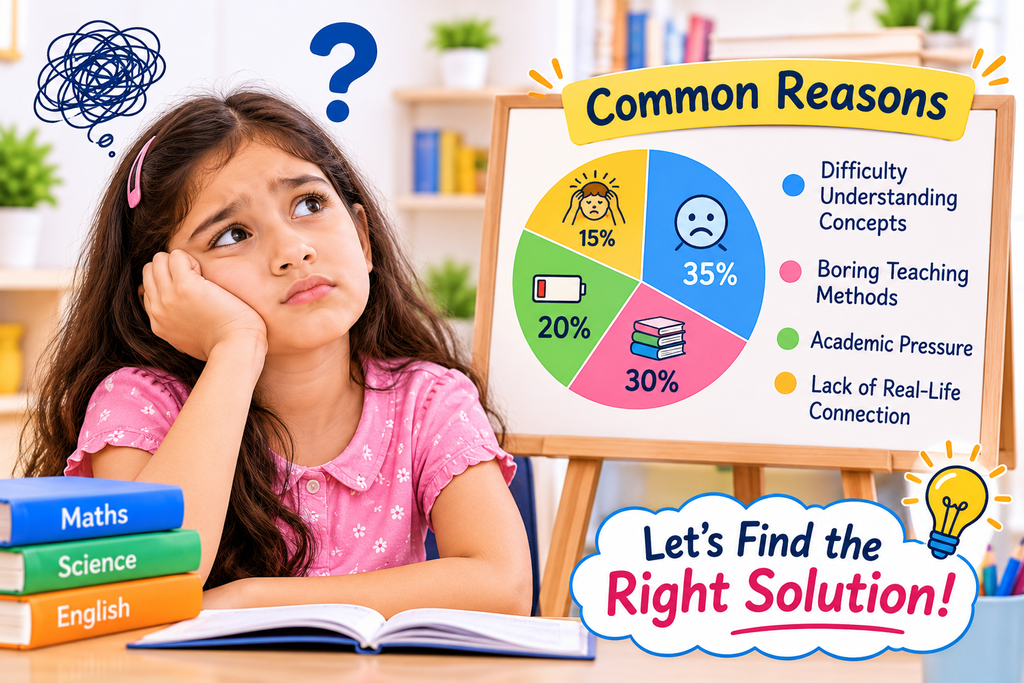
Every child has different interests, abilities, and learning preferences. Some students enjoy Mathematics, while others feel more confident studying English, Science, or creative subjects. However, there are times when children gradually lose interest in a subject they previously enjoyed.
A student who once participated actively in class may start avoiding homework, showing less curiosity, or finding excuses not to study. This change can affect academic performance, confidence, and overall learning habits. Understanding the reasons behind these Student Learning Problems is important for parents who want to support their child’s educational journey.
Losing interest in a subject does not always mean a student is unwilling to learn. Sometimes, the teaching approach, difficult concepts, lack of confidence, or learning environment may be responsible.
In this blog, we will explore why students lose interest in particular subjects and how parents and tutors can help them develop a more positive attitude towards learning.
Quick Answer: Why Do Students Lose Interest in a Subject?
Students may lose interest in a subject because they find it difficult to understand, feel overwhelmed by academic pressure, lack motivation, or do not connect with the teaching approach.
Other reasons may include repeated poor performance, limited practical examples, insufficient individual attention, and fear of making mistakes.
Parents can help by identifying the underlying difficulty, encouraging curiosity, setting achievable goals, and providing suitable academic support.
1. Difficulty Understanding Basic Concepts
One of the most common reasons students lose interest in a subject is difficulty understanding its basic concepts.
For example, a student who struggles with multiplication may find fractions and algebra increasingly challenging. Similarly, weak reading comprehension can make subjects that involve lengthy explanations more difficult.
When students cannot understand the foundation of a topic, every new lesson may feel more complicated.
How parents can help:
- Identify the specific topics your child finds difficult.
- Encourage regular revision of fundamental concepts.
- Use simple examples to explain challenging topics.
- Avoid rushing through lessons.
- Provide additional practice without creating pressure.
Building a strong foundation can make learning more comfortable and encourage students to explore advanced concepts.
2. Repetitive Teaching Methods Make Learning Boring
Students may lose interest when lessons follow the same teaching pattern every day.
Listening to lengthy explanations, memorising definitions, and completing similar exercises repeatedly can make certain subjects feel less engaging.
Children often learn better when they have opportunities to participate, ask questions, solve problems, and explore ideas.
For example, instead of only memorising scientific definitions, students can understand concepts through diagrams, demonstrations, and everyday examples.
What can make lessons more interesting?
- Interactive quizzes and activities.
- Real-life examples.
- Educational videos and visual explanations.
- Group discussions and problem-solving exercises.
- Creative assignments and practical demonstrations.
A varied teaching approach can help students become active participants rather than passive listeners.
3. Fear of Making Mistakes and Losing Confidence
Repeated mistakes can affect how students feel about a particular subject.
When children consistently receive low marks or struggle to answer questions, they may start believing that they are not good at that subject.
For example, a student who regularly makes mistakes in Mathematics may begin saying, “I am bad at Maths” or avoid attempting difficult questions.
This negative mindset can gradually reduce participation and motivation.
How parents and tutors can help:
- Treat mistakes as opportunities to learn.
- Appreciate effort and improvement.
- Avoid comparing children with classmates or siblings.
- Encourage students to ask questions.
- Break difficult tasks into smaller steps.
Building confidence takes time. Students should understand that making mistakes is a normal part of the learning process.
4. Lack of Connection Between Subjects and Real Life
Sometimes, students fail to understand why they need to study a particular subject.
When lessons focus entirely on textbooks and examinations, children may struggle to recognise how the knowledge applies to everyday situations.
For example:
| Subject | Real-life connection |
|---|---|
| Mathematics | Shopping, budgeting, and measurements |
| Science | Health, nature, and everyday technology |
| English | Communication, reading, and writing |
| Geography | Understanding countries, weather, and environments |
| Art | Creativity, observation, and visual expression |
Connecting academic concepts with practical situations can make lessons more meaningful.
Parents and tutors should encourage children to explore how different subjects relate to their interests and everyday experiences.
5. Too Much Academic Pressure
Academic pressure is another reason students may gradually lose interest in studying.
When children constantly feel expected to achieve high marks, complete assignments, and perform better in examinations, learning can start feeling like a responsibility rather than an enjoyable activity.
Some students may become anxious about disappointing their parents or teachers.
Instead of developing curiosity, they may focus only on completing tasks and avoiding mistakes.
Parents can create a healthier learning environment by:
- Setting realistic academic expectations.
- Allowing sufficient time for rest and recreation.
- Appreciating effort instead of focusing only on marks.
- Avoiding unnecessary comparisons.
- Encouraging hobbies and extracurricular activities.
A balanced routine can help children maintain interest in academics while enjoying other activities.
6. Lack of Individual Attention
Every student has a different learning pace. Some understand concepts quickly, while others require additional explanations and practice.
In a classroom with many students, teachers may have limited time to address every child’s individual difficulties.
As a result, students who need additional support may gradually fall behind.
These Student Learning Problems can become more noticeable when children hesitate to ask questions or cannot follow the pace of classroom lessons.
Personalised learning can help address this challenge by allowing tutors to:
- Understand individual learning needs.
- Identify difficult topics.
- Adjust lesson speed.
- Provide additional practice.
- Give regular feedback.
- Encourage independent thinking.
Individual attention can help students feel more comfortable and involved in their learning journey.
7. How Parents Can Recognise When a Child Is Losing Interest
Parents are often the first to notice changes in their child’s study habits.
However, losing interest may not always be obvious. It can appear through small changes in behaviour over time.
Look for these common signs:
| Behaviour | What it may indicate |
|---|---|
| Avoiding homework | Difficulty or lack of motivation |
| Frequently getting distracted | Lessons may not feel engaging |
| Not asking questions | Lack of confidence or fear of mistakes |
| Poor participation | Reduced interest or understanding |
| Delaying assignments | Feeling overwhelmed |
| Negative comments about a subject | Frustration or low confidence |
These signs do not automatically mean that a child has a serious academic difficulty. Parents should talk openly with their children and teachers before deciding what kind of support is needed.
8. How Online Tutoring Can Help Students Regain Interest
A suitable online learning environment can provide students with additional opportunities to understand subjects in ways that match their learning needs.
Parents looking for the best online tuition class should consider teaching methods that encourage participation, individual attention, and conceptual understanding.
Online tutoring can support students through:
Personalised Explanations: Tutors can explain difficult concepts using simpler examples and adjust the pace according to the student’s understanding.
Interactive Learning: Digital whiteboards, quizzes, visual resources, and practical activities can make lessons more engaging.
Regular Feedback: Constructive feedback helps students understand their mistakes and recognise areas of improvement.
Flexible Learning: Students can attend lessons from home and follow a suitable learning schedule.
Confidence Building: A supportive tutor can encourage students to ask questions, participate in discussions, and attempt challenging tasks.
The goal should not be to force students to enjoy every subject. Instead, it should be to help them understand concepts, discover their interests, and develop confidence.
9. Practical Ways to Help Children Develop an Interest in Learning
Parents can introduce small changes in everyday study routines to make learning more enjoyable.
Here are some useful strategies:
- Understand their interests: Connect lessons with activities, hobbies, or topics your child enjoys.
- Set small goals: Divide larger academic tasks into manageable learning targets.
- Encourage curiosity: Allow children to ask questions and explore different ideas.
- Use different learning resources: Introduce books, videos, educational games, and practical activities.
- Celebrate small improvements: Recognise consistent effort and progress rather than focusing only on examination results.
- Maintain a balanced routine: Make time for studying, hobbies, exercise, and relaxation.
- Communicate regularly: Discuss academic challenges with teachers and tutors to understand what kind of support may help.
These simple habits can encourage a healthier relationship with education.
Frequently Asked Questions (FAQs)
1. Why do students suddenly lose interest in a subject?
Students may lose interest because of difficult concepts, academic pressure, repetitive lessons, poor performance, or a lack of confidence. Sometimes, changes in personal circumstances or study routines can also affect motivation.
2. How can parents motivate children who do not enjoy studying?
Parents can identify the reasons behind their child’s lack of interest, introduce interactive learning activities, set achievable goals, and appreciate small improvements. Encouragement and patience are often more helpful than pressure.
3. Can teaching methods affect a student’s interest in a subject?
Yes. Teaching methods can influence how students experience a subject. Interactive explanations, practical examples, discussions, and personalised guidance can make lessons more engaging.
4. Does losing interest in one subject affect overall academic performance?
It can. When students avoid a particular subject, they may miss important concepts, struggle with assignments, and perform less confidently in examinations. Early support can help prevent these difficulties from increasing.
5. Can online tutoring help students regain interest in difficult subjects?
Yes. Online tutoring can offer personalised explanations, interactive activities, flexible learning, and regular feedback. The effectiveness depends on the tutor’s teaching approach and the student’s individual needs.
6. When should parents consider additional academic support?
Parents can consider additional support when a child consistently struggles with concepts, avoids studying a subject, shows declining performance, or needs more individual attention than regular classroom lessons provide.
Conclusion
Losing interest in a subject is not always a sign of laziness or a lack of ability. It may indicate that a student needs a different teaching approach, additional practice, better explanations, or more encouragement.
Understanding the reasons behind Student Learning Problems allows parents and educators to provide suitable support before academic frustration becomes a regular habit.
With interactive lessons, personalised guidance, realistic goals, and a positive learning environment, children can gradually rebuild their confidence and develop a stronger interest in subjects they once found difficult.
Parents exploring the best online tuition class should look for learning opportunities that focus on individual progress, conceptual understanding, and student engagement rather than examination results alone.
Every child has the potential to learn and improve. Sometimes, all they need is the right guidance, patience, and encourageme
Explore More on GenieClasses
Looking for more guidance to support your child’s academic journey? Explore these useful resource
Discover more learning opportunities at GenieClasses Home Page.
Learn more about our platform on the About Us page or reach out through our Contact Us page to explore suitable learning support for your child.