
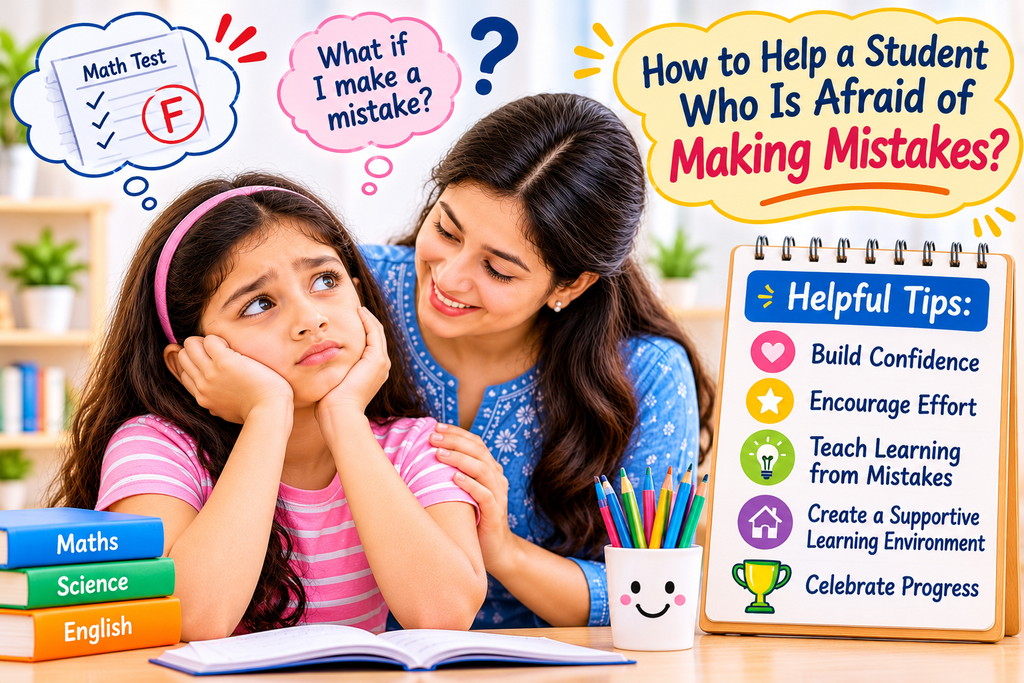
How to Help a Student Who Is Afraid of Making Mistakes? A Complete Guide for Parents
Making mistakes is a natural part of learning, but what happens when a student becomes so afraid of getting an answer wrong that they stop trying altogether?
Some children hesitate before answering questions, avoid difficult assignments, or become nervous when teachers ask them to participate. Even when they know the correct answer, the fear of making a mistake can prevent them from expressing themselves.
These Student Learning Problems can affect academic confidence, classroom participation, and a child’s willingness to explore new subjects.
But here is something every parent should understand: A child who makes mistakes is not failing. A child who is afraid to try needs encouragement, not pressure.
Let’s explore why this fear develops and how parents and tutors can help children become more confident learners.
Understanding the Problem: What Happens When Students Fear Mistakes?
Imagine two students attempting the same Mathematics question.
Student A
Gets the answer wrong, checks the solution, understands the mistake, and tries again.
Student B
Gets the answer wrong, feels embarrassed, avoids the next question, and becomes afraid of participating.
Both students made the same mistake. However, their responses were completely different.
The difference often comes from confidence, previous learning experiences, and the environment in which they study.
The real challenge isn’t making mistakes. It’s developing the fear of making them.
1. Why Are Some Students Afraid of Making Mistakes?
Before finding a solution, parents need to understand what causes this fear.
Several factors can influence how children respond to incorrect answers.
Five Common Reasons Behind the Fear
| Common Reason | How It Affects Students |
|---|---|
| Fear of failure | Students avoid difficult questions. |
| Academic pressure | Children worry about disappointing parents. |
| Negative feedback | Repeated criticism reduces confidence. |
| Comparison with others | Students feel less capable than classmates. |
| Lack of confidence | Children hesitate to participate. |
Parent Insight: Sometimes, children are not afraid of the subject itself. They are afraid of how others will react when they get something wrong.
2. Change the Way Children Look at Mistakes
A simple mindset shift can make a big difference.
Instead of teaching children to avoid mistakes, help them understand what mistakes can teach them.
The Four Stages of Learning From Mistakes
| Stage | What Students Should Do |
|---|---|
| 1. Try | Attempt a question without worrying about getting everything right. |
| 2. Recognise | Identify where the answer or approach went wrong. |
| 3. Understand | Review the incorrect step and learn the correct method. |
| 4. Improve | Try a similar question using the new understanding. |
For example, if a child makes a calculation mistake, encourage them to identify the incorrect step rather than simply giving them the right answer.
This teaches children to focus on improvement instead of embarrassment.
Remember: The purpose of learning is not to get everything right immediately. It is to understand, practise, and improve over time.
3. Replace Negative Feedback With Positive Encouragement
The words parents use can influence how children feel about their abilities.
A small change in communication can make children more comfortable discussing their mistakes.
What Parents Should Say Instead
| Instead of Saying | Try Saying Instead |
|---|---|
| Why did you get it wrong? | Let’s understand what happened. |
| You should know this! | Let’s revise it together. |
| Your friend can do it. | You can improve at your own pace. |
| Don’t make mistakes. | Mistakes help us learn. |
| You are not trying hard enough. | Let’s find a better way to practise. |
Parent’s Reminder
A child’s confidence grows when they feel supported, even when their answers are incorrect. Praise their effort, recognise improvement, and avoid making academic performance the only measure of success.
4. Five Practical Ways Parents Can Build Student Confidence
Helping children overcome their fear does not require complicated strategies. Small changes in everyday learning habits can make a difference.
1. Appreciate Effort, Not Just Marks
Celebrate when children attempt difficult questions, complete assignments independently, or improve after practising.
2. Encourage Questions
Let children know that asking questions is a positive learning habit, not a sign of weakness.
3. Avoid Unnecessary Comparisons
Every child has a different learning pace. Focus on individual improvement rather than comparing examination results.
4. Allow Children to Solve Problems Independently
Give them time to think before providing the answer. Ask guiding questions instead of immediately correcting them.
5. Make Learning Enjoyable
Use educational games, quizzes, practical examples, and interactive activities to reduce the pressure associated with studying.
5. How Can Parents Create a Mistake-Friendly Learning Environment?
Children should feel safe enough to experiment, ask questions, and express their doubts.
Here is a simple comparison of two learning environments:
| Pressure-Based Environment | Supportive Learning Environment |
|---|---|
| Focuses only on marks | Focuses on improvement |
| Discourages incorrect answers | Encourages learning from errors |
| Compares students | Respects individual progress |
| Creates fear of failure | Builds confidence |
| Expects immediate results | Allows time to understand |
The Goal: Create a home where children feel comfortable saying, “I don’t understand this yet.”
That small word “yet” can encourage a more positive attitude towards learning.
6. Break Difficult Subjects Into Smaller Learning Goals
Sometimes, students fear mistakes because they find a particular subject too difficult.
Instead of expecting them to understand an entire chapter immediately, divide the learning process into smaller steps.
Example: Helping a Student Who Struggles With Mathematics
| Learning Step | Activity | Expected Benefit |
|---|---|---|
| Step 1 | Revise formulas and basic concepts. | Stronger foundation |
| Step 2 | Solve simple questions. | Initial confidence |
| Step 3 | Review incorrect answers. | Better understanding |
| Step 4 | Attempt challenging questions. | Independent problem-solving |
This approach helps children progress gradually without feeling overwhelmed.
Learning Tip: Small achievements can encourage students to attempt bigger challenges with greater confidence.
7. How Tutors Can Help Students Overcome Their Fear
Sometimes, children need additional academic guidance to become comfortable with learning.
A supportive tutor can provide a more personalised learning experience where students get opportunities to ask questions, practise concepts, and understand their mistakes.
What Should a Supportive Tutor Provide?
| Teaching Approach | Benefit for Students |
|---|---|
| Individual attention | Helps identify specific difficulties |
| Patient explanations | Makes difficult topics easier to understand |
| Constructive feedback | Encourages improvement |
| Regular practice | Develops confidence |
| Personalised learning goals | Supports gradual progress |
Parents searching for the best online tuition class should look beyond academic results and consider tutors who encourage questions, independent thinking, and positive learning habits.
A good tutor does not simply provide correct answers. They help students understand how to reach those answers themselves.
8. Signs That Your Child May Need Additional Support
Sometimes, the fear of making mistakes becomes more noticeable in a child’s daily behaviour.
Parent Checklist
Look out for these signs:
- Avoids attempting difficult questions.
- Gets upset after making small mistakes.
- Hesitates to answer questions in class.
- Frequently seeks reassurance about answers.
- Avoids subjects they previously enjoyed.
- Shows reduced confidence during examinations.
If these behaviours occur regularly, talk to your child and their teachers to understand what support may help. If the fear causes persistent distress, a school counsellor or qualified child mental health professional may also be helpful.
Recognising Student Learning Problems early can help parents address academic difficulties before they become bigger barriers to learning.
9. A Simple 7-Day Confidence-Building Activity for Parents
Parents can try this simple activity at home to help children become more comfortable with making mistakes.
| Day | Small Activity |
|---|---|
| Day 1 | Ask your child to share one thing they find difficult. |
| Day 2 | Solve a new question together. |
| Day 3 | Discuss one mistake and what it teaches. |
| Day 4 | Encourage independent problem-solving. |
| Day 5 | Appreciate an improvement, however small. |
| Day 6 | Try a fun educational quiz or activity. |
| Day 7 | Discuss what your child has learned during the week. |
The purpose isn’t perfection in seven days. It is to gradually make learning feel safer, more positive, and less stressful.
Frequently Asked Questions (FAQs)
1. Why Are Some Students Afraid of Making Mistakes?
Students may fear mistakes because of academic pressure, criticism, comparison with classmates, negative learning experiences, or a lack of confidence.
2. How Can Parents Build Confidence in Students?
Parents can encourage independent thinking, appreciate effort, avoid unnecessary comparisons, and create a supportive environment where children feel comfortable asking questions.
3. Should Parents Correct Every Mistake Their Child Makes?
No. Parents should help children understand why an answer is incorrect rather than immediately providing the correct solution. This encourages independent learning.
4. Can Fear of Making Mistakes Affect Academic Performance?
Yes. Students may avoid challenging questions, hesitate to participate in class, and struggle to develop new skills when they constantly worry about getting answers wrong.
5. How Can Tutors Help Students Who Lack Confidence?
Tutors can provide individual attention, patient explanations, constructive feedback, and regular opportunities to practise difficult concepts.
6. Can Online Tutoring Help Students Overcome Their Fear of Failure?
Yes. A suitable online tutor can offer personalised guidance, encourage questions, and help students learn at a comfortable pace. Results depend on the student’s needs and the quality of teaching.
Final Thoughts: Let Children Learn Without the Fear of Being Wrong
Every child deserves an environment where learning feels like an opportunity rather than a test of perfection.
Making mistakes is not a weakness. It is part of discovering new ideas, understanding difficult concepts, and developing independent thinking skills.
Parents can make a meaningful difference by appreciating effort, encouraging questions, and allowing children to learn at their own pace.
Addressing Student Learning Problems requires patience, consistency, and the right support system.
When students stop worrying about being wrong, they become more willing to try, explore, and improve.
And that is where real learning begins.
Remember: Don’t teach children to be afraid of mistakes. Teach them how to grow from them.
Explore More on GenieClasses
Want to understand your child’s learning needs better? Explore these related educational resources:
Discover more personalised learning opportunities at GenieClasses Home Page.
Know more about our learning approach on the About Us page.
Have questions? Visit our Contact Us page to connect with our team.