
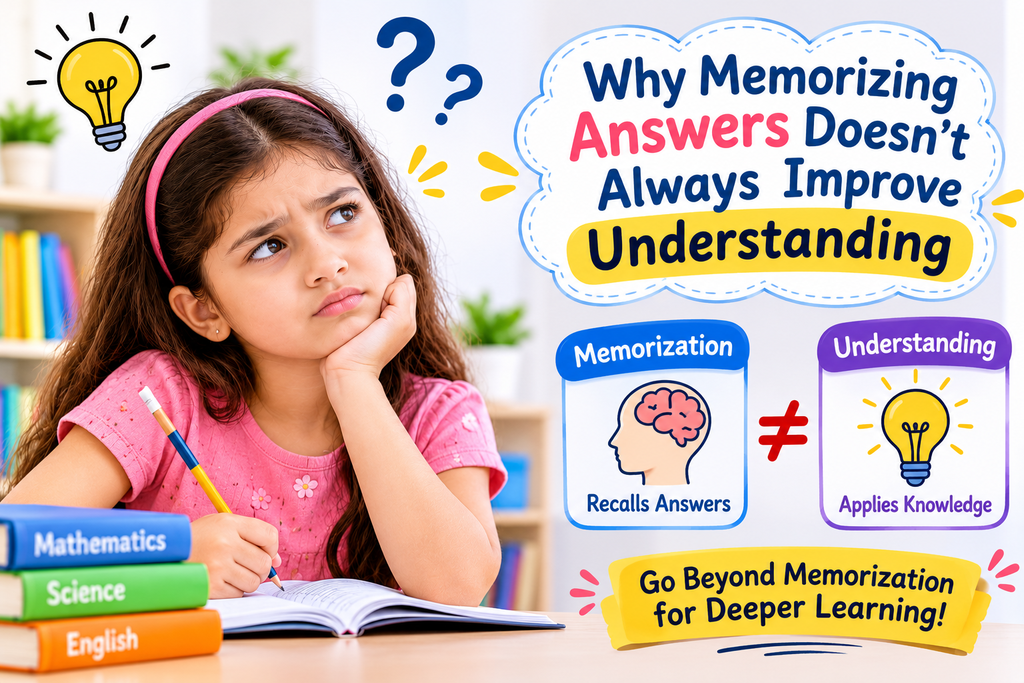
Imagine a student who can remember an entire textbook answer before an examination but struggles to explain the same topic when asked a slightly different question.
The student may score well in a familiar test but feel confused when faced with a new problem. Why does this happen?
The reason is simple: remembering information and understanding it are two different learning processes.
Memorization can help students remember important facts, definitions, and formulas. However, depending only on memorized answers may prevent them from developing the ability to explain concepts, apply knowledge, and think independently.
These Student Learning Problems can become more noticeable when students move to advanced topics that require reasoning instead of repeating textbook information.
Let’s understand why memorization alone is not enough and how parents can encourage meaningful learning.
Quick Insight: Memorizing vs Understanding
Memorizing helps students recall information, while understanding helps them explain, connect, and apply what they have learned.
| Memorization | Understanding |
|---|---|
| Remembers textbook answers | Explains concepts in their own words |
| Focuses on repeated learning | Focuses on meaningful learning |
| May struggle with unfamiliar questions | Can apply knowledge to new situations |
| Often depends on exact wording | Understands the meaning behind information |
| Focuses on recalling facts | Develops reasoning and problem-solving |
The key takeaway: Memorization can support learning, but understanding makes knowledge more useful.
1. Why Do Students Depend Too Much on Memorization?
Many students believe that learning an answer word by word is the easiest way to prepare for examinations.
There are several reasons behind this habit:
- Examination pressure: Students may focus more on marks than understanding.
- Limited revision time: Memorizing answers can feel quicker when examinations are approaching.
- Complex topics: Children may choose memorization when they find explanations difficult.
- Study habits: Repeatedly reading and writing the same answer can become a routine.
- Fear of making mistakes: Some students feel safer reproducing textbook answers exactly.
Although these methods may help with short-term recall, they do not always prepare students to answer questions that require explanation or application.
Parents should understand that these Student Learning Problems are not necessarily signs of laziness. Sometimes, children simply need a better approach to learning.
2. What Happens When Students Memorize Without Understanding?
Memorization without conceptual clarity can create difficulties in different subjects.
Consider these examples:
| Subject | Memorization-Based Learning | Understanding-Based Learning |
|---|---|---|
| Mathematics | Remembers formulas | Understands when and how to use formulas |
| Science | Recalls definitions | Explains scientific processes |
| English | Memorizes answers | Understands passages and develops ideas |
| History | Remembers dates | Understands events and their connections |
| Geography | Learns facts by heart | Understands locations, patterns, and reasons |
For example, a student may memorize the formula for calculating the area of a rectangle but struggle when a question presents the same concept in a different format.
This happens because remembering a formula is not the same as understanding how it works.
Parent Insight: Encourage your child to explain the reason behind an answer instead of checking only whether the answer is correct.
3. Five Signs Your Child May Be Memorizing Instead of Understanding
Sometimes, parents may not immediately recognise the difference between memorization and genuine understanding.
Look for these common signs:
1. The child cannot explain answers independently.
They may reproduce textbook sentences but struggle to describe the same concept in simple language.
2. They forget information quickly.
Previously memorized answers may become difficult to recall after a short period.
3. They struggle with differently worded questions.
Even when the topic is familiar, a small change in the question can create confusion.
4. They depend heavily on textbooks.
The child may feel uncomfortable answering questions without looking at notes.
5. They find application-based questions difficult.
They can remember definitions but struggle to connect concepts with practical examples.
If these patterns appear regularly, parents should explore the reasons behind the child’s learning difficulties rather than focusing only on examination scores.
4. How Memorization Can Affect Long-Term Learning
Learning becomes more challenging as students move from basic topics to advanced concepts.
Many subjects are interconnected. A student who does not understand foundational concepts may struggle when those concepts are used in more complicated lessons.
For example:
Basic Mathematics → Fractions → Decimals → Algebra
If a child only memorizes the steps for solving fraction problems without understanding them, learning algebra may become more difficult.
Similarly, memorizing scientific definitions without understanding the processes behind them can create confusion when students study advanced Science topics.
These Student Learning Problems can gradually affect confidence, classroom participation, and independent problem-solving.
Parents can also explore how a tutor can identify a student’s learning gaps to understand why identifying foundational difficulties is important.
5. Practical Ways to Help Children Learn Beyond Memorization
The goal is not to eliminate memorization completely. Students still need to remember formulas, vocabulary, definitions, and important facts.
Instead, parents should encourage children to combine memory with conceptual understanding.
The 5-Step Understanding-Based Learning Method
Step 1: Read to Understand
Ask your child to read the topic carefully and identify its main idea instead of immediately memorizing the answer.
Step 2: Explain in Their Own Words
Encourage children to describe the concept using simple language. This helps parents understand whether the child has genuinely understood the lesson.
Step 3: Connect Concepts With Examples
Use everyday situations to make difficult topics easier to understand.
For example, explain fractions through pizza slices or percentages through shopping discounts.
Step 4: Practise Different Questions
Give children questions that test the same concept in different ways. This helps them apply their knowledge instead of depending on one memorized answer.
Step 5: Revise and Reflect
Ask children what they learned, which part was difficult, and how they would explain the concept to someone else.
Try This: Instead of asking, “Have you memorized the answer?”, ask, “Can you explain this concept without looking at your book?”
6. The Role of Teachers and Tutors in Building Conceptual Understanding
A supportive teacher does more than provide answers. They guide students through the reasoning process and encourage them to think independently.
An effective teaching approach may include:
- Explaining difficult topics through simple examples.
- Asking questions that encourage critical thinking.
- Using diagrams and visual learning materials.
- Giving students opportunities to solve problems independently.
- Providing feedback when students make mistakes.
- Revisiting concepts that need additional practice.
Parents looking for an online tutor who understands school students’ learning needs should consider whether the tutor encourages questions, explains the reasoning behind answers, and adapts lessons according to the child’s understanding.
A personalised learning environment can help children become more comfortable discussing doubts and exploring difficult concepts.
7. How Personalised Learning Can Improve Understanding
Every child has a different learning pace. Some students understand a concept through visual explanations, while others need practical examples, discussions, or repeated practice.
Personalised learning can make it easier to address these differences.
| Learning Method | How It Supports Students |
|---|---|
| Visual explanations | Makes complex concepts easier to understand |
| Interactive discussions | Encourages students to ask questions |
| Practical examples | Connects lessons with everyday situations |
| Guided practice | Builds independent problem-solving skills |
| Regular feedback | Helps students recognise and correct mistakes |
At GenieClasses, students can explore online learning opportunities and subject classes that support different learning needs through personalised educational experiences.
The aim should be to help children understand concepts and use their knowledge confidently, rather than simply remember answers for examinations.
8. A Simple Parent Checklist: Is Your Child Learning or Just Memorizing?
Use this checklist to observe your child’s learning habits.
- Can your child explain a topic in their own words?
- Can they answer questions that are worded differently?
- Do they understand why a formula or method works?
- Can they connect lessons with practical examples?
- Are they comfortable asking questions?
- Can they solve familiar problems without looking at notes?
- Do they remember concepts during later revision?
If your child struggles with several of these activities, it may be useful to discuss their learning approach with their teacher or tutor.
Remember, Student Learning Problems should be addressed with patience, suitable guidance, and consistent practice.
Frequently Asked Questions (FAQs)
1. Why Is Memorizing Answers Not Enough for Students?
Memorization helps students recall information, but it does not always develop conceptual understanding. Students also need to understand ideas, explain them, and apply knowledge to different questions.
2. Is Memorization Bad for Learning?
No. Memorization is useful for remembering facts, formulas, definitions, and vocabulary. However, it works best when combined with understanding, practice, and application.
3. How Can Parents Know If Their Child Understands a Topic?
Parents can ask children to explain the topic in their own words, provide a new example, or solve a differently worded question without looking at the textbook.
4. How Can Teachers Encourage Conceptual Learning?
Teachers can use real-life examples, visual explanations, discussions, practical activities, and problem-solving exercises to help students understand concepts more deeply.
5. Can Online Tutoring Help Students Move Beyond Memorization?
Yes. Interactive lessons, personalised explanations, guided practice, and regular feedback can help students focus on understanding concepts rather than simply reproducing textbook answers.
6. What Is the Difference Between Rote Learning and Meaningful Learning?
Rote learning focuses on repeating information, often without understanding its meaning. Meaningful learning connects new information with existing knowledge and helps students apply what they have learned.
Conclusion: Focus on Understanding, Not Just Remembering
Memorizing answers may help students prepare for certain examination questions, but genuine learning requires more than remembering information.
Children need opportunities to ask questions, explore ideas, solve problems, and explain concepts in their own words.
By encouraging meaningful revision, practical examples, independent thinking, and personalised academic support, parents can help children develop stronger learning habits.
The important thing is to recognise that every child learns differently. When parents and teachers understand the reasons behind Student Learning Problems, they can provide better guidance and create a more supportive learning experience.
Explore GenieClasses to learn more about its approach to personalised education. You can also visit the About Us page to understand the platform better or reach the team through the Contact Us page for further information.
Remember: A student who understands an answer can use that knowledge in new situations. A student who only memorizes it may remember the words but miss the meaning.