
Every student has different strengths, learning preferences, and academic challenges. While some children understand new concepts quickly, others may struggle with specific topics even when they attend classes regularly and complete their homework. These difficulties are often connected to learning gaps—areas where a student has not fully understood or developed an essential skill.
Identifying these gaps early can help prevent confusion as lessons become more advanced. For example, a student who has not mastered multiplication may find fractions and algebra more difficult later. Recognising the underlying problem allows educators to provide targeted support rather than repeatedly teaching material the student already understands.
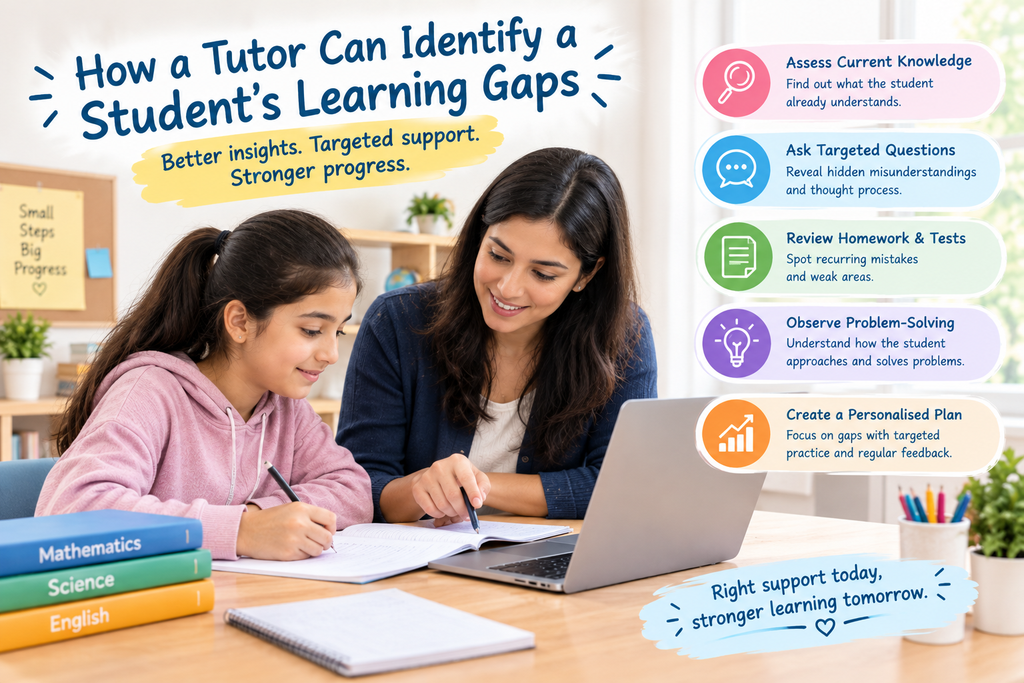
An effective online tutor can use questions, assessments, classroom observations, and practice activities to understand where a student needs help. In this guide, we explain how tutors identify learning gaps, which methods they use, and how parents can support their child’s academic progress.
Quick Answer: How Can a Tutor Identify a Student’s Learning Gaps?
A tutor can identify learning gaps by assessing a student’s existing knowledge, asking targeted questions, reviewing schoolwork, observing problem-solving methods, and using short quizzes or practice exercises.
Once the difficulties are identified, the tutor can revisit foundational concepts, adapt lesson plans, provide targeted practice, and monitor progress over time. Regular communication with parents and feedback from the student can also help ensure that the learning plan addresses the right needs.
1. Assessing the Student’s Existing Knowledge
The first step in identifying learning gaps is understanding what the student already knows. Before starting a new topic, a tutor should check whether the student understands the basic concepts required to learn it.
For example, before teaching algebra, a tutor may check the student’s understanding of multiplication, division, fractions, and basic equations. If the student struggles with these foundations, moving directly to advanced problems may create further confusion.
An initial assessment can include:
- Short quizzes covering previous topics.
- Questions about essential concepts.
- Simple problem-solving activities.
- Review of recently completed schoolwork.
- Discussion about subjects the student finds difficult.
The purpose is not to judge the student or create unnecessary pressure. It is to establish a starting point so lessons can focus on the areas where support is most useful.
2. Asking Targeted Questions During Lessons
Students may sometimes provide the correct answer without fully understanding the concept. Asking follow-up questions helps tutors discover whether the student understands the reasoning behind an answer.
For instance, a tutor teaching Science might ask a student to explain why a particular process occurs instead of asking them to memorise a definition. In Mathematics, the tutor might ask the student to describe the steps used to solve a problem.
Useful questions include:
- Can you explain how you reached this answer?
- Why did you choose this method?
- Can you solve the same problem in a different way?
- Which part of the question seems confusing?
- Can you explain this concept in your own words?
These questions reveal misunderstandings that may not appear in a final answer alone. They also encourage students to think independently and communicate their difficulties more clearly.
3. Reviewing Homework, Tests, and School Assignments
A student’s previous work can provide valuable clues about recurring learning difficulties. Incorrect answers, incomplete explanations, and repeated mistakes may indicate that certain concepts need further attention.
Tutors can review homework, class tests, worksheets, and examination papers to look for patterns.
For example, a student might consistently make errors when converting fractions into decimals. Rather than focusing only on correcting each answer, the tutor can investigate whether the student understands place value and equivalent fractions.
During this review, tutors should consider:
- Repeated mistakes across different assignments.
- Topics where the student frequently loses marks.
- Difficulty understanding written instructions.
- Errors caused by weak foundational knowledge.
- Problems applying a concept to unfamiliar questions.
A single mistake does not necessarily indicate a learning gap. Tutors should look for recurring patterns and ask the student to explain their thinking before deciding what needs attention.
4. Observing How the Student Solves Problems
The process a student follows can reveal more than the final answer. A tutor should observe how the student approaches a question, selects a method, and responds when something goes wrong.
For example, a student may know a formula but struggle to recognise when it should be used. Another student may understand a concept verbally but find it difficult to apply it independently.
An online tutor can observe these patterns during live problem-solving exercises, screen sharing, written work, and discussions.
Tutors should pay attention to whether the student:
- Understands what the question is asking.
- Selects an appropriate method.
- Follows steps in a logical order.
- Checks their own work.
- Can explain the reasoning behind an answer.
- Applies previously learned concepts to new problems.
This information helps tutors distinguish between a simple calculation error and a deeper misunderstanding that requires additional teaching.
5. Using Short Quizzes and Practice Exercises
Short assessments can help tutors check whether students have understood a topic before moving forward. These activities do not need to be formal examinations. They can include multiple-choice questions, short written answers, oral questions, or practical tasks.
For example, after teaching fractions, a tutor might provide a few questions that test equivalent fractions, addition, and comparison. The results can show which skills the student has mastered and which need further practice.
Effective practice activities should:
- Focus on specific learning objectives.
- Include questions of varying difficulty.
- Test understanding rather than memorisation alone.
- Provide opportunities for students to explain answers.
- Help tutors identify recurring errors.
Assessments should be used as learning tools, not as a reason to label students negatively. Their main purpose is to guide teaching decisions and identify the next steps.
6. Listening to the Student’s Own Concerns
Students often know which subjects or topics make them uncomfortable, even if they cannot explain the underlying problem. Some may find word problems difficult, struggle to remember scientific terminology, or feel anxious about reading aloud.
Tutors should encourage students to share these concerns in a supportive environment.
They can ask questions such as:
- Which topic do you find hardest at the moment?
- Is there anything from the previous lesson you would like to review?
- Do you understand the explanation, or would another example help?
- Which types of questions make you feel uncertain?
Student feedback provides useful context alongside assessments and observations. However, tutors should avoid assuming that a student knows exactly why they are struggling. A combination of discussion and assessment is usually more informative.
7. Creating a Personalised Learning Plan
Once learning gaps have been identified, the next step is to create a plan that addresses them in a manageable order.
A student who struggles with several related concepts may need to revisit foundational topics before moving to advanced material. Another student may understand the basics but require additional practice applying them in examinations.
A personalised plan may include:
- Revising prerequisite concepts.
- Breaking difficult topics into smaller steps.
- Providing targeted worksheets and exercises.
- Setting short-term learning goals.
- Scheduling regular revision.
- Gradually increasing question difficulty.
For example, if a student struggles with algebra because of weak fraction skills, the tutor can revise fractions first and then return to algebra problems.
Parents looking for the best online tuition class should consider whether the teaching approach identifies individual learning needs and adjusts lessons accordingly, rather than simply following a fixed schedule for every student.
8. Tracking Progress and Checking for Improvement
Identifying learning gaps is not a one-time task. Tutors need to check whether the student is improving and whether previously difficult concepts have become clearer.
Progress can be monitored through short quizzes, completed assignments, oral explanations, independent problem-solving, and regular revision.
A useful progress review should consider:
| Area to monitor | What the tutor can observe |
|---|---|
| Understanding | Can the student explain the concept accurately? |
| Accuracy | Are repeated mistakes becoming less frequent? |
| Independence | Can the student solve problems with less guidance? |
| Application | Can the student use the concept in new questions? |
| Confidence | Is the student more willing to attempt difficult tasks? |
| Retention | Can the student remember and apply the concept later? |
Progress may be gradual, and not every difficulty will disappear immediately. If a student continues to struggle, the tutor may need to change the explanation, revisit earlier concepts, or explore whether additional support is appropriate.
9. How Parents Can Help Identify Learning Gaps
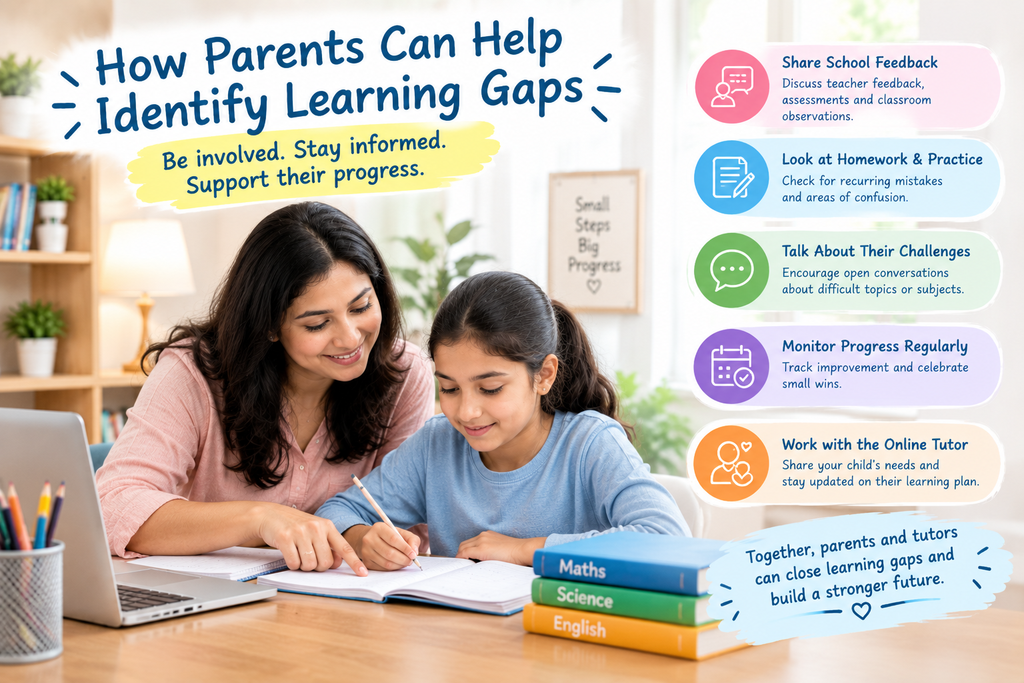
Parents can support the process by sharing information about their child’s school experience, homework habits, and academic concerns.
Helpful steps include:
- Reviewing feedback from school teachers.
- Discussing subjects the child finds challenging.
- Keeping examples of recurring homework mistakes.
- Encouraging the child to ask questions without fear.
- Sharing relevant test results with the tutor.
- Reviewing progress with the tutor regularly.
Parents should avoid comparing their child with siblings or classmates. Each student develops skills at a different pace, and comparisons can make it harder for children to discuss their difficulties openly.
For families considering the best online tuition class, clear communication between the tutor, student, and parents can help ensure that lessons remain focused on meaningful learning goals.
Frequently Asked Questions
1. What are learning gaps in students?
Learning gaps are areas where a student has not fully understood a concept or developed a skill needed for further learning. They may involve foundational knowledge, subject-specific concepts, or the ability to apply information independently.
2. How does a tutor identify learning gaps?
Tutors can use initial assessments, targeted questions, homework reviews, practice exercises, and observations of problem-solving methods. Combining these approaches helps reveal recurring misunderstandings.
3. Why is it important to identify learning gaps early?
Identifying learning gaps early can prevent foundational misunderstandings from affecting more advanced topics. It also helps tutors focus lesson time on the concepts a student needs to strengthen.
4. Can online tutoring help identify learning difficulties?
Yes. Live discussions, digital worksheets, quizzes, screen sharing, and reviewed assignments can help tutors understand a student’s knowledge and problem-solving approach. The effectiveness depends on the teaching method and the quality of assessment.
5. How can parents recognise learning gaps at home?
Parents may notice recurring homework mistakes, difficulty explaining school concepts, frustration with particular subjects, or dependence on frequent help. Discussing these observations with the child’s teacher or tutor can help clarify the underlying issue.
6. How long does it take to address learning gaps?
The time required depends on the number of gaps, their complexity, the student’s starting point, and the consistency of practice. Some concepts may improve quickly, while others require repeated revision and continued support.
7. How often should tutors assess student progress?
Tutors can check understanding during every lesson and use more structured reviews at suitable intervals. The frequency should reflect the student’s needs, the subject, and the learning goals.
8. What should parents look for when choosing a tutor?
Parents should consider subject expertise, teaching experience, communication skills, personalised lesson planning, and the ability to assess progress. They should also ask how the tutor identifies learning gaps and adapts lessons when a student struggles.
Conclusion
Learning gaps can affect a student’s understanding, confidence, and ability to progress through more advanced topics. Identifying them requires more than checking examination marks. Tutors need to assess existing knowledge, ask thoughtful questions, review schoolwork, observe problem-solving, and listen to the student’s concerns.
An effective online tutor can use this information to develop a personalised learning plan, provide targeted practice, and monitor progress over time. Parents can contribute by sharing observations, encouraging open communication, and reviewing learning goals with the tutor.
When comparing the best online tuition class options, focus on the quality of teaching, individual attention, and the methods used to identify and address learning needs. With consistent support and realistic goals, students can strengthen foundational skills, develop greater independence, and approach challenging subjects with more confidence.
Learn more about GenieClasses and our approach to supporting students through personalised online learning. Visit our About Us page.
Have questions about online learning options for your child? Connect with the GenieClasses team through our Contact Us page.