
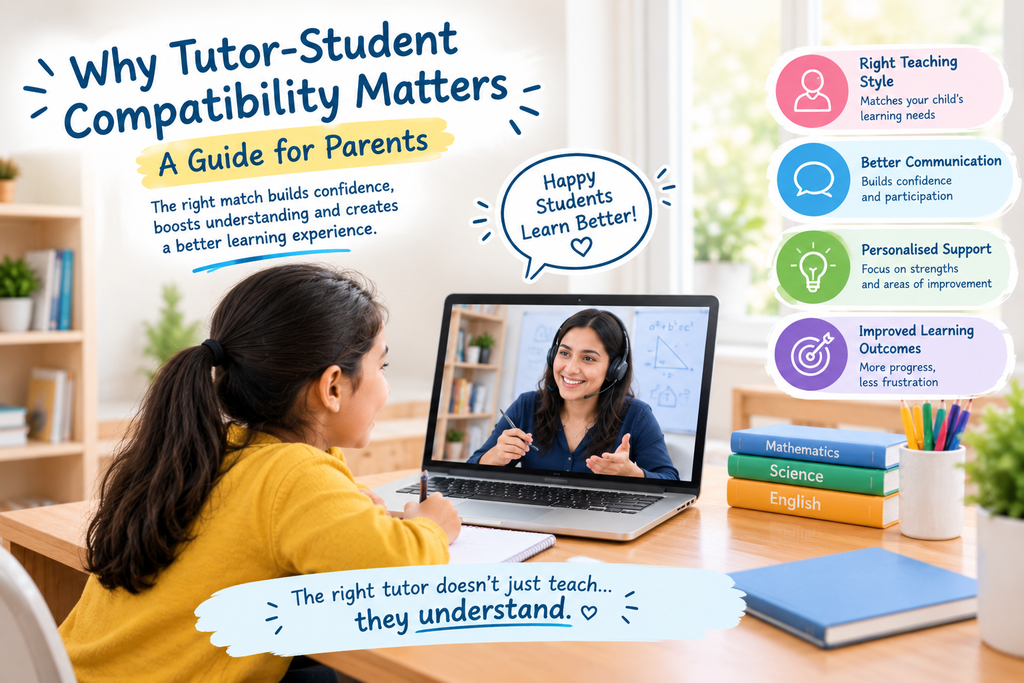
Every child learns differently. Some students understand new concepts quickly through visual examples, while others need step-by-step explanations, practice questions, or additional time to understand a topic. Because of these differences, choosing the right tutor involves more than checking qualifications or subject knowledge.
Tutor-student compatibility plays an important role in creating a comfortable and productive learning environment. When a student feels understood, respected, and encouraged, they may become more willing to ask questions, discuss difficulties, and participate actively in lessons.
An online tutor who understands a student’s learning needs can adapt explanations, adjust the pace of lessons, and provide appropriate guidance. This can help students develop confidence, strengthen their understanding, and build better study habits.
In this guide, we explain why tutor-student compatibility matters, what parents should look for, and how to identify a teaching relationship that supports their child’s academic growth.
Quick Answer: Why Does Tutor-Student Compatibility Matter?
Tutor-student compatibility matters because students learn more comfortably when a tutor’s teaching style, communication, pace, and approach match their individual needs.
A suitable learning relationship can encourage students to ask questions, overcome learning difficulties, participate in lessons, and develop confidence. Parents should consider subject expertise alongside communication skills, patience, flexibility, and their child’s comfort during a trial lesson.
1. Every Student Has Different Learning Needs
No two students have exactly the same learning preferences, strengths, or challenges. One child may need extra help with Mathematics fundamentals, while another may need support with reading comprehension, writing, or examination preparation.
A tutor who recognises these differences can adjust lessons instead of following the same method for every student.
For example, a student who struggles with fractions may benefit from diagrams and practical examples. Another student may understand the concept more effectively by working through several problems with guided explanations.
A suitable tutor should be able to identify these needs and plan lessons accordingly.
Parents should consider whether a tutor:
- Understands the student’s current academic level.
- Identifies topics that need additional attention.
- Adjusts lesson pace when necessary.
- Uses different examples to explain difficult concepts.
- Provides practice based on the student’s needs.
- Encourages questions and independent thinking.
When lessons address specific learning needs, students can focus on the areas where they need the most support.
2. The Right Teaching Style Can Improve Understanding
Teaching style is an important part of tutor-student compatibility. Some students prefer structured lessons with clear explanations, while others respond better to discussions, interactive activities, visual resources, or practical exercises.
A tutor does not necessarily need to use only one teaching method. The ability to adjust explanations according to the student’s response can make lessons more effective.
For example, a Science tutor might use diagrams to explain the human digestive system. An English tutor may combine reading activities, grammar exercises, and writing practice to strengthen language skills.
When choosing an online tutor, parents should observe whether the tutor:
- Explains concepts in simple language.
- Uses examples relevant to the student’s age and level.
- Checks understanding throughout the lesson.
- Changes the explanation when the student is confused.
- Encourages the student to explain ideas in their own words.
The goal is not simply to finish the syllabus. It is to help the student understand the material and apply that knowledge independently.
3. Compatibility Builds Confidence and Encourages Questions
Some students hesitate to ask questions because they worry about making mistakes or appearing less capable than their classmates. A supportive tutor can help create an environment where questions are welcomed and mistakes are treated as opportunities to learn.
When students feel comfortable communicating with their tutor, they may be more willing to explain what they do not understand.
This can help tutors identify learning gaps before those difficulties become more challenging.
A compatible tutor should:
- Listen patiently to the student’s concerns.
- Respond respectfully to incorrect answers.
- Encourage questions without judgment.
- Recognise effort and improvement.
- Provide constructive feedback.
- Help students approach difficult tasks with confidence.
Confidence develops gradually through practice, encouragement, and meaningful progress. A positive tutor-student relationship can support this process without creating unnecessary pressure.
4. Better Communication Makes Lessons More Productive
Effective communication works both ways. Tutors need to explain concepts clearly, but students also need to communicate their doubts, interests, and difficulties.
If a tutor speaks too quickly, uses unfamiliar terminology, or rarely checks understanding, a student may struggle even when the tutor has excellent subject knowledge.
Compatibility helps establish a communication style that works for both people.
Parents can look for signs such as:
- The student feels comfortable asking for clarification.
- The tutor listens carefully to answers.
- Instructions are clear and easy to follow.
- Feedback focuses on specific areas for improvement.
- The tutor encourages the student to participate.
- Learning difficulties are discussed constructively.
Clear communication can also help parents understand their child’s progress and decide whether the current learning plan is meeting expectations.
5. A Compatible Tutor Can Support Better Study Habits
Tutoring is not only about understanding individual subjects. It can also help students develop routines and strategies that support independent learning.
A tutor who understands a student’s habits and challenges can provide practical guidance on revision, time management, problem-solving, and regular practice.
For example, a student who frequently forgets mathematical formulas may benefit from short revision exercises. A student who struggles to complete written assignments may need help breaking larger tasks into smaller steps.
A supportive tutor can help students:
- Set realistic learning goals.
- Organise study time.
- Practise regularly.
- Review previous lessons.
- Identify and correct mistakes.
- Develop independent problem-solving skills.
These habits take time to establish. Parents should look for gradual improvements in consistency and independence rather than expecting immediate changes.
6. Compatibility Helps Reduce Learning Frustration
When a student’s learning needs and the tutor’s teaching approach do not align, lessons can become frustrating. A student may feel that explanations are too difficult, the pace is too fast, or there is insufficient opportunity to practise.
Sometimes, the problem is not a lack of ability or effort. The teaching approach may simply need to change.
A compatible tutor pays attention to signs of confusion and responds constructively.
For instance, if a student repeatedly struggles with a topic, the tutor might revisit foundational concepts, introduce simpler examples, or divide the topic into smaller sections.
Parents should notice whether their child:
- Understands explanations more clearly over time.
- Participates during lessons.
- Feels comfortable discussing difficulties.
- Shows willingness to practise.
- Becomes more confident when approaching challenging topics.
Occasional frustration is a normal part of learning, but persistent discomfort or confusion deserves attention and discussion.
7. How Can Parents Find the Right Tutor-Student Match?
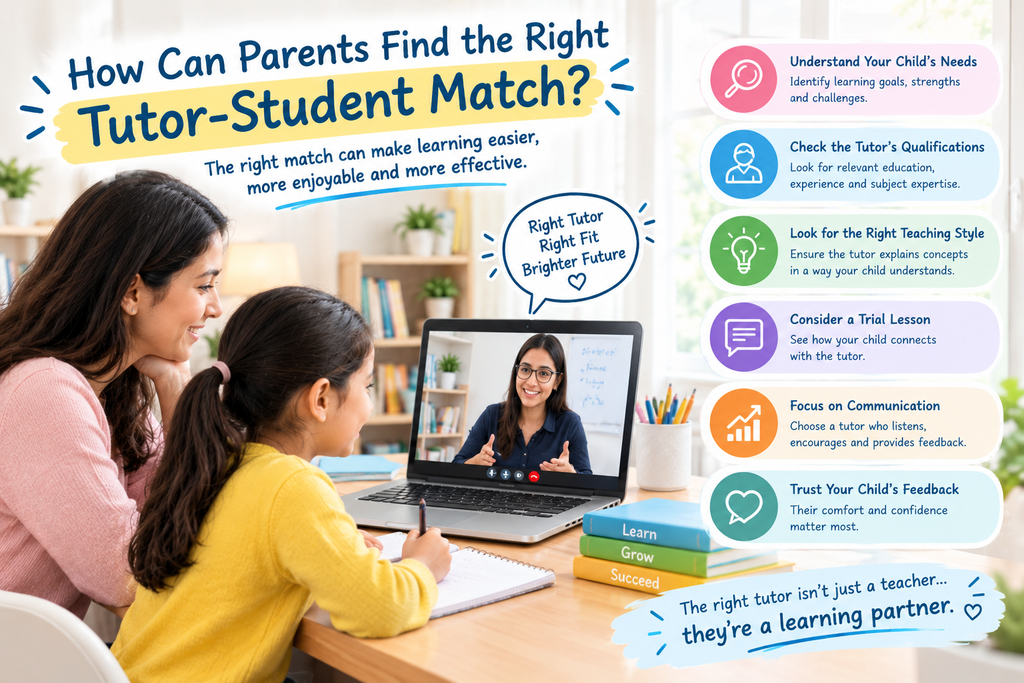
Finding a suitable tutor requires careful observation and communication. Parents can take several practical steps before committing to regular lessons.
Understand Your Child’s Needs
Identify the subjects your child finds difficult, their academic goals, and the kind of support they require. Consider whether they need help with basic concepts, homework, revision, or examination preparation.
Review the Tutor’s Experience
Check the tutor’s subject knowledge, qualifications, teaching experience, and familiarity with the relevant grade level or curriculum.
Observe a Trial Lesson
A trial lesson can help parents evaluate how the tutor explains concepts, responds to questions, and adapts to the student’s learning level.
Ask for Your Child’s Feedback
After the session, ask your child whether they understood the lesson and felt comfortable participating. Their feedback is an important part of the decision.
Monitor Progress Over Time
Once lessons begin, review progress through practice work, assessments, participation, and feedback from the tutor. If the current approach is not working, discuss possible adjustments.
GenieClasses offers online learning options that include one-on-one live sessions and group classes, allowing families to explore different formats according to their learning needs. The platform also highlights free demo classes, customized worksheets, guided corrections, and learning insights.
8. Signs That a Tutor-Student Relationship Is Working
A good match does not mean every lesson will be easy. Students still need to practise, work through challenging concepts, and learn from mistakes.
However, several signs may indicate that the learning relationship is productive.
| What to observe | Positive signs |
|---|---|
| Communication | The student feels comfortable asking questions. |
| Understanding | Concepts become clearer with explanations and practice. |
| Participation | The student contributes during lessons. |
| Confidence | The student is increasingly willing to attempt difficult tasks. |
| Learning habits | Revision and practice become more consistent. |
| Feedback | The tutor explains strengths and areas for improvement. |
| Progress | The student gradually works toward their learning goals. |
Progress can look different for every child. Parents should consider the student’s starting point, learning goals, and development over time rather than relying on a single test result.
9. Common Mistakes Parents Should Avoid
When choosing a tutor, parents can avoid several common mistakes:
- Focusing only on qualifications: Subject expertise is important, but communication and adaptability also matter.
- Ignoring the child’s opinion: A student’s comfort and willingness to participate can influence the learning experience.
- Expecting instant improvement: Academic development usually requires consistent lessons and independent practice.
- Choosing a teaching style that feels unsuitable: A tutor should be willing to adjust explanations when necessary.
- Overlooking communication with parents: Regular feedback helps families understand progress and address difficulties.
- Continuing without reviewing results: If lessons are not meeting the student’s needs, discuss changes to the teaching approach or consider another tutor.
The aim is to find a tutor who supports both academic development and a positive attitude toward learning.
Frequently Asked Questions
1. What is tutor-student compatibility?
Tutor-student compatibility refers to how well a tutor’s teaching style, communication, pace, and approach match a student’s learning needs and preferences.
2. Why is compatibility important when choosing an online tutor?
Compatibility can help students feel comfortable asking questions, understand explanations, participate actively, and develop confidence. It also helps tutors adapt lessons to individual learning needs.
3. How can parents check whether a tutor is suitable for their child?
Parents can review the tutor’s qualifications and experience, arrange a trial lesson where available, ask the child for feedback, and monitor progress after regular lessons begin.
4. Can a good tutor improve a student’s confidence?
A supportive tutor can help build confidence by encouraging questions, recognising effort, explaining mistakes constructively, and helping students develop their skills through practice.
5. What if my child does not get along with their tutor?
First, try to understand the reason. Discuss the issue with the tutor and consider whether changes to communication, lesson pace, or teaching methods may help. If the mismatch continues, exploring another tutor may be appropriate.
6. Is teaching style more important than a tutor’s qualifications?
Both matter. Qualifications and subject knowledge help establish expertise, while teaching style and communication influence how effectively that knowledge is shared with the student.
7. How long does it take to know whether a tutor is a good match?
A trial lesson may provide initial insights, but compatibility often becomes clearer over several sessions. Parents should observe comfort, participation, understanding, and progress over time.
8. Does tutor-student compatibility guarantee better grades?
No. Compatibility can support effective learning, but academic outcomes also depend on attendance, practice, motivation, prior knowledge, school requirements, and other individual factors.
Conclusion
Tutor-student compatibility is an important part of a positive learning experience. When students feel understood and supported, they may become more confident, communicate their difficulties openly, and engage more actively with their studies.
Choosing the right online tutor means looking beyond qualifications alone. Parents should consider teaching style, communication, patience, adaptability, curriculum knowledge, and their child’s comfort during lessons.
Start by identifying your child’s learning needs, observe a trial lesson if available, and review progress regularly. If a teaching approach is not working, communicate with the tutor and explore adjustments.
A suitable tutor-student match can help create a learning environment where children feel encouraged to ask questions, practise consistently, and develop the skills they need to become more independent learners.
Learn more about GenieClasses, our approach to personalized online learning, and how we support students in their academic journey. Visit our About Us page.
Have questions about our online learning options? Get in touch with the GenieClasses team for more information and assistance. Visit our Contact Us page.