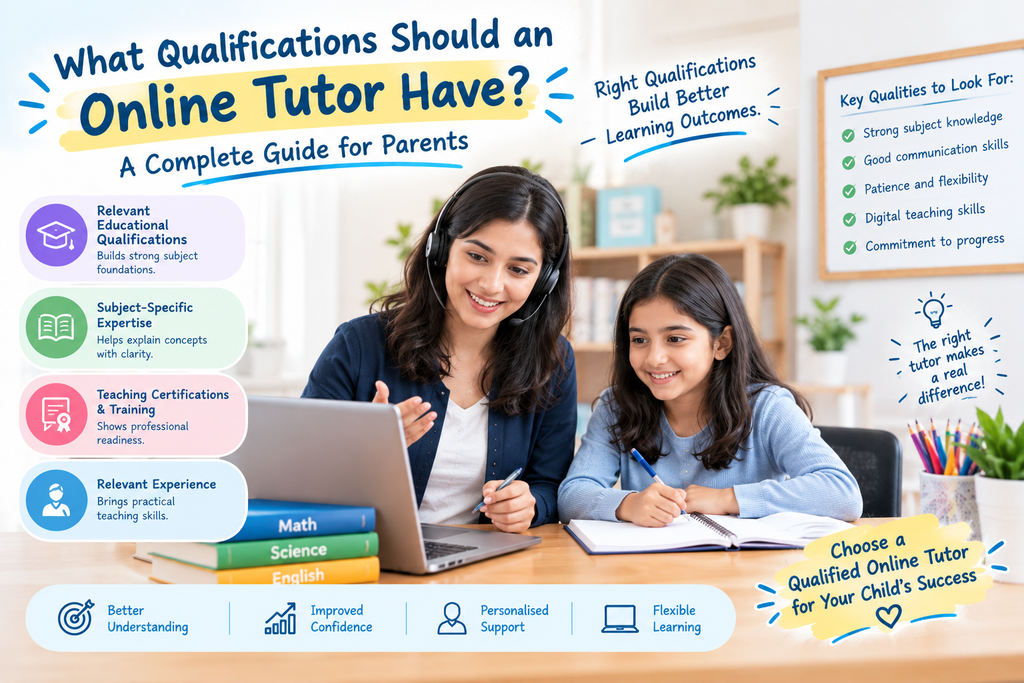
Choosing the right tutor can make a meaningful difference in a child’s educational journey. A knowledgeable teacher can help students understand difficult concepts, strengthen their subject knowledge, and develop confidence in their abilities. However, parents often wonder what qualifications they should check before selecting an online tutor for their child.
Academic degrees and teaching certificates are important considerations, but they are not the only indicators of teaching quality. Subject expertise, practical experience, communication skills, patience, and the ability to adapt lessons to individual learning needs also matter.
In this guide, we explain the essential qualifications and skills parents should look for when choosing an online tutor, along with practical tips for evaluating a tutor before enrolling their child.
Quick Answer: What Qualifications Should an Online Tutor Have?
An online tutor should have strong knowledge of the subject they teach, relevant educational qualifications or demonstrated expertise, and the ability to explain concepts clearly. Teaching experience, familiarity with the student’s curriculum, digital teaching skills, and effective communication are also valuable.
The exact qualifications required depend on the subject, grade level, curriculum, and type of tutoring. Parents should check credentials where applicable and evaluate the tutor’s actual teaching ability through a trial lesson, references, or other available evidence.
1. Relevant Educational Qualifications
Educational qualifications can help parents understand whether a tutor has studied the subject they intend to teach.
For example, a tutor teaching advanced Mathematics may have a degree in Mathematics, Engineering, or a related field. A tutor teaching English may have a qualification in English, literature, language education, or a relevant teaching discipline.
For younger students, a background in primary education or elementary teaching can be useful because teaching foundational skills requires a different approach from teaching advanced academic subjects.
When reviewing an online tutor’s educational background, consider:
- Relevant degrees, diplomas, or academic qualifications.
- Subject-specific certifications, where applicable.
- Teacher training or recognised teaching credentials, if relevant to the role.
- Additional qualifications related to the student’s curriculum.
- Evidence that the tutor has maintained their subject knowledge.
Keep in mind that qualification requirements differ across countries, subjects, institutions, and tutoring arrangements. A teaching degree may be required for some roles but not for every private tutoring arrangement.
2. Strong Subject Knowledge and Expertise
A qualification is useful, but the tutor must also understand the subject thoroughly. Students often ask unexpected questions or need a concept explained in a different way. A tutor with strong subject knowledge can respond accurately and help students understand the reasoning behind an answer.
For instance, a Science tutor should be able to explain scientific principles using examples, while a Mathematics tutor should show the steps involved in solving a problem rather than simply provide the final answer.
Before choosing a tutor, parents should consider whether the tutor can:
- Explain fundamental concepts clearly.
- Solve subject-related problems accurately.
- Answer questions with confidence and clarity.
- Identify common student misconceptions.
- Provide relevant examples and practice exercises.
- Teach the required grade level or examination syllabus.
Strong subject expertise is particularly important for students preparing for examinations or studying demanding curricula such as CBSE, ICSE, Cambridge IGCSE, A Levels, or the International Baccalaureate (IB).
3. Relevant Teaching Experience
Experience helps a tutor understand the challenges students commonly face. An experienced teacher may recognise when a student is struggling with a basic concept that affects their understanding of more advanced topics.
However, the number of years spent teaching should not be the only factor in your decision. A newer tutor may also be effective if they have strong subject knowledge, good communication skills, and a suitable teaching approach.
When evaluating teaching experience, ask:
- Which grades and age groups have you taught?
- Have you taught this subject or curriculum before?
- How do you support students who struggle with particular topics?
- How do you prepare students for tests and examinations?
- How do you assess whether a student understands a lesson?
The most relevant experience is experience that matches your child’s academic needs. For example, a tutor who specialises in primary Mathematics may not be the ideal choice for advanced secondary-level Physics.
4. Understanding of the Student’s Curriculum
Curriculum knowledge is especially important when a student follows a particular school board or international education programme.
Different curricula may use different assessment methods, subject structures, terminology, and examination expectations. A tutor who understands the student’s syllabus can organise lessons around the relevant learning objectives.
Parents should check whether the tutor has experience with the child’s:
- School board or international curriculum.
- Grade level and subject syllabus.
- Examination format and assessment criteria.
- Homework and assignment requirements.
- Learning goals and upcoming assessments.
If your child studies an international curriculum, ask the tutor about their familiarity with the relevant course content and examination style. This can help ensure that lessons complement school learning rather than follow an unrelated programme.
5. Clear Communication and Explanation Skills
Subject knowledge alone does not guarantee effective teaching. A tutor must be able to communicate that knowledge in a way the student understands.
A good teacher can explain a complicated idea using simpler language, examples, diagrams, or step-by-step demonstrations. They should also listen carefully to questions and encourage students to speak when they are confused.
Look for a tutor who:
- Uses age-appropriate language.
- Explains concepts in a structured way.
- Welcomes questions without making students uncomfortable.
- Checks understanding instead of assuming the student has learned.
- Provides constructive feedback.
- Communicates progress and concerns to parents when appropriate.
During a trial session, notice whether your child can follow the explanation and feels comfortable asking questions. These observations can tell you more about the tutor’s practical teaching ability than a qualification list alone.
6. Patience, Adaptability, and Personalised Teaching
Every student learns at a different pace. Some understand a concept quickly, while others need extra examples, revision, or guided practice.
An effective online tutor should be patient and willing to adjust the lesson when a student struggles. Rather than repeating the same explanation, they should try a different example or teaching method.
For example, a student who finds fractions difficult may benefit from visual diagrams and practical examples. Another student may learn better by solving several problems with step-by-step guidance.
Parents should look for tutors who can:
- Recognise individual learning difficulties.
- Adjust lesson pace according to student needs.
- Provide additional practice where necessary.
- Encourage independent thinking.
- Set realistic learning goals.
- Help students learn from mistakes.
Personalised teaching can make lessons more relevant and help children build confidence over time.
7. Digital Teaching and Technology Skills
An online tutor needs more than subject expertise. They should also be comfortable using digital tools to deliver lessons effectively.
A well-managed online lesson should be organised, interactive, and easy for the student to follow. Tutors may use digital whiteboards, screen sharing, presentations, online worksheets, quizzes, or other learning resources depending on the subject.
Useful digital teaching skills include:
- Managing live video lessons.
- Explaining concepts using digital whiteboards.
- Sharing educational resources and assignments.
- Using interactive tools appropriately.
- Managing lesson time effectively.
- Handling basic technical issues.
Technology should support learning rather than distract from it. Parents can observe a trial lesson to see whether the tutor uses digital resources purposefully and keeps the student involved.
8. Professionalism, Reliability, and Communication With Parents
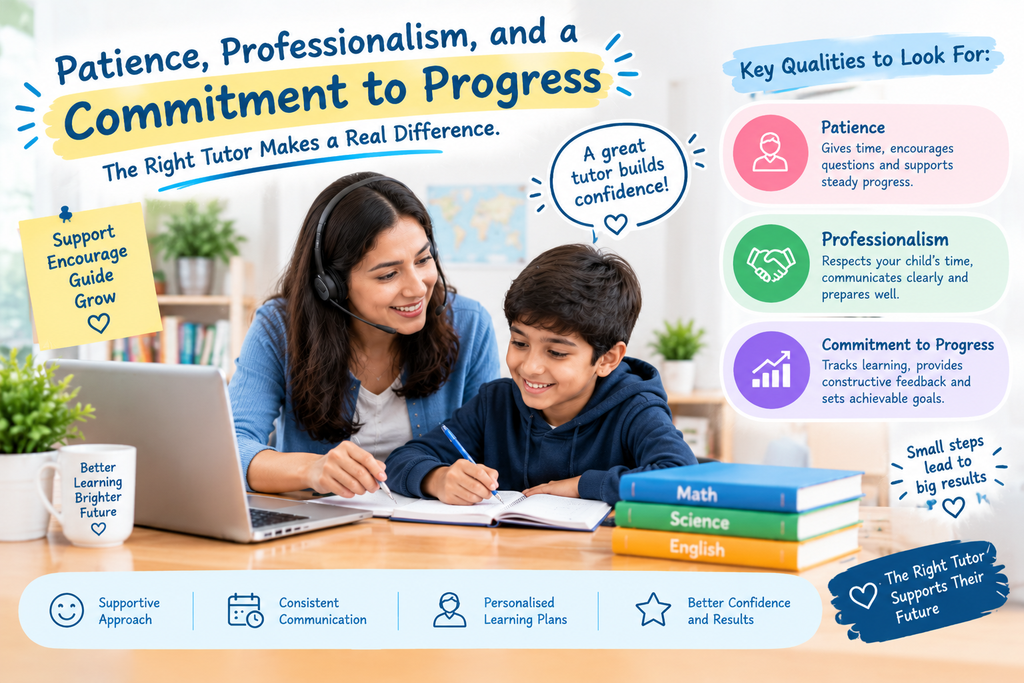
Professional behaviour is another important factor when selecting an online tutor. Students benefit from consistent lessons, clear expectations, and a respectful learning environment.
A professional tutor should arrive on time, prepare lessons, follow agreed schedules, and communicate changes promptly. They should also respect student privacy and maintain appropriate professional boundaries.
Parents can check whether the tutor:
- Provides clear information about qualifications and experience.
- Explains lesson schedules and expectations.
- Communicates progress honestly.
- Gives useful feedback on strengths and learning gaps.
- Respects privacy and appropriate boundaries.
- Follows the platform’s relevant policies and procedures.
Where tutoring involves children, parents should also ask about relevant identity verification, safeguarding practices, and any background checks that may apply. Do not assume that every tutor or platform follows the same verification process.
9. How Can Parents Verify an Online Tutor’s Qualifications?
Before committing to regular lessons, take a few practical steps to evaluate the tutor.
Step 1: Review the tutor’s profile. Check their education, subject expertise, experience, and any listed certifications.
Step 2: Ask relevant questions. Clarify their experience with your child’s grade, syllabus, and academic goals.
Step 3: Request supporting evidence where appropriate. Depending on the qualification, this may include certificates, professional credentials, or references.
Step 4: Arrange a trial lesson if available. Observe how the tutor explains concepts, answers questions, and adapts to your child’s needs.
Step 5: Discuss progress tracking. Ask how the tutor will identify learning gaps and share feedback about improvement.
GenieClasses helps families explore tutors and their teaching profiles to find options suited to their learning needs. Parents can learn more about the platform on the GenieClasses website and review its About Us page.
10. Common Mistakes to Avoid When Choosing a Tutor
Parents can make a more informed decision by avoiding these common mistakes:
- Choosing based only on degrees: Qualifications matter, but communication and teaching ability matter too.
- Ignoring curriculum experience: A tutor should understand the syllabus relevant to the student’s needs.
- Assuming more experience always means better teaching: Evaluate the quality and relevance of the tutor’s experience.
- Skipping the trial lesson: When available, a trial can reveal how the tutor interacts with your child.
- Overlooking professionalism: Reliability, respectful communication, and privacy practices are important.
- Expecting immediate results: Progress usually requires consistent teaching, practice, and feedback.
The right tutor should combine subject expertise with a teaching approach that helps your child understand, practise, and improve steadily.
Frequently Asked Questions
1. What qualifications should an online tutor have?
An online tutor should have strong subject knowledge and relevant educational qualifications, certifications, or demonstrated expertise. Teaching experience and familiarity with the student’s curriculum can also be valuable.
2. Is a teaching degree necessary to become an online tutor?
Not always. Requirements depend on the country, subject, role, and tutoring arrangement. Some positions require recognised teaching credentials, while other tutoring roles focus on subject expertise, experience, and teaching ability.
3. Is subject knowledge more important than teaching experience?
Both are important. Subject knowledge helps a tutor provide accurate explanations, while teaching experience can help them identify learning difficulties and adapt lessons. Parents should evaluate both alongside communication skills.
4. How can parents check an online tutor’s qualifications?
Parents can review the tutor’s profile, ask about educational background and certifications, request supporting evidence where appropriate, and check references if available. A trial lesson can help evaluate practical teaching skills.
5. Should an online tutor have experience with a specific curriculum?
Ideally, yes, particularly when the student follows a specialised syllabus or prepares for curriculum-specific examinations. Familiarity with the syllabus helps the tutor align lessons with school requirements and assessment expectations.
6. What digital skills should an online tutor have?
An online tutor should be able to manage video lessons, use digital teaching tools, share learning materials, explain concepts clearly on screen, and maintain an interactive classroom environment.
7. How do I know whether a tutor is right for my child?
Look for clear explanations, patience, relevant subject expertise, suitable teaching methods, and a comfortable learning environment. Your child’s feedback and progress over time can help you determine whether the tutor is a good fit.
8. Where can parents find qualified online tutors?
Parents can explore tutoring platforms such as GenieClasses, review tutor profiles, compare relevant experience, and check available trial-session options before deciding. Always confirm the details that matter for your child’s learning needs.
Conclusion
Choosing a tutor involves more than checking degrees or counting years of experience. Parents should consider subject knowledge, relevant qualifications, curriculum familiarity, communication skills, patience, digital teaching ability, and professionalism.
When evaluating an online tutor, focus on whether they can explain concepts clearly, adapt lessons to your child’s needs, and provide useful feedback about learning progress. A trial lesson, where available, can help you assess these qualities before making a commitment.
To explore tutoring options, visit GenieClasses. You can learn more about the platform through the About Us page or contact the team through the Contact Us page to ask questions about available learning options.
The right tutor can support your child’s learning journey by building understanding, encouraging curiosity, and helping them develop confidence one lesson at a time.