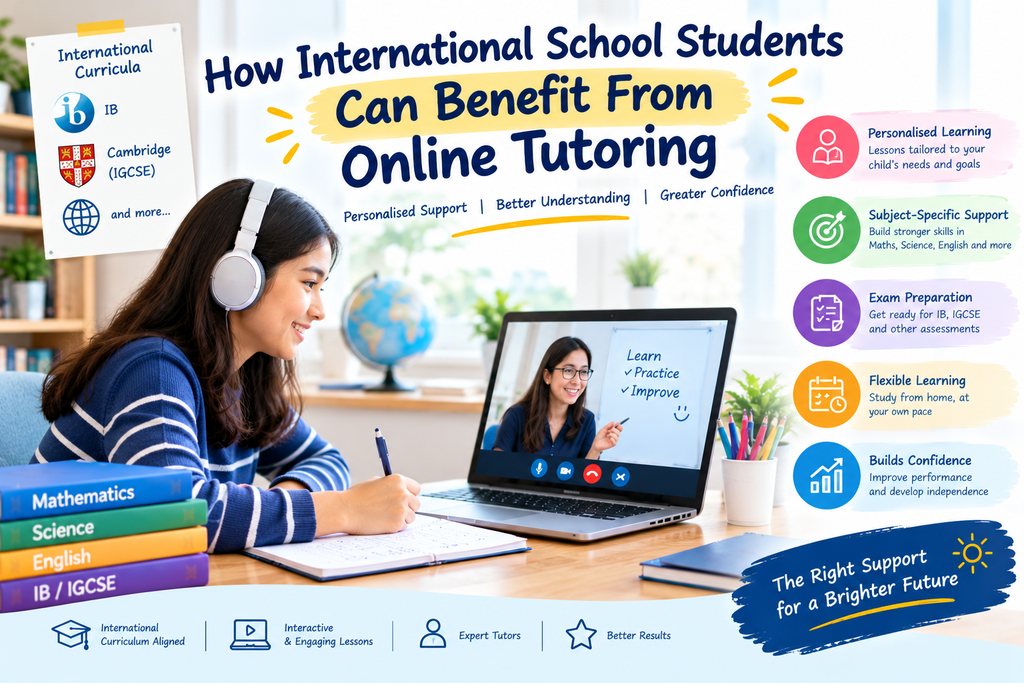
Online tutoring helps international school students receive personalised academic support, understand challenging concepts, prepare for curriculum-specific assessments, and develop independent learning skills. Whether students follow the International Baccalaureate (IB), Cambridge, IGCSE, or another international curriculum, online lessons can offer greater flexibility, focused subject guidance, and opportunities to strengthen academic confidence.
Introduction
International school students often follow academic programmes that emphasise critical thinking, independent learning, research, and practical application. While these approaches help students develop valuable skills, they can also present challenges when a subject becomes difficult or schoolwork starts to feel overwhelming.
Students may need additional help with Mathematics, Science, English, essay writing, research projects, or examination preparation. In such situations, online tutoring can provide targeted support that complements classroom learning.
Choosing the best online tuition class can help students revisit difficult topics, practise problem-solving techniques, and receive guidance suited to their curriculum and learning pace. For parents, online tutoring also offers a convenient way to support their children’s academic progress without adding unnecessary travel time to an already busy schedule.
1. Personalised Learning for Different International Curricula
One of the main benefits of online tutoring is the opportunity to tailor lessons to a student’s academic needs. International schools may follow different curricula, assessment systems, and teaching approaches. A student studying IB Mathematics may require a different type of support from someone preparing for Cambridge IGCSE examinations.
A suitable tutor can identify areas where the student needs improvement and structure lessons accordingly.
Personalised tutoring may include:
- Revising concepts that were difficult to understand in class.
- Adjusting lesson pace according to the student’s progress.
- Providing curriculum-relevant practice questions.
- Explaining complex topics using examples and step-by-step methods.
- Supporting subject-specific assignments and revision plans.
This focused approach can make learning more manageable and help students build a stronger foundation before moving on to advanced topics.
2. Better Understanding of IB, IGCSE, and Cambridge Subjects
International curricula often require students to apply knowledge rather than simply memorise information. They may need to interpret data, explain scientific reasoning, construct well-supported arguments, or solve unfamiliar problems.
Online tutoring can help students practise these skills through guided examples and structured feedback.
For example, a Mathematics tutor can help a student understand how to approach multi-step problems, while a Science tutor can explain difficult concepts and help the student practise applying them. English tutoring may focus on reading comprehension, analytical writing, grammar, and essay structure.
Students following different programmes can explore suitable resources through the official International Baccalaureate website and Cambridge International website.
The goal is to complement classroom teaching and help students become more confident in applying what they learn.
3. Flexible Learning Around a Busy School Schedule
International school students often balance lessons, homework, extracurricular activities, sports, projects, and examination preparation. Finding time for additional academic support can therefore be challenging.
Online tutoring allows families to arrange lessons around school and personal commitments, subject to tutor availability.
This flexibility can help students:
- Attend lessons from home.
- Schedule additional revision before assessments.
- Focus on one challenging subject at a time.
- Avoid unnecessary travel to a tuition centre.
- Maintain a more organised weekly study routine.
When selecting the best online tuition class, parents should look for a schedule that supports consistent learning without leaving the student exhausted or overcommitted.
4. Stronger Exam Preparation and Assessment Skills
Assessment formats differ across international programmes. Some examinations emphasise structured answers and subject knowledge, while other tasks may require analysis, evaluation, research, or the application of concepts to unfamiliar situations.
Online tutors can help students understand the expectations of their particular course and practise appropriate assessment techniques.
Useful preparation activities may include:
- Reviewing important syllabus topics.
- Working through suitable past-paper questions where available.
- Practising time management during timed exercises.
- Learning how to structure written answers.
- Identifying recurring mistakes and reviewing them.
- Developing a realistic revision timetable.
Tutoring cannot guarantee higher grades, but regular practice and constructive feedback can help students prepare more effectively and identify areas that need further attention.
5. Individual Attention and Immediate Feedback
In a classroom, teachers need to divide their attention among multiple students. Some learners may hesitate to ask questions when they are confused, particularly if they feel they are falling behind.
Online tutoring creates an opportunity for students to discuss doubts directly with a tutor. Lessons can focus on the specific concepts the student finds difficult, rather than spending equal time on topics they already understand.
For example, if a student understands a scientific theory but struggles to answer application-based questions, the tutor can dedicate more time to practical examples and question-solving strategies.
Timely feedback also helps students recognise mistakes and understand how to correct them. Over time, this can encourage more active participation and independent problem-solving.
6. Improved Confidence and Independent Learning
Academic confidence is important for students studying demanding international programmes. When students repeatedly struggle with a subject, they may begin to doubt their abilities or avoid challenging questions.
A supportive tutor can break complex topics into smaller steps and help students practise until they understand the underlying ideas.
Online tutoring can also encourage independent learning by helping students develop habits such as:
- Setting achievable study goals.
- Reviewing lessons regularly.
- Asking clear and specific questions.
- Checking answers and learning from mistakes.
- Managing assignments and revision deadlines.
- Identifying when they need additional support.
These habits are useful beyond examinations. They can help students approach future academic challenges with greater responsibility and confidence.
7. Convenient Access to Subject Specialists
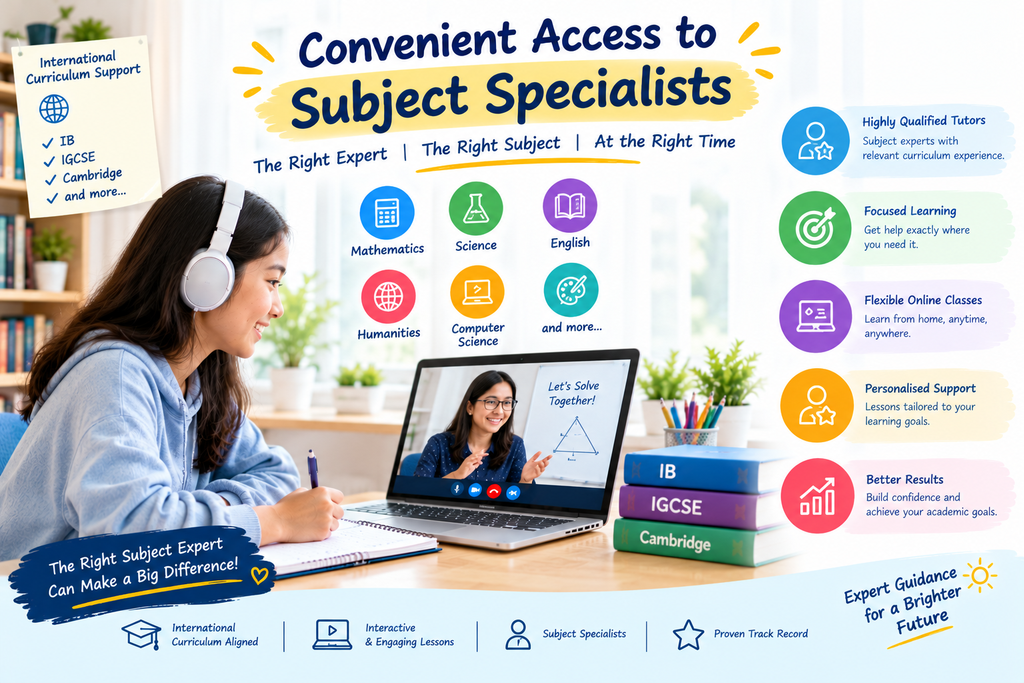
Depending on their location, school, and subject requirements, families may find it difficult to access a suitable tutor with experience in a particular international curriculum.
Online learning can widen the range of tutors a family can consider, although availability and curriculum expertise should always be checked.
Parents should look for tutors who understand the relevant syllabus, assessment requirements, and age group. It is also worth asking whether the tutor has experience supporting students with similar academic goals.
Before choosing a tutor, review the qualities discussed in our guide to what makes a good online tutor for school students.
The right match depends not only on subject knowledge but also on communication, teaching style, reliability, and the student’s comfort level.
8. Regular Progress Monitoring for Parents
Parents often want to understand whether additional tuition is helping their child. Online tutoring can make progress easier to discuss when tutors provide regular feedback and clear learning goals.
Depending on the service, progress monitoring may include:
- Reviewing performance in practice questions.
- Identifying topics that require additional revision.
- Tracking completed learning goals.
- Discussing strengths and areas for improvement.
- Adjusting future lessons according to progress.
Parents should ask prospective tutors how feedback is shared and how often progress is reviewed. Clear communication helps families understand what the student is working on and where further support may be useful.
How to Choose the Right Online Tutoring Support
Before enrolling, parents should consider the student’s curriculum, subjects, learning needs, schedule, and academic goals.
Here are some important factors to evaluate:
Curriculum knowledge: Confirm that the tutor understands the student’s specific programme, such as IB, IGCSE, or Cambridge.
Teaching approach: Look for explanations, examples, practice, and feedback that suit the student’s needs.
Personalisation: Ask whether lessons can focus on the student’s current difficulties and upcoming assessments.
Technology and resources: Check that the student has a suitable device, a stable internet connection, and access to the required learning materials.
Communication: Understand how the tutor will share progress updates and discuss areas for improvement.
Practical fit: Compare lesson timings, fees, session frequency, and cancellation arrangements before making a decision.
Parents exploring the best online tuition class should prioritise teaching quality and suitability rather than relying on price or promotional claims alone.
To learn more about the available support, visit the GenieClasses website, read more about GenieClasses, or contact the team to discuss your child’s learning requirements.
Frequently Asked Questions (FAQs)
1. Is online tutoring suitable for international school students?
Yes. Online tutoring can suit students following IB, IGCSE, Cambridge, and other international programmes when lessons are aligned with their curriculum, academic level, and learning needs.
2. Which subjects can international school students study online?
Students may receive online support in Mathematics, Physics, Chemistry, Biology, English, and other subjects, depending on tutor availability and the curriculum being followed.
3. Can online tutoring help IB and IGCSE students prepare for exams?
Online tutors can help students revise syllabus topics, practise relevant questions, improve answer structure, and develop time-management strategies. The usefulness of tutoring depends on the quality of instruction and the student’s regular practice.
4. How often should an international school student attend online tutoring?
The ideal frequency depends on the student’s goals, current understanding, workload, and upcoming assessments. Some students may benefit from weekly lessons, while others may need more frequent sessions during revision periods.
5. What should parents look for in an international curriculum tutor?
Parents should consider curriculum knowledge, subject expertise, communication skills, teaching methods, flexibility, and the ability to provide useful feedback on progress.
6. Is online tutoring better than classroom tuition?
Neither option is automatically better for every student. Online tutoring offers convenience and access to a wider range of tutors, while classroom tuition may suit students who prefer in-person interaction. The best choice depends on the learner’s preferences and requirements.
7. How can parents measure progress through online tutoring?
Parents can review practice-question performance, topic understanding, feedback from the tutor, completion of learning goals, and the student’s confidence in handling independent work.
8. How do I choose the best online tuition class for my child?
Start by identifying your child’s curriculum, subjects, and areas of difficulty. Then compare tutors based on relevant experience, teaching approach, lesson flexibility, feedback practices, and overall suitability.
Conclusion
Online tutoring can be a valuable source of additional academic support for international school students. From understanding complex concepts and preparing for assessments to building confidence and developing independent study habits, personalised lessons can complement the learning taking place at school.
The key is to choose support that matches the student’s curriculum, academic goals, and individual learning needs. With suitable guidance, consistent practice, and regular feedback, students can approach their studies in a more organised and confident way.
If you are exploring the best online tuition class for your child, begin by identifying the subjects where extra support would be most useful and choose a tutor who can provide a clear, personalised learning plan.
Discover our teaching approach and learn how GenieClasses supports students with personalised online learning and academic guidance by visiting our About Us page.
Looking for the right online tutoring support for your child? Contact GenieClasses to discuss your child’s curriculum, subject requirements, and individual learning goals.