Quick Answer: What Is the Difference Between IB and IGCSE?
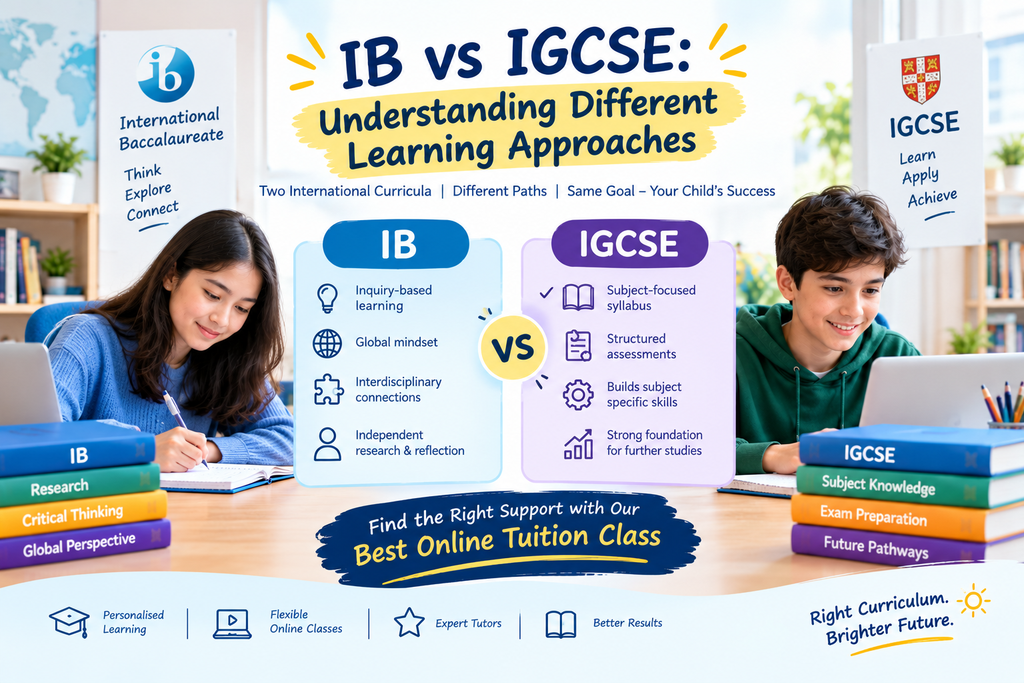
The International Baccalaureate (IB) and International General Certificate of Secondary Education (IGCSE) are international education programmes, but they differ in structure, assessment, and learning approach. The IB places strong emphasis on inquiry, reflection, connections between subjects, and independent learning, particularly in the Diploma Programme. IGCSE generally focuses on subject-specific knowledge, understanding, and applying concepts through a structured syllabus and assessments.
The right choice depends on a student’s learning style, academic goals, preferred subjects, and future education plans.
Key Takeaways
- IB encourages inquiry, critical thinking, reflection, and connections between subjects.
- IGCSE provides structured subject-based learning with clearly defined syllabuses.
- Assessment methods vary by programme, subject, and school.
- Neither curriculum is automatically better for every student.
- Online tutoring can help students adapt to the expectations of their chosen curriculum.
- Parents should compare subject options, workload, assessment requirements, and future academic pathways before deciding.
Introduction
Choosing an international curriculum is an important decision for students and parents. Schools offering international education may provide different programmes, each designed to develop academic knowledge and learning skills in its own way.
Two widely recognised options are the International Baccalaureate (IB) and the International General Certificate of Secondary Education (IGCSE). While both aim to prepare students for further education, their structures and expectations can differ significantly.
Some students enjoy exploring ideas, conducting investigations, and connecting concepts across subjects. Others prefer a clearly structured syllabus that allows them to focus deeply on individual subjects and prepare systematically for assessments.
Understanding IB vs IGCSE can help parents identify which learning environment may suit their child’s strengths and long-term goals. Additional academic support, including the best online tuition class for a student’s specific needs, can also make it easier to manage the expectations of either programme.
1. Understanding the IB Curriculum
The International Baccalaureate offers several educational programmes, including the Primary Years Programme (PYP), Middle Years Programme (MYP), Diploma Programme (DP), and Career-related Programme (CP).
The learning approach depends on the programme and age group. However, IB education is widely associated with inquiry-based learning, reflection, international-mindedness, and the development of independent thinking.
Inquiry and critical thinking
IB students are encouraged to ask questions, investigate topics, evaluate information, and explain their reasoning. Rather than focusing only on remembering facts, students may be asked to analyse evidence and develop their own interpretations.
Connections between subjects
IB learning can encourage students to recognise relationships between different areas of knowledge. This helps them understand how academic concepts connect to real-world situations.
Independent research and reflection
In the Diploma Programme, students complete specific core components, including Theory of Knowledge (TOK), the Extended Essay (EE), and Creativity, Activity, Service (CAS). These components contribute to the programme’s emphasis on reflection, research, and personal development.
Students who enjoy exploring ideas and taking responsibility for their learning may appreciate this approach. However, they also need to manage deadlines, research tasks, and subject requirements effectively.
For official programme information, visit the International Baccalaureate website.
2. Understanding the IGCSE Curriculum
The International General Certificate of Secondary Education (IGCSE) is a subject-based qualification offered by examination boards, including Cambridge International. Specific structures and assessment arrangements depend on the awarding organisation and subject.
IGCSE courses generally have defined syllabuses that outline the knowledge, skills, and topics students are expected to study.
Structured subject learning
Students study individual subjects such as Mathematics, English, Biology, Chemistry, Physics, and Humanities, depending on their school’s offerings and chosen subjects.
This structure helps learners understand what each subject requires and plan their preparation around the relevant syllabus.
Subject-specific understanding
IGCSE students develop knowledge and skills within individual disciplines. Depending on the subject, they may need to explain concepts, interpret information, solve problems, complete practical work, or apply knowledge to unfamiliar questions.
Assessment preparation
Assessment methods vary by subject and examination board. They may include written examinations, coursework, practical assessments, or other specified components where applicable.
Students often benefit from reviewing syllabus requirements, practising relevant question types, and learning how to present answers clearly.
IGCSE can suit students who appreciate clear subject objectives and systematic preparation. However, it also requires conceptual understanding, analytical thinking, and consistent practice rather than memorisation alone.
For further details, visit Cambridge International Education.
3. IB vs IGCSE: Key Differences at a Glance
| Feature | IB | IGCSE |
|---|---|---|
| Learning approach | Inquiry, reflection, critical thinking, and connections between subjects | Structured, subject-based learning with defined syllabus objectives |
| Subject structure | Depends on the IB programme; the Diploma Programme has a specific subject-group structure | Students select individual subjects according to school offerings and qualification requirements |
| Assessment | Varies by programme; may include examinations, internal assessments, projects, and core components | Varies by subject and exam board; may include examinations, coursework, and practical assessments |
| Independent learning | Important across programmes, with substantial research and reflection in the Diploma Programme | Important for subject study, revision, coursework, and independent practice |
| Workload | Depends on programme, subjects, school, and assessment schedule | Depends on subject choices, school, and examination requirements |
| Best fit | Students who enjoy inquiry, reflection, and broader connections between ideas may appreciate this approach | Students who prefer defined subject structures and systematic syllabus preparation may appreciate this approach |
Important: These are general distinctions, not absolute rules. Both curricula can develop analytical thinking, subject knowledge, and independent learning. The actual experience depends on the programme, school, teachers, subjects, and assessment design.
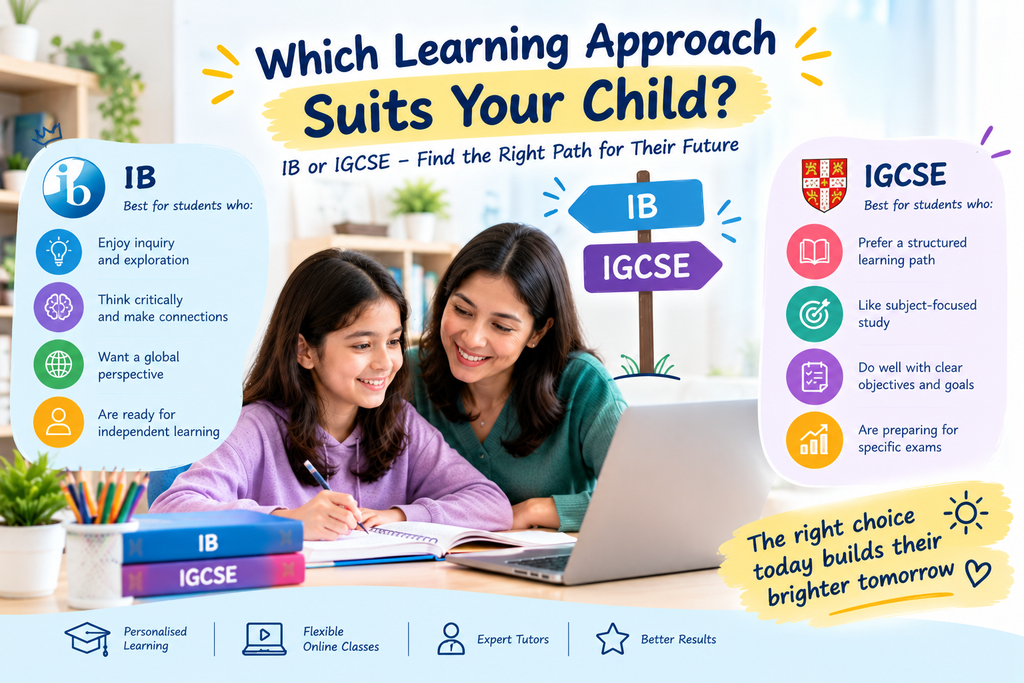
4. Which Learning Approach Suits Your Child?
Choosing between IB and IGCSE requires more than comparing examination results or programme reputations. Parents should consider how their child learns and responds to different academic expectations.
Students who enjoy exploration
A student who likes asking questions, discussing different perspectives, researching independently, and connecting concepts may enjoy the inquiry-based elements of IB learning.
Students who prefer clear subject objectives
A student who likes working through defined topics, practising subject-specific questions, and following a structured revision plan may appreciate the IGCSE approach.
Students with specific academic strengths
Subject interests also matter. Parents should compare the available subject choices, teaching support, assessment requirements, and future academic pathways offered by the schools they are considering.
Students who need help managing workload
Both programmes require planning and consistency. Students may need support organising revision, balancing assignments, or addressing difficult concepts. The best fit is one that challenges the student while remaining manageable with appropriate guidance.
5. How Online Tutoring Can Support IB and IGCSE Students
Online tutoring can provide supplementary academic support tailored to a student’s curriculum, subject, and current learning needs.
For IB students, tutoring may help clarify difficult concepts, strengthen analytical writing, plan research tasks, and practise subject-specific assessment skills. Support should reflect the student’s exact IB programme and course requirements.
For IGCSE students, tutors can help review syllabus topics, explain challenging concepts, practise relevant questions, and identify recurring errors. Revision can be organised around the student’s examination board and subject specification.
When comparing the best online tuition class, parents should look for tutors who understand the relevant curriculum and can adapt their teaching methods to the student’s needs.
Useful features to consider include:
- Personalised lessons: Focus on the student’s learning gaps and academic goals.
- Curriculum familiarity: Ensure the tutor understands the correct programme, subject, and assessment requirements.
- Regular practice: Reinforce understanding through suitable questions and activities.
- Constructive feedback: Help students understand mistakes and improve their approach.
- Progress monitoring: Review improvement areas and adjust the learning plan.
- Flexible scheduling: Fit additional lessons around schoolwork, activities, and rest.
Online tutoring should complement school learning rather than replace independent study or the guidance provided by school teachers.
Parents can explore GenieClasses to learn more about its learning support services. Visit the About Us page or use the Contact Us page to enquire about suitable academic support.
6. Preparing for Future Education
Future academic plans should be part of the curriculum decision. Parents may want to investigate the entry requirements of universities, colleges, or other educational institutions their child may consider.
IB Diploma Programme students may pursue university pathways using their IB qualifications, subject to each institution’s entry requirements. IGCSE students commonly progress to further qualifications, such as A Levels or the IB Diploma Programme, depending on the school and pathway available.
Neither curriculum automatically guarantees university admission. Requirements differ by institution, country, course, subjects, grades, and other criteria.
Before deciding, families should check official school and university guidance rather than relying only on general comparisons.
Frequently Asked Questions (FAQs)
1. Is IB harder than IGCSE?
Difficulty depends on the student, programme, subjects, school, and assessment requirements. IB programmes may involve substantial inquiry and reflection, while IGCSE requires detailed subject knowledge and preparation. Neither is universally harder for every learner.
2. What is the main difference between IB and IGCSE?
IB emphasises inquiry, reflection, and connections between ideas, although its approach varies across programmes. IGCSE generally follows defined subject syllabuses with subject-specific learning and assessments.
3. Can students move from IGCSE to IB?
Yes, many schools offer pathways from IGCSE to the IB Diploma Programme. Admission, subject preparation, and eligibility depend on the school’s policies and the student’s academic background.
4. Which curriculum is better for university preparation?
Both can support further education. The appropriate choice depends on the student’s intended university, course requirements, subject preferences, and available qualifications.
5. Do IB and IGCSE students need online tutoring?
Not every student needs tutoring. Additional lessons may be useful when students require individual explanations, structured practice, revision support, or help managing particular academic challenges.
6. How should parents choose an online tutor for IB or IGCSE?
Parents should check curriculum and subject expertise, teaching methods, familiarity with the relevant assessment requirements, progress feedback, and whether the tutor can address the student’s specific needs.
7. Can online tutoring help with IB assignments and IGCSE exam preparation?
Yes. Tutors can explain concepts, guide students through practice, and help them develop independent study skills. For assessed work, support should follow the school’s academic integrity rules and the programme’s requirements.
8. What should parents compare before choosing IB or IGCSE?
Compare the programme structure, subject choices, assessment methods, school teaching approach, workload, future education pathways, and the student’s learning preferences.
Conclusion
IB and IGCSE offer different approaches to international education, but both can help students develop valuable academic skills. IB programmes often emphasise inquiry, reflection, and connections between ideas, while IGCSE generally provides a structured, subject-based framework with clearly defined syllabus requirements.
The right choice depends on the student’s interests, strengths, learning preferences, and future plans. Parents should review the specific programme and school rather than assuming that one curriculum is always better than the other.
For students who need additional academic guidance, the best online tuition class can offer personalised explanations, targeted practice, and a more organised approach to learning. With appropriate support and consistent effort, students can build confidence and work towards their academic goals in either curriculum.
Learn more about our teaching approach and how we support students in achieving their academic goals by visiting our About Us page.
Looking for personalised online tutoring for your child? Visit our Contact Us page to discuss your child’s learning needs and explore suitable academic support.