
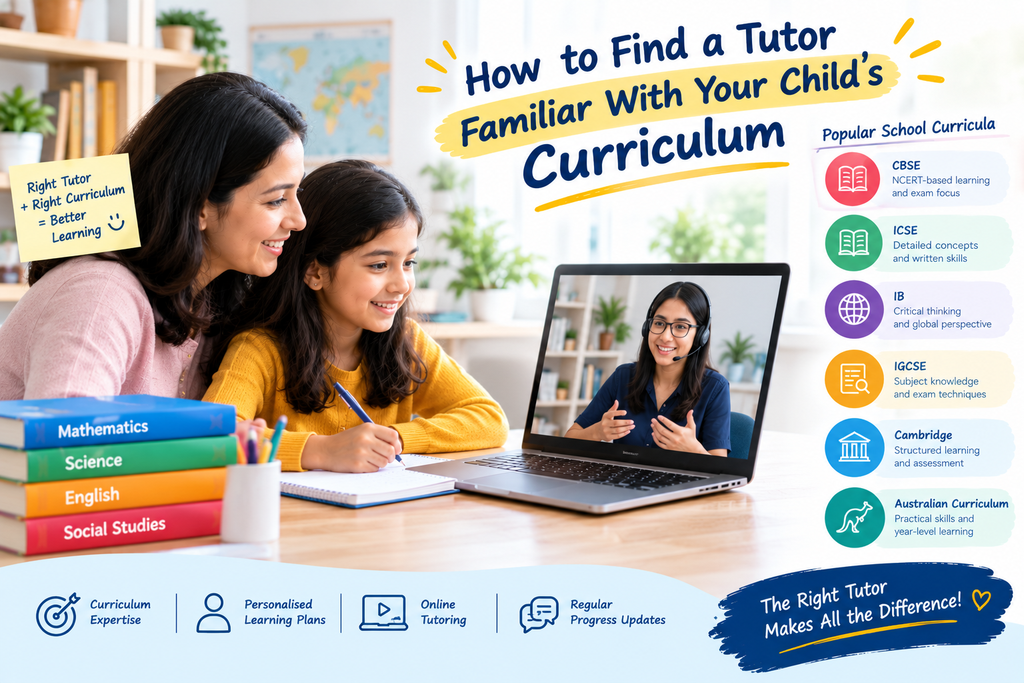
Choosing the right tutor for your child involves more than checking qualifications or comparing tuition fees. A tutor must also understand the curriculum your child follows, the topics covered in school, the assessment methods used, and the expectations of upcoming examinations.
For example, a student following CBSE may need support aligned with NCERT textbooks, while an IGCSE or IB student may require a tutor familiar with subject-specific assessment criteria and the demands of their particular programme. Even when two students study the same subject, their learning requirements can differ considerably depending on their curriculum and grade level.
Finding a curriculum-specific tutor can help your child connect classroom lessons with additional support, practise relevant questions, and develop greater confidence in challenging subjects.
This guide explains how parents can identify a suitable tutor, evaluate their teaching approach, and choose an effective learning arrangement for their child.
Quick Answer: How Can You Find a Tutor Who Understands Your Child’s Curriculum?
To find the right tutor, identify your child’s curriculum, grade, subject, and learning goals first. Then check the tutor’s experience with the same curriculum, familiarity with textbooks and assessment patterns, teaching approach, and ability to track progress. Arrange a trial lesson before committing to a long-term plan.
The best online tuition class for your child should provide curriculum-aligned teaching, clear explanations, personalised guidance, and regular feedback rather than relying on a one-size-fits-all approach.
1. Identify Your Child’s Exact Curriculum and Academic Needs
Before searching for a tutor, establish what kind of academic support your child needs.
Start by identifying:
- Curriculum or board: CBSE, ICSE, IB, IGCSE, Cambridge, Australian Curriculum, or a relevant national or state curriculum.
- Grade or year level: Tutors should be comfortable teaching the appropriate academic stage.
- Subject requirements: Identify whether your child needs help with Mathematics, Science, English, or another subject.
- Specific learning gaps: Note difficult chapters, concepts, homework challenges, or examination concerns.
- Learning goals: Decide whether the priority is understanding concepts, keeping up with schoolwork, revising for exams, or developing independent study habits.
For instance, a student who understands classroom explanations but struggles with examination questions may need more guided practice. Another student may need foundational concepts explained in smaller steps.
Defining these needs makes it easier to shortlist tutors who can provide relevant support.
2. Check the Tutor’s Experience With Your Child’s Curriculum
Subject knowledge is important, but curriculum familiarity is equally valuable.
A tutor may be highly knowledgeable in Mathematics or Science without having sufficient experience with the specific syllabus your child follows. Ask whether the tutor has taught students from the same curriculum and grade level.
Questions parents should ask
- Which school curricula and grade levels do you teach regularly?
- Are you familiar with the textbooks and prescribed learning objectives?
- How do you align lessons with the student’s school syllabus?
- Have you helped students prepare for this curriculum’s assessments?
- How do you adapt your teaching when the school introduces a new topic?
A suitable tutor should be able to explain how they would approach your child’s subject and learning goals.
For international curricula, clarify the exact programme and level rather than relying on broad labels. For example, experience teaching one Cambridge qualification does not automatically establish familiarity with every Cambridge subject or examination level.
3. Understand the Differences Between School Curricula
Different curricula can vary in content, sequencing, assessment styles, and expectations. Understanding these differences helps parents ask more relevant questions.
| Curriculum | What to look for in a tutor |
|---|---|
| CBSE | Familiarity with the relevant syllabus, NCERT textbooks where applicable, and examination-style questions |
| ICSE/ISC | Experience with the prescribed subject content, detailed explanations, and appropriate written responses |
| IB | Understanding of the specific IB programme, subject requirements, and relevant assessment approaches |
| IGCSE | Familiarity with the relevant subject syllabus, examination format, and assessment objectives |
| Cambridge | Experience with the specific Cambridge programme, subject, and qualification level |
| Australian Curriculum | Knowledge of the relevant year-level expectations and subject learning outcomes |
These are general considerations; requirements differ by subject, grade, and qualification.
When discussing a potential tutor, ask them to explain how they would use your child’s current school materials to plan lessons. Their answer can help you determine whether they understand the curriculum in practical terms.
4. Evaluate Teaching Methods, Not Just Qualifications
A tutor’s qualifications can indicate subject knowledge, but effective teaching also depends on communication, patience, and adaptability.
During an introductory conversation or trial class, observe whether the tutor:
- Checks your child’s existing understanding before starting a topic.
- Explains difficult concepts using examples your child can follow.
- Encourages questions and independent problem-solving.
- Identifies mistakes and explains how to correct them.
- Adjusts the lesson pace when your child needs more time.
- Provides suitable practice activities after the lesson.
A tutor should not simply repeat the textbook. They should help your child understand why a concept works and how to apply it to unfamiliar questions.
When looking for the best online tuition class, prioritise a teaching approach that combines curriculum knowledge with personalised attention and meaningful student participation.
5. Arrange a Trial Lesson Before Making a Decision
A trial lesson allows you to assess whether the tutor’s approach suits your child.
Share a recent school assignment, a difficult topic, or an upcoming lesson before the session. This gives the tutor an opportunity to demonstrate how they would support your child within the existing curriculum.
After the lesson, consider these questions:
- Did the tutor explain the topic clearly?
- Did they address the learning difficulty you identified?
- Did your child have opportunities to ask questions?
- Was the lesson relevant to the school syllabus?
- Did the tutor suggest practical next steps?
- Did your child feel comfortable learning with them?
Ask your child for honest feedback. A student who feels comfortable asking questions is more likely to communicate confusion and participate actively.
Avoid committing to a large package simply because a trial lesson went well. First, understand the tutor arrangement, session frequency, fees, cancellation terms, and any tutor replacement policy.
6. Look for Personalised Lessons and Progress Tracking
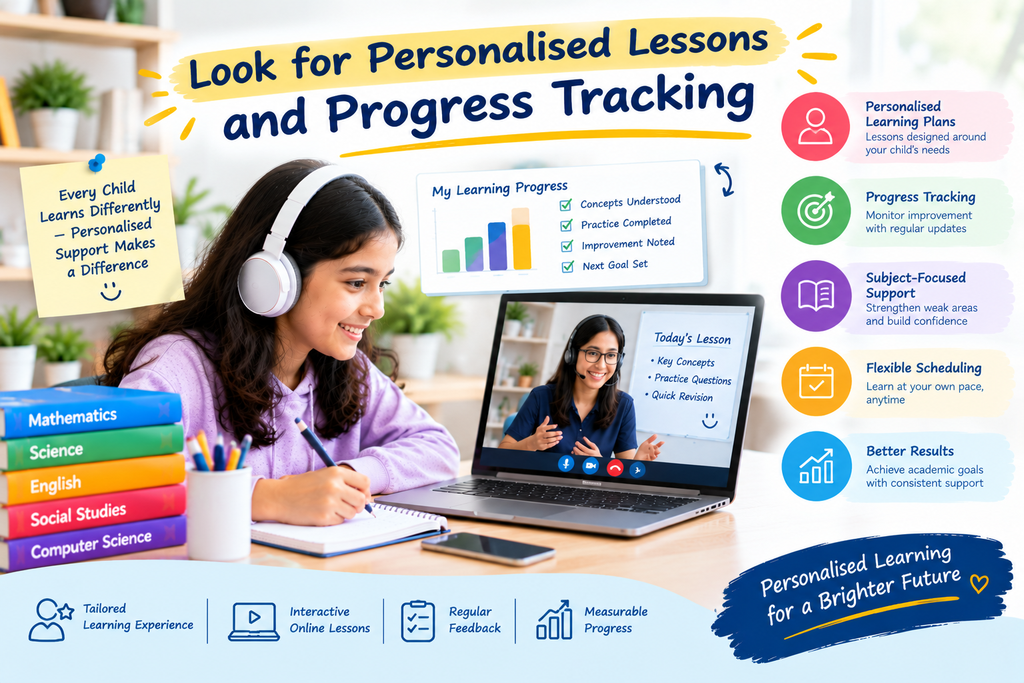
Children following the same curriculum can have different strengths, weaknesses, and learning speeds. A good tutor recognises these differences and adjusts the learning plan accordingly.
For example, one student may need additional practice with algebraic equations, while another may understand the calculations but struggle to explain their reasoning in written answers.
Ask how the tutor will identify learning gaps and measure progress over time.
Useful progress indicators include:
- Improved understanding of previously difficult concepts.
- More accurate homework and practice answers.
- Better use of subject-specific terminology.
- Greater independence when solving questions.
- Improved organisation and revision habits.
- Increased confidence when discussing schoolwork.
Regular parent updates can also help you understand which topics have been covered, what needs further practice, and what the tutor plans to teach next.
Remember that academic improvement may take time. Progress should be evaluated through several indicators rather than marks alone.
7. Check Communication, Scheduling, and Online Learning Support
A tutor can understand the curriculum perfectly and still be unsuitable if the arrangements do not work for your family.
Before enrolling, confirm the following:
Scheduling: Can sessions fit around school hours, extracurricular activities, and examination periods?
Communication: Will you receive updates about lesson topics, homework, and areas requiring improvement?
Learning resources: Does the tutor use relevant worksheets, digital whiteboards, practice questions, or other appropriate materials?
Technology: Is the online teaching setup reliable, accessible, and suitable for your child’s age?
Safety and privacy: Are there clear communication boundaries, appropriate supervision arrangements, and transparent policies for online sessions?
Fees and policies: Are pricing, cancellations, rescheduling, and any additional charges explained clearly?
The best online tuition class should combine academic suitability with practical arrangements that help your child maintain a consistent learning routine.
8. Compare Tutors Before Choosing One
Rather than choosing the first available tutor, compare a few suitable options using the same criteria.
Consider their curriculum experience, subject expertise, communication style, trial lesson performance, progress reporting, and overall value.
The lowest price does not always represent the best fit, and a higher fee does not automatically guarantee better teaching. Focus on what your child will receive and how well the tutor’s experience matches the learning goals.
You can explore the learning support available through GenieClasses, learn more about the organisation on its About Us page, or use the Contact Us page to enquire about suitable learning options.
Common Mistakes to Avoid When Selecting a Tutor
Parents can make a more informed choice by avoiding these common mistakes:
- Choosing based only on qualifications: Check actual teaching experience with the relevant curriculum and grade.
- Ignoring the exact subject level: General subject expertise may not be enough for advanced or examination-specific requirements.
- Skipping the trial lesson: Observe how the tutor explains concepts and responds to your child.
- Focusing only on marks: Consider understanding, confidence, participation, and independent problem-solving.
- Overlooking communication: Agree on how progress and concerns will be discussed.
- Committing too early: Understand the fees and terms before purchasing a long-term package.
- Assuming every curriculum is the same: Confirm the tutor’s experience with the specific programme and subject.
A thoughtful selection process helps reduce mismatches and gives your child a stronger foundation for productive learning.
Frequently Asked Questions
1. Why should I choose a tutor familiar with my child’s curriculum?
A curriculum-familiar tutor can align lessons with school topics, prescribed learning objectives, and relevant assessment expectations. This helps make additional tuition more relevant to your child’s academic needs.
2. How can I check whether a tutor understands a specific curriculum?
Ask about their experience with the exact board, grade, and subject. Discuss textbooks, syllabus requirements, assessment methods, and how they would teach a topic your child currently finds difficult.
3. Is a subject expert always the right tutor?
Not necessarily. Subject expertise is important, but the tutor should also understand the curriculum, communicate clearly, adapt to your child’s learning pace, and provide suitable practice.
4. Should I choose a tutor from the same school board?
A tutor with experience in the same board or curriculum can be particularly helpful because they are more likely to understand its syllabus and assessment expectations. However, evaluate their specific subject and grade-level experience as well.
5. Are online tutors suitable for international curricula?
Yes, online tutoring can be suitable for students following IB, IGCSE, Cambridge, Australian, and other international curricula, provided the tutor has relevant subject and programme experience and the online format works for the student.
6. What should I look for during a trial class?
Observe the tutor’s explanations, patience, curriculum alignment, ability to identify learning gaps, and willingness to involve your child. The session should give you a clear idea of the proposed teaching approach.
7. How do I know whether the tutor is helping my child improve?
Review progress in concept understanding, homework accuracy, practice assessments, confidence, and independent work. Regular feedback from the tutor and observations from school can provide additional context.
8. How often should my child attend tutoring sessions?
The appropriate frequency depends on your child’s learning needs, school workload, goals, and examination schedule. Discuss a realistic plan with the tutor and review it as your child progresses.
Conclusion
Finding a tutor who understands your child’s curriculum is an important step towards making additional academic support more effective. Start by identifying the exact syllabus, subject, grade, and learning goals. Then evaluate the tutor’s relevant experience, teaching methods, trial lesson, progress-tracking process, and communication arrangements.
The right tutor should do more than help your child finish homework. They should strengthen understanding, encourage questions, address learning gaps, and support steady academic development.
When comparing options for the best online tuition class, remember to prioritise curriculum alignment, personalised teaching, transparent communication, and your child’s comfort with the learning process.
At GenieClasses, we believe every child deserves learning support that matches their individual needs. Explore our About Us page to understand our approach to helping students learn with confidence.
Need guidance in choosing suitable online tuition for your child? Connect with us through the Contact Us page to discuss your child’s learning requirements.