
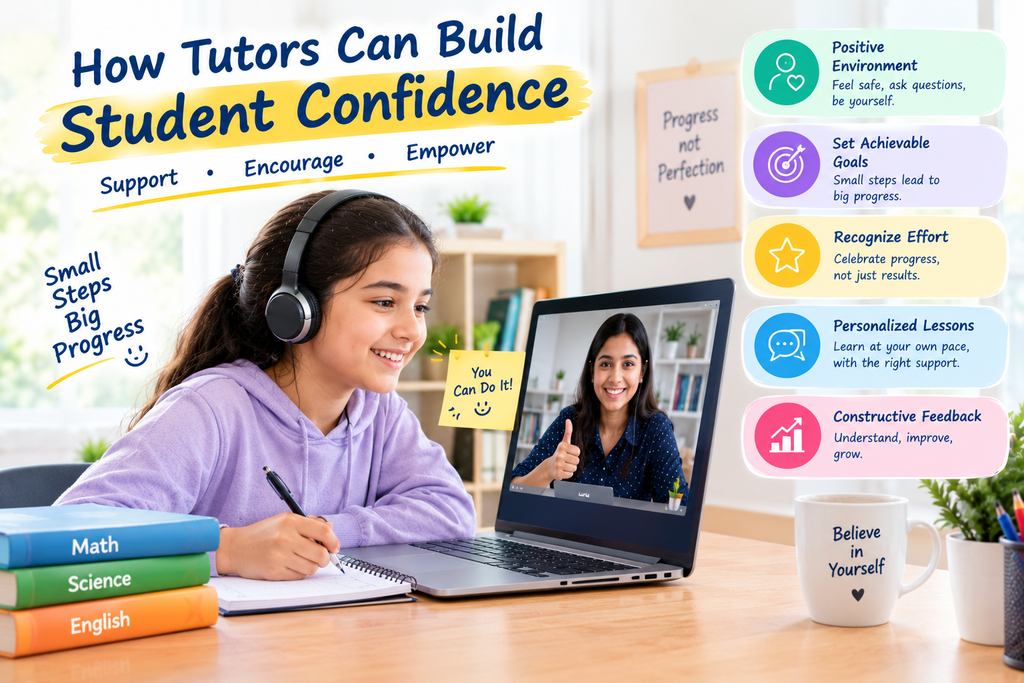
Student confidence plays an important role in academic success. When students believe in their abilities, they are more likely to ask questions, participate in lessons, attempt challenging tasks, and learn from their mistakes. However, some students hesitate to speak up because they fear giving incorrect answers or disappointing others.
Tutors can help students overcome these challenges by creating a supportive learning environment where questions are encouraged and progress is recognized. An effective online tutor understands that every student learns at a different pace and may need individual guidance to develop confidence.
Building confidence is not about ensuring that students always get the right answers. It is about helping them recognize their strengths, learn from difficulties, and understand that consistent effort can lead to improvement.
1. Create a Safe and Supportive Learning Environment
Students learn more comfortably when they feel respected and understood. If they worry about being criticized for making mistakes, they may avoid answering questions or trying unfamiliar tasks.
Tutors can create a positive environment by listening patiently, encouraging questions, and responding to mistakes constructively. Instead of immediately pointing out that an answer is wrong, they can ask the student to explain their thinking and guide them toward the correct approach.
For example, if a student struggles with a mathematics problem, the tutor can break it into smaller steps and work through each part together.
A supportive atmosphere helps students understand that mistakes are a natural part of learning. Over time, this can encourage them to participate more actively and approach difficult subjects with greater confidence.
2. Recognize Effort and Celebrate Progress
Students need to understand that improvement matters just as much as final results. Recognizing genuine effort helps them see that practice and persistence can make a difference.
Tutors should acknowledge specific achievements, such as completing a difficult exercise, improving reading fluency, or explaining a concept more clearly than before.
Instead of offering only general praise, tutors can say, “You used the correct method independently this time” or “Your explanation is much clearer than it was last week.”
Specific feedback shows students exactly what they are doing well. It also helps them identify the learning habits that contribute to their progress.
Celebrating small milestones can be particularly helpful for students who struggle with a subject or have previously lost confidence in their academic abilities.
3. Set Small and Achievable Learning Goals
Large academic goals can sometimes feel overwhelming, especially when students are struggling with several topics. Breaking these goals into smaller steps makes progress easier to understand and manage.
Tutors can work with students to set realistic weekly or lesson-based targets. For example, a student who struggles with fractions might first focus on understanding equivalent fractions before moving on to more complex calculations.
Each completed goal gives the student an opportunity to recognize improvement and prepare for the next challenge.
Tutors should also review goals regularly and adjust them when necessary. Goals need to be challenging enough to encourage growth but realistic enough to prevent unnecessary frustration.
This approach helps students build confidence through consistent, measurable progress.
4. Personalize Lessons According to Student Needs
Every student has different strengths, interests, and learning challenges. A teaching strategy that works well for one learner may not be equally effective for another.
An online tutor can observe how a student responds to explanations, practice questions, visual examples, and interactive activities. Based on these observations, lessons can be adjusted to suit the student’s current understanding.
For example, a student who struggles with abstract mathematical concepts may benefit from visual demonstrations and worked examples. A student who finds writing difficult may need help organizing ideas before developing complete paragraphs.
When lessons match a student’s needs, challenging concepts can become more manageable. This allows students to experience success gradually instead of feeling overwhelmed by material that moves too quickly.
5. Encourage Questions and Active Participation
Students sometimes remain silent because they worry that their questions will appear unimportant or that their classmates will judge them. Tutors can help by making curiosity a normal part of every lesson.
They can invite students to explain their reasoning, ask follow-up questions, and share their opinions about a topic. Open-ended questions such as “How did you reach this answer?” can encourage students to think independently rather than simply memorize information.
Tutors should give students enough time to respond without rushing them. If a student finds it difficult to answer immediately, hints or guiding questions can help them develop their response.
As students become more comfortable expressing their ideas, they may participate more confidently in lessons and classroom discussions.
6. Teach Students How to Learn From Mistakes
Mistakes can feel discouraging when students interpret them as evidence that they are not capable of succeeding. Tutors can change this perspective by helping students understand why an error occurred and what they can do differently next time.
For example, after an incorrect science answer, a tutor might review the question, identify a misunderstanding, and provide a similar question for practice.
The aim is to turn an error into a useful learning opportunity.
Tutors can also encourage students to review corrected work and explain the right approach in their own words. This helps them understand the concept rather than simply memorize an answer.
When students learn to respond to mistakes constructively, they may become more willing to attempt challenging tasks and persist when learning becomes difficult.
7. Provide Clear and Constructive Feedback
Feedback can influence how students view their abilities. Vague criticism may leave them uncertain about what went wrong, while specific guidance gives them a practical path forward.
Tutors should explain what the student has done well, identify one or two areas for improvement, and suggest clear next steps.
For example, instead of saying, “Your essay needs work,” a tutor can explain that the main argument is clear but the supporting paragraphs need stronger examples.
Regular feedback also allows students to compare their current work with previous efforts and recognize their improvement.
The goal is to provide honest guidance while helping students feel capable of making progress through practice.
8. Build Independence Through Gradual Guidance
Students develop confidence when they learn to solve problems themselves. If tutors provide every answer immediately, students may become overly dependent on assistance.
Instead, tutors can gradually reduce their support as students become more comfortable with a topic.
They might demonstrate a method first, solve another example with the student, and then ask the student to complete a similar task independently.
This approach helps students develop problem-solving skills and recognize their own abilities.
Tutors can also encourage learners to check their answers, review instructions, and identify when they need help. These habits support independence and prepare students to manage homework and examinations more confidently.
9. Communicate With Parents About Student Progress
Parents can reinforce confidence-building strategies by recognizing improvement and supporting consistent learning habits at home.
Tutors should communicate progress clearly, including strengths, current challenges, and realistic next steps. This helps parents understand how they can support their child’s learning without creating unnecessary pressure.
For example, if a student has become more comfortable answering questions but still needs practice in mathematics, parents can encourage regular revision while acknowledging the student’s increased participation.
Communication should focus on individual progress rather than comparisons with siblings or classmates.
For more information about effective tutoring and individual attention, parents can read What Makes a Good Online Tutor for School Students?.
Families can also learn more about GenieClasses, visit the About Us page, or contact the team through the Contact Us page.
Conclusion
Building student confidence requires patience, encouragement, and consistent support. Tutors can help learners develop confidence by creating a safe learning environment, setting achievable goals, recognizing progress, and teaching them to learn from mistakes.
Personalized lessons and constructive feedback allow students to understand their strengths and work on their challenges step by step. Encouraging questions and gradually developing independence can also help learners become more comfortable with difficult subjects.
An effective online tutor supports more than academic performance. They help students develop the confidence to participate, solve problems, and approach new challenges with a positive mindset.
When tutors focus on individual progress rather than perfection, they help create a learning experience in which students feel supported, motivated, and prepared to reach their potential.
Frequently Asked Questions (FAQs)
1. How can tutors build student confidence?
Tutors can build student confidence by providing positive and constructive feedback, setting achievable goals, encouraging questions, recognizing progress, and creating a supportive environment where mistakes are treated as learning opportunities.
2. Why is student confidence important in learning?
Student confidence can encourage participation, persistence, and willingness to attempt challenging tasks. Confident learners may be more comfortable asking for help and learning from mistakes.
3. How does personalized tutoring improve confidence?
Personalized tutoring adapts lessons to a student’s learning pace, strengths, and difficulties. This can make challenging topics more manageable and help students recognize their progress.
4. How should tutors respond when students make mistakes?
Tutors should explain mistakes calmly, identify the underlying misunderstanding, and guide students through the correct approach. They should focus on improvement rather than criticism.
5. What role does feedback play in building confidence?
Specific, constructive feedback helps students understand what they are doing well and what they can improve. It gives them clear next steps and makes progress easier to recognize.
6. How can tutors encourage shy students to participate?
Tutors can ask supportive questions, allow enough time to respond, encourage students to share ideas, and acknowledge their contributions without putting them under unnecessary pressure.
7. How can parents support student confidence at home?
Parents can recognize effort, encourage regular practice, listen to their child’s concerns, and focus on progress rather than comparisons. Maintaining communication with tutors can also help families provide consistent support.
8. How can tutors help students become independent learners?
Tutors can gradually reduce assistance, encourage students to solve problems independently, teach self-checking strategies, and help them set realistic learning goals.