
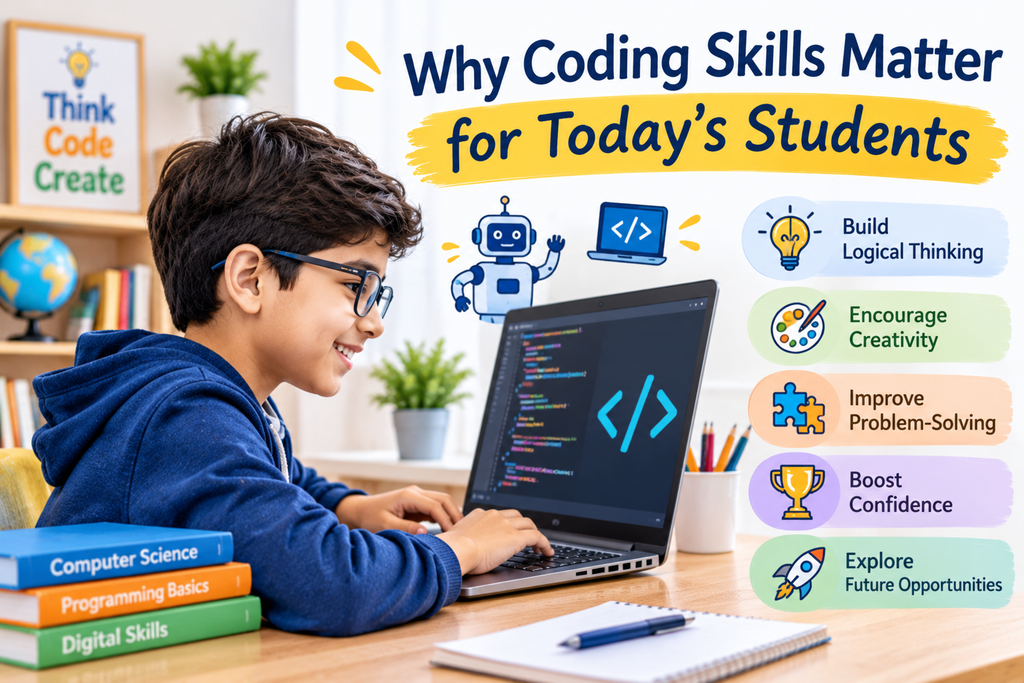
Technology is becoming an important part of everyday life, from the applications children use to the websites they visit and the digital tools that support their education. Understanding how technology works can help students become more confident and independent learners. Learning coding introduces children to the basics of programming while encouraging logical thinking, creativity, and problem-solving. Just as online art classes allow students to explore creative ideas through visual activities, coding gives them opportunities to turn their ideas into interactive digital projects.
Coding is not only about writing lines of instructions. It teaches students how to understand a problem, break it into smaller steps, and develop a solution. These skills can support their academic learning and prepare them to participate confidently in an increasingly digital world.
Quick Answer: Why Should Students Learn Coding?
Coding is valuable for students because it helps them:
- Develop logical and computational thinking.
- Improve problem-solving abilities.
- Build creativity through practical projects.
- Understand how digital technology works.
- Develop patience and attention to detail.
- Learn collaboration and communication.
- Explore future academic and career opportunities.
Students do not need to become professional programmers to benefit from learning basic coding concepts.
Key Takeaways
- Coding encourages logical and structured thinking.
- Programming projects help students learn through practical experience.
- Coding supports creativity and independent problem-solving.
- Learning from mistakes builds patience and confidence.
- Digital skills can complement traditional academic subjects.
- Early exposure can help students explore future interests in technology.
1. Coding Develops Logical and Computational Thinking
One of the most important benefits of coding is that it encourages students to think logically.
When children write a program, they need to understand what they want the computer to do and arrange instructions in the correct order. They learn to identify patterns, recognise errors, and organise information into manageable steps.
For example, a student creating a simple game must decide how a character moves, what happens when it reaches an obstacle, and how the score should change.
These activities introduce computational thinking, which can also support reasoning and structured problem-solving in everyday situations.
2. Programming Encourages Creativity
Coding provides students with an opportunity to create something of their own rather than simply using existing technology.
They can design simple games, build animations, create interactive stories, and develop basic websites. Each project allows them to experiment with ideas and find different ways to achieve an outcome.
This creative process is similar to other learning activities. For example, online art classes encourage students to explore colours, shapes, and visual designs, while coding allows them to express their ideas through digital experiences.
Combining creative and technical activities can help children discover different interests and develop confidence in their abilities.
3. Coding Improves Problem-Solving Skills
Coding projects often involve challenges. A program may not work as expected, an animation may stop at the wrong point, or a game may contain an error.
Students learn to examine the problem, identify what went wrong, and test possible solutions.
This process is known as debugging. It teaches children that mistakes are not failures but opportunities to understand something better.
With regular practice, students can become more comfortable approaching unfamiliar challenges and finding solutions step by step.
4. Students Become More Confident with Technology
Children regularly interact with smartphones, computers, websites, and applications. However, using technology and understanding how it works are two different things.
Learning coding helps students move beyond being technology users. They begin to understand the instructions and processes behind digital tools.
For example, creating a basic website can help students understand how text, images, layouts, and links work together.
This practical experience can make them more confident when exploring new digital platforms and learning unfamiliar technologies.
5. Coding Encourages Patience and Independent Learning
Learning programming requires time, practice, and attention to detail. Students may need several attempts before a project works correctly.
This encourages them to remain patient and keep improving their work rather than giving up when they face difficulties.
Coding also supports independent learning. Students gradually learn to research problems, test ideas, and make decisions without depending entirely on someone else.
These habits can be useful in school assignments, personal projects, and other areas of learning.
6. Coding Connects Mathematics, Science, and Technology
Coding can help students understand how different academic subjects connect with real-world applications.
For example:
- Mathematics: Programming uses numbers, patterns, sequences, and logical operations.
- Science: Students can use coding to represent data, create simulations, and explore scientific ideas.
- English: Writing instructions and developing interactive stories can encourage clear communication and language skills.
- Technology: Coding helps students understand how websites, applications, and digital systems are developed.
These connections make learning more practical and help students see how classroom knowledge can be applied outside school.
7. Coding Introduces Students to Future Opportunities
Technology is used across many industries, including healthcare, education, engineering, business, entertainment, and communication.
Basic coding knowledge can help students understand some of the skills used in these fields.
As they explore programming, students may discover interests in areas such as software development, web design, robotics, game development, or artificial intelligence.
Learning coding does not mean every child needs to pursue a technology-related career. Instead, it gives them additional knowledge and helps them make more informed decisions about their future interests.
8. How Can Parents Encourage Children to Learn Coding?
Parents can make coding more approachable by connecting it with activities children already enjoy.
Here are some practical suggestions:
- Introduce beginner-friendly programming activities.
- Encourage children to create simple games or animations.
- Allow them to explore technology through supervised projects.
- Celebrate progress instead of expecting perfect results.
- Encourage questions and experimentation.
- Provide a regular but flexible learning schedule.
- Let children explore different areas of technology.
Parents can also balance technical activities with other creative interests. For instance, online art classes can encourage visual imagination, while programming projects develop technical and logical skills.
9. How to Choose the Right Coding Learning Environment
The right learning environment can make a difference in how comfortably students understand programming concepts.
Parents should consider the child’s age, existing knowledge, interests, and learning pace before choosing a programme.
A suitable learning experience should include:
- Age-appropriate programming concepts.
- Practical activities and project-based learning.
- Clear explanations of difficult topics.
- Opportunities to ask questions.
- Guidance from knowledgeable educators.
- Constructive feedback and regular practice.
GenieClasses features Technology & Computing among its subject areas, along with other learning options. Parents can explore the platform to understand its educational approach and available subjects.
You can visit the GenieClasses homepage to explore its learning options. Learn more about the platform on the About Us page or connect with the team through the Contact Us page.
Frequently Asked Questions (FAQs)
1. Why is coding important for school students?
Coding helps students develop logical thinking, problem-solving abilities, creativity, and an understanding of digital technology. These skills can support learning across different subjects.
2. At what age can children start learning coding?
Children can begin exploring basic coding concepts at an early age through visual programming, puzzles, and simple interactive activities. The right starting point depends on their interests and readiness.
3. Does a child need mathematics knowledge to learn coding?
Advanced mathematics is not necessary for beginners. Children can start with basic logic, patterns, sequences, and simple instructions before progressing to more advanced programming concepts.
4. Can coding improve problem-solving skills?
Yes. Coding encourages students to break challenges into smaller steps, test solutions, identify errors, and improve their work through repeated practice.
5. What can students create after learning basic coding?
Depending on their age and skill level, students can create simple games, animations, interactive stories, basic websites, and other small digital projects.
6. Is coding useful for students who do not want a technology career?
Yes. Logical thinking, creativity, structured problem-solving, and digital awareness can be useful in many academic and professional fields, not only technology careers.
7. How can parents make coding interesting for children?
Parents can connect coding with children’s interests, such as games, stories, animations, or simple websites. Practical projects and encouragement can make the learning process more enjoyable.
8. Can coding and creative activities be learned together?
Yes. Coding and creative activities can complement one another. Students can combine visual design, storytelling, and programming to develop projects that involve both imagination and technical skills.
Conclusion
Coding skills matter for today’s students because they help children understand technology while developing logical thinking, creativity, patience, and problem-solving abilities. Through practical projects, students learn how to turn ideas into working solutions and become more confident when approaching challenges.
Parents can support this development by introducing age-appropriate activities, encouraging experimentation, and providing access to suitable learning guidance. Combining programming with creative activities, including online art classes, can also give children opportunities to explore different interests.
The goal is not simply to teach children how to write code. It is to help them become curious, confident, and capable learners who can understand and use technology thoughtfully.
Encourage your child’s interest in technology and support their learning journey with GenieClasses. Visit GenieClasses or Contact Us to explore the available learning options.