
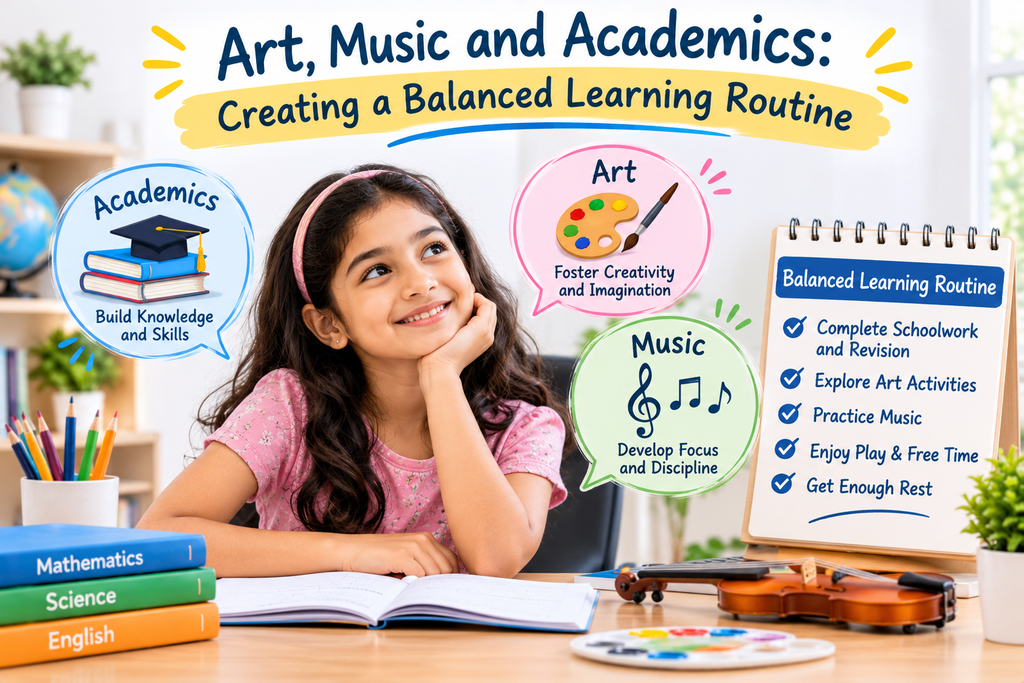
A child’s education should not be limited to textbooks, homework, and examinations. While academic subjects build essential knowledge, activities such as drawing, painting, singing, and playing musical instruments help children explore their interests and express themselves creatively.
However, many parents find it challenging to balance schoolwork with creative activities. A packed timetable can leave children feeling tired, while an unstructured routine may make it difficult to complete important academic tasks.
The solution is not to give every activity equal time every day. Instead, parents should create a flexible routine that gives academics, art, and music their own space.
Creative learning opportunities, including online art classes, can help children explore artistic interests while maintaining a routine that also includes schoolwork, music, and relaxation.
The Balanced Learning Principle
Strong academics + Creative exploration + Enough rest = A healthier learning routine.
Quick Answer: How Can Parents Balance Art, Music, and Academics?
Parents can create a balanced learning routine by:
- Prioritising essential schoolwork and revision.
- Scheduling short, regular art and music sessions.
- Allowing children to choose activities based on their interests.
- Including breaks and free-play time.
- Reviewing the routine regularly to avoid unnecessary pressure.
The goal is to help children enjoy learning while developing academic knowledge, creativity, discipline, and confidence.
1. Understand the Different Benefits of Each Learning Area
Academics, art, and music contribute to a child’s development in different ways. Instead of treating them as competing activities, parents can view them as complementary parts of education.
| Learning Area | Skills Children Can Develop | Example Activities |
|---|---|---|
| Academics | Logical thinking, knowledge, problem-solving | Mathematics, Science, English |
| Art | Imagination, observation, self-expression | Drawing, painting, craft |
| Music | Rhythm, listening, concentration, practice habits | Singing, keyboard, guitar |
Why All Three Matter
Academics build understanding: School subjects help children develop knowledge and prepare for future educational opportunities.
Art encourages creativity: Drawing and painting give children opportunities to experiment, observe details, and communicate ideas visually.
Music develops discipline: Learning an instrument or practising a song encourages patience, listening, consistency, and gradual improvement.
Parent Tip: A child does not need to become an artist, musician, or academic topper. The purpose is to give them opportunities to explore different abilities.
2. Create a Daily Routine That Gives Every Activity Space
A successful routine should be realistic. Parents should consider school timings, homework, the child’s energy levels, and existing commitments before creating a timetable.
Here is an example of how an after-school routine might look:
| Time | Activity | Purpose |
|---|---|---|
| 3:00–3:30 PM | Lunch and relaxation | Recharge after school |
| 3:30–4:15 PM | Homework and revision | Complete academic tasks |
| 4:15–4:30 PM | Short break | Refresh the mind |
| 4:30–5:00 PM | Art or creative activity | Explore imagination |
| 5:00–5:30 PM | Outdoor play or free time | Physical activity |
| 5:30–6:00 PM | Music practice | Develop musical skills |
| Evening | Family time and reading | Relax and reflect |
This is only an illustrative timetable. Adjust the timings according to your child’s age, school schedule, and individual needs.
A Simple Weekly Activity Planner
Children do not have to practise every creative skill daily. Rotating activities can make the routine more enjoyable.
| Day | Creative Focus | Academic Focus |
|---|---|---|
| Monday | Drawing and colouring | Mathematics revision |
| Tuesday | Music practice | English homework |
| Wednesday | Art and craft | Science concepts |
| Thursday | Singing or instrument practice | Reading and writing |
| Friday | Creative project | Weekly revision |
| Saturday | Art or music exploration | Pending schoolwork |
| Sunday | Family activity and free play | Light preparation for the week |
3. Use a Simple Learning Flow to Organise the Day
One helpful way to prevent an overloaded schedule is to follow a consistent sequence. Children know what to expect, while parents can make sure that learning and relaxation both receive attention.
The Balanced Learning Flow
       START THE DAY
             |
             v
      School and Classes
             |
             v
       Complete Homework
             |
             v
       Take a Short Break
             |
             v
    Choose a Creative Activity
        /           \
       v             v
      ART           MUSIC
       \             /
        \           /
             v
      Free Time and Play
             |
             v
       Family and Rest
             |
             v
        READY FOR TOMORROW
The sequence can change depending on the child’s energy and responsibilities. For example, a child who feels tired after school may benefit from a short break before starting homework.
4. Make Art a Regular Part of the Learning Experience
Art is not simply an activity to fill spare time. It can give children an opportunity to explore ideas, experiment with materials, and develop their own ways of expressing themselves.
Parents can introduce simple activities such as:
- Drawing scenes from a favourite story.
- Creating greeting cards for family members.
- Making craft projects using everyday materials.
- Painting objects from nature.
- Designing imaginative characters or patterns.
Creative Activity Box: Try This at Home
The 20-Minute Creativity Challenge
- Give your child a blank sheet of paper.
- Choose a theme, such as nature, animals, or space.
- Allow them to draw or paint freely for 20 minutes.
- Ask them to explain their artwork.
This activity encourages imagination and gives children a chance to talk about their ideas without worrying about making everything perfect.
Parents who want to introduce structured creative learning can explore online art classes or workshops covering activities such as Art & Craft and Calligraphy.
5. Include Music Without Making Practice Feel Like Pressure
Music practice can become more enjoyable when children have realistic goals and freedom to explore different styles.
Parents can encourage children to:
- Practise an instrument for a short, manageable period.
- Listen to different types of music.
- Learn songs they genuinely enjoy.
- Repeat challenging sections patiently.
- Share their progress with family members.
Consistency is more valuable than forcing long practice sessions. A child who enjoys practising for 15 minutes regularly may develop a healthier relationship with music than one who is pressured into lengthy sessions.
6. Keep Academic Learning Organised and Manageable
Creative activities should complement academics, not replace essential school responsibilities. Children need enough time to understand concepts, complete assignments, and revise lessons.
Parents can make academic learning easier by dividing larger tasks into smaller steps.
For example:
| Academic Challenge | Practical Solution |
|---|---|
| Too much homework | Divide assignments into smaller tasks |
| Difficulty understanding a topic | Revisit concepts with examples |
| Poor revision habits | Create short revision sessions |
| Lack of confidence | Encourage questions and regular practice |
| Busy weekly schedule | Plan learning activities in advance |
Parents should also make sure that creative sessions do not become another source of pressure. The purpose of activities such as online art classes is to encourage exploration and enjoyment while keeping academic responsibilities manageable.
7. When Should Parents Consider Additional Learning Support?
Some children manage schoolwork independently, while others need additional guidance with particular subjects or study habits.
Parents may consider extra academic support when a child:
- Frequently struggles to understand classroom concepts.
- Needs help organising homework and revision.
- Finds it difficult to prepare for assessments.
- Requires more individual attention.
- Wants to strengthen subject knowledge.
Structured lessons, personalised explanations, and regular practice can help children manage their academic responsibilities more confidently. Parents should choose learning support that fits the child’s schedule and leaves enough time for creative interests.
GenieClasses offers professionally qualified tutors, one-on-one live sessions, group classes, customised worksheets, and guided corrections. Parents can explore these learning options according to their child’s requirements.
8. Common Mistakes to Avoid While Creating a Balanced Routine
Even a well-planned timetable can become stressful if parents focus too much on completing every activity.
| Common Mistake | Better Approach |
|---|---|
| Scheduling too many activities | Keep the timetable realistic |
| Comparing children with others | Respect individual interests and pace |
| Treating art as a reward only | Give creative activities regular space |
| Forcing music practice | Encourage enjoyable, consistent practice |
| Ignoring rest and play | Include breaks and free time |
| Focusing only on academic results | Appreciate effort and creativity too |
The most important thing is to create a routine that supports a child’s interests without making their day unnecessarily demanding.
9. How GenieClasses Can Support a Balanced Learning Journey
Children benefit when they have access to learning opportunities that match their interests and academic needs.
GenieClasses offers learning options across subjects such as English, Mathematics, Science, Foreign Languages, Art & Design, Tamil, Music, and Technology & Computing.
Its learning environment includes professionally qualified tutors, one-on-one sessions, group classes, free demo classes, customised worksheets, and AI-powered learning insights.
Parents can explore GenieClasses to discover academic and creative learning options that may fit their child’s routine. Those interested in artistic development can also explore online art classes as an opportunity for children to practise creative skills.
To understand the platform and its approach to learning, visit the About Us page. For questions about available classes, visit the Contact Us page.
Frequently Asked Questions
1. Why should children balance art, music, and academics?
A balanced routine gives children opportunities to develop academic knowledge alongside creativity, self-expression, concentration, and other useful skills.
2. How much time should children spend on art and music?
There is no fixed duration for every child. Short, regular sessions can be a practical starting point. Parents should adjust the schedule according to age, interest, energy, and school responsibilities.
3. Can art and music affect academic performance?
Creative activities can complement academic learning by encouraging skills such as observation, listening, patience, and concentration. However, outcomes vary between children.
4. How can parents create a balanced study timetable?
Parents should begin with fixed school timings and essential homework, then include creative activities, breaks, outdoor play, and rest. The timetable should remain flexible.
5. Should children learn both art and music?
Children can explore both activities if they enjoy them and have enough time. Parents do not need to force participation in every activity.
6. Are online art classes suitable for children?
Yes. Age-appropriate online art classes can give children opportunities to explore drawing, painting, and other creative activities through structured learning. Parents should choose sessions that match their child’s interests and experience.
7. How can parents keep children motivated?
Give children choices, appreciate their effort, set achievable goals, and avoid comparing their progress with others. Allowing them to explore their interests can make learning more enjoyable.
Final Thoughts: Build a Routine That Helps Children Grow
A balanced learning routine is not about filling every hour with activities. It is about giving children enough opportunities to study, create, practise, play, and rest.
Academics help children build knowledge, art gives them space to express their imagination, and music encourages patience and consistent practice. Together, these experiences can make learning more engaging and meaningful.
Parents should observe their child’s interests, create realistic schedules, and make adjustments whenever necessary. With the right academic guidance and opportunities for creative exploration, children can develop skills that support them both inside and outside the classroom.
Give your child the freedom to learn, create, and discover. A balanced routine can make every part of that journey meaningful.