Mathematics and Science are important subjects in every child’s academic journey. But does education end with solving equations, understanding scientific concepts, and completing school assignments? What about creativity, communication, imagination, decision-making, and practical abilities?
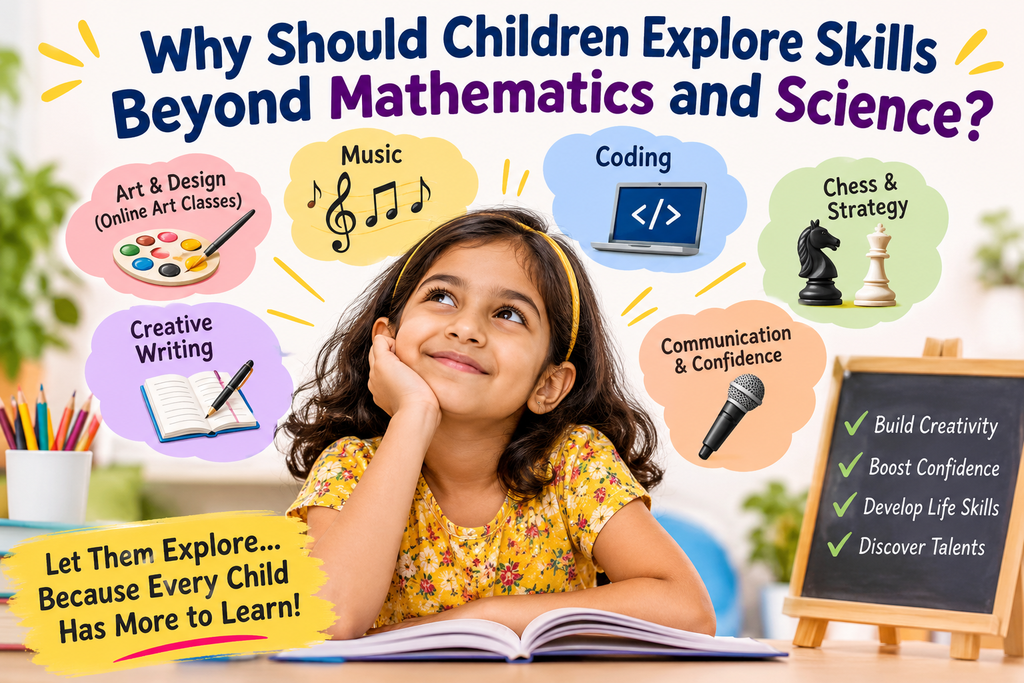
Children have different interests and talents. Some enjoy drawing and painting, while others love music, storytelling, coding, chess, or designing new things. Giving them opportunities to explore these interests can help them develop abilities that traditional classroom learning may not always provide.
For parents in Gujarat, encouraging children to explore different learning experiences can create a more balanced educational journey. Whether a child studies in Ahmedabad, Surat, Vadodara, Rajkot, or Gandhinagar, opportunities such as online art classes and other creative activities can make learning more engaging.
So, why should children explore skills beyond Mathematics and Science? Which activities can help them discover their potential? And how can parents introduce these experiences without affecting academic responsibilities?
Let’s explore!
1. Why Is Learning Beyond Mathematics and Science Important for Children?
Academic subjects help children understand concepts, but different activities introduce them to different ways of thinking and expressing themselves.
Imagine a child who enjoys drawing but spends most of their learning time solving Mathematics problems. Could introducing artistic activities help them discover another interest? Similarly, a child who enjoys puzzles might develop an interest in chess or coding.
Here are some important reasons to encourage learning beyond traditional subjects:
| Development Area | Why Does It Matter? | Activities to Explore |
|---|---|---|
| Creativity | Encourages original ideas | Drawing, painting, craft |
| Communication | Helps express thoughts clearly | Storytelling, writing |
| Problem-Solving | Encourages logical thinking | Chess, coding, puzzles |
| Confidence | Provides opportunities for self-expression | Public speaking, music |
| Discipline | Encourages regular practice | Music, calligraphy |
| Imagination | Helps children explore new ideas | Art, creative writing |
What Can Children Gain From Exploring Different Skills?
Can Creative Activities Improve Self-Expression?
Yes! Drawing, painting, music, and storytelling give children different ways to express their thoughts and emotions. They can communicate ideas through creative work rather than relying only on written answers.
How Can Practical Activities Improve Problem-Solving?
Activities such as coding, chess, and craft projects encourage children to experiment, identify challenges, and think about possible solutions.
Can Exploring New Skills Help Children Discover Their Talents?
Absolutely. Trying different activities gives children opportunities to identify what they genuinely enjoy. These interests may gradually develop into hobbies, personal strengths, or future learning goals.
2. Which Skills Should Children Explore Beyond Traditional Academic Subjects?
Should every child learn the same extracurricular activities? Not necessarily! Every child has different interests, so parents should introduce a variety of learning opportunities.
The Child’s Skill Discovery Map
Which learning path matches your child’s interests?
| Skill Category | Activities to Explore | What Can Children Practise? |
|---|---|---|
| 🎨 Creative Skills | Drawing, painting, calligraphy | Imagination and observation |
| 🎵 Performing Arts | Singing, keyboard, music | Listening and discipline |
| 💻 Technical Skills | Coding, computer science, AI basics | Logical thinking |
| ♟️ Thinking Skills | Chess, puzzles, strategy games | Planning and decision-making |
| ✍️ Communication | Creative writing, storytelling | Expression and vocabulary |
| 🎤 Confidence Building | Public speaking, presentations | Communication and confidence |
Which Creative Skills Can Children Develop Through Art?
Art is not simply about making attractive drawings. It gives children opportunities to experiment with colours, understand shapes, observe their surroundings, and communicate ideas visually.
Through online art classes, children can explore different artistic techniques, practise drawing, experiment with painting, and gradually develop their creative interests.
Parents can also introduce calligraphy, paper crafts, and creative design activities to make learning more varied.
3. How Can Parents Identify Which Skills Match Their Child’s Interests?
Choosing an activity becomes easier when parents observe what their children naturally enjoy.
For example:
- Does your child enjoy colours and drawing? Explore Art & Design.
- Do they love stories and books? Introduce creative writing.
- Are they interested in computers? Try beginner-level coding.
- Do they enjoy puzzles and challenges? Explore chess.
- Do they love singing? Consider music lessons.
How Can You Find the Right Activity? Follow This Simple Learning Flow
Observe → Explore → Practise → Discover → Improve
| Step | What Should Parents Do? |
|---|---|
| 01. Observe | Identify your child’s natural interests |
| 02. Explore | Introduce one or two new activities |
| 03. Practise | Allow time for regular learning |
| 04. Discover | Understand which activity they enjoy |
| 05. Improve | Encourage gradual progress |
The goal is not to make children experts in every activity. It is to give them the freedom to discover what they enjoy.
4. Why Should Parents Encourage Creativity Through Art and Design?
Can art help children think differently? Yes! Creative activities provide opportunities to experiment, make decisions, and turn imagination into something visible.
For example, when children create a painting, they decide which colours to use, how to arrange different elements, and how to represent their ideas.
Parents can encourage these experiences through online art classes, where children can explore creative techniques in a structured learning environment.
Can Children Develop Creativity Through a Simple 30-Minute Challenge?
Try this activity at home!
The Imagine, Create and Explain Challenge
| Time | Activity | Purpose |
|---|---|---|
| 5 Minutes | Choose a theme | Build imagination |
| 10 Minutes | Collect materials and plan | Develop observation |
| 10 Minutes | Create a drawing or craft | Encourage creativity |
| 5 Minutes | Explain the creation | Practise communication |
Try These Creative Themes:
- What would your dream house look like?
- Can you design an imaginary animal?
- How would you draw your favourite festival?
- Can you create a colourful picture of the future?
These simple activities make creative learning enjoyable while giving children opportunities to express their ideas.
5. How Can Technical and Thinking Activities Complement Creative Skills?
Does skill development only involve artistic activities? Of course not!
Children can also explore technical and analytical activities that encourage them to think independently.
Here are four interesting examples:
1. Can Coding Introduce Children to Logical Thinking?
Coding helps children understand instructions, sequences, and how different commands work together. Beginner-friendly projects can make technical learning interesting.
2. How Can Chess Encourage Strategic Thinking?
Chess introduces children to planning, patience, and decision-making. It encourages them to consider different possibilities before making a move.
3. Can Creative Writing Improve Communication?
Writing stories, poems, and short descriptions allows children to organise their thoughts and communicate ideas more effectively.
4. Why Should Children Explore Music?
Learning music can provide opportunities to practise listening, coordination, consistency, and discipline.
Combining these activities with creative learning can introduce children to different areas of personal development.
6. How Can Parents Balance Academic Learning With Other Activities?
Should children spend hours attending extracurricular classes after school? No. Skill development should complement academic education, not create additional pressure.
A balanced weekly schedule can help children explore different interests while keeping enough time for homework, outdoor activities, and relaxation.
What Does a Balanced Weekly Skill Planner Look Like?
| Day | Suggested Activity | Learning Focus |
|---|---|---|
| Monday | Drawing and painting | Creativity |
| Tuesday | Chess and puzzles | Strategic thinking |
| Wednesday | Creative writing | Communication |
| Thursday | Music practice | Listening |
| Friday | Beginner coding | Technical skills |
| Saturday | Art and craft | Creative exploration |
| Sunday | Free-time activities | Independent discovery |
This is only a sample planner. Parents should adjust activities according to their child’s age, interests, and school workload.
7. What Mistakes Should Parents Avoid When Introducing New Skills?
Encouraging children to explore different interests is important, but can too many expectations make learning stressful? Yes!
Parents should avoid turning every hobby into another academic responsibility.
| Common Mistake | What Is a Better Approach? |
|---|---|
| Choosing activities because they are popular | Consider the child’s interests |
| Introducing too many classes | Start with one or two activities |
| Expecting quick results | Encourage consistent practice |
| Comparing children with others | Appreciate individual progress |
| Ignoring school responsibilities | Maintain a balanced schedule |
| Treating hobbies like examinations | Keep learning enjoyable |
Remember, every child develops differently. The purpose of skill development is to encourage curiosity, confidence, and exploration rather than competition.
8. How Can Children in Gujarat Access Different Learning Opportunities?
Do children need to travel to different locations to explore new skills? Not always!
Online learning has made it possible for families to explore different educational activities from home. Parents across Ahmedabad, Surat, Vadodara, Rajkot, Gandhinagar, and other parts of Gujarat can consider online learning opportunities according to their children’s interests.
For example, online art classes can help children explore drawing, painting, and artistic techniques without making additional travel arrangements.
Before choosing an activity, parents should consider:
- Is the activity suitable for the child’s age?
- Does the teaching approach match their interests?
- Are there opportunities for regular practice?
- Can the schedule fit around schoolwork?
- Does the child enjoy participating?
These questions can help parents select activities that support learning without creating unnecessary pressure.
9. How Can GenieClasses Help Children Explore Skills Beyond Academics?
Are you looking for opportunities that allow your child to explore interests beyond Mathematics and Science?
GenieClasses provides online learning opportunities across different subjects, including Art & Design, English, Foreign Languages, Mathematics, Music, Science, Tamil, and Technology & Computing.
Its workshops also cover creative and practical learning areas such as:
- Art & Craft
- Calligraphy
- Creative Writing
- Chess
- Computer Science / AI
The platform offers professionally qualified tutors, one-on-one live sessions, group classes, free demo classes, customised worksheets, guided corrections, and AI-powered learning insights.
Parents can explore GenieClasses to discover learning opportunities that match their children’s interests.
Want to explore more creative and practical activities? Visit the GenieClasses Workshops page to discover available workshop options.
With the right learning environment, children can explore new interests while continuing their regular academic education.
Frequently Asked Questions
1. Why Should Children Explore Skills Beyond Mathematics and Science?
Children should explore different skills because education involves more than academic knowledge. Activities such as art, music, coding, and chess provide opportunities to practise creativity, communication, problem-solving, and independent thinking.
2. Which Skills Are Important for Children’s Overall Development?
Creativity, communication, logical thinking, decision-making, problem-solving, and technical abilities are useful areas for children to explore. Activities should be selected according to their age and interests.
3. How Can Parents Encourage Skill-Based Learning at Home?
Parents can introduce drawing, storytelling, puzzles, music, simple craft projects, and beginner coding activities. Providing time for exploration and appreciating children’s efforts can make learning enjoyable.
4. Are Online Art Classes Suitable for Beginners?
Yes. Beginners can explore basic drawing, colouring, painting, and other artistic techniques through structured lessons suitable for their age and experience.
5. Can Extracurricular Activities Improve Children’s Confidence?
Extracurricular activities can provide opportunities for children to express themselves, participate in projects, share their ideas, and practise new abilities. These experiences may help them become more comfortable with different challenges.
6. How Many Extracurricular Activities Should a Child Explore?
There is no fixed number. Starting with one or two activities is often a manageable approach. Parents can introduce additional activities according to their child’s interest and available time.
7. How Can Children in Gujarat Access Creative Learning Opportunities?
Families in Gujarat can explore online learning platforms and workshops to discover creative activities, technical skills, and other practical learning opportunities from home.
8. Can Skill-Based Learning Complement School Education?
Yes. Skill-based learning can complement school education by giving children opportunities to apply ideas, explore interests, and practise abilities that support their overall development.
Final Thoughts: Are We Giving Children Enough Opportunities to Explore Their Potential?
Mathematics and Science are important foundations of education, but should they define everything children learn? Certainly not!
Children also need opportunities to create, communicate, experiment, solve problems, and discover what genuinely interests them.
Whether it is art, music, coding, chess, or creative writing, every activity can introduce children to a different learning experience.
For parents in Gujarat, combining academic education with creative and practical activities can make a child’s learning journey more varied and engaging.
Start with your child’s interests, introduce new activities gradually, and encourage them to enjoy the process of learning.
Because every child has potential beyond textbooks. Sometimes, all they need is the opportunity to explore it.