
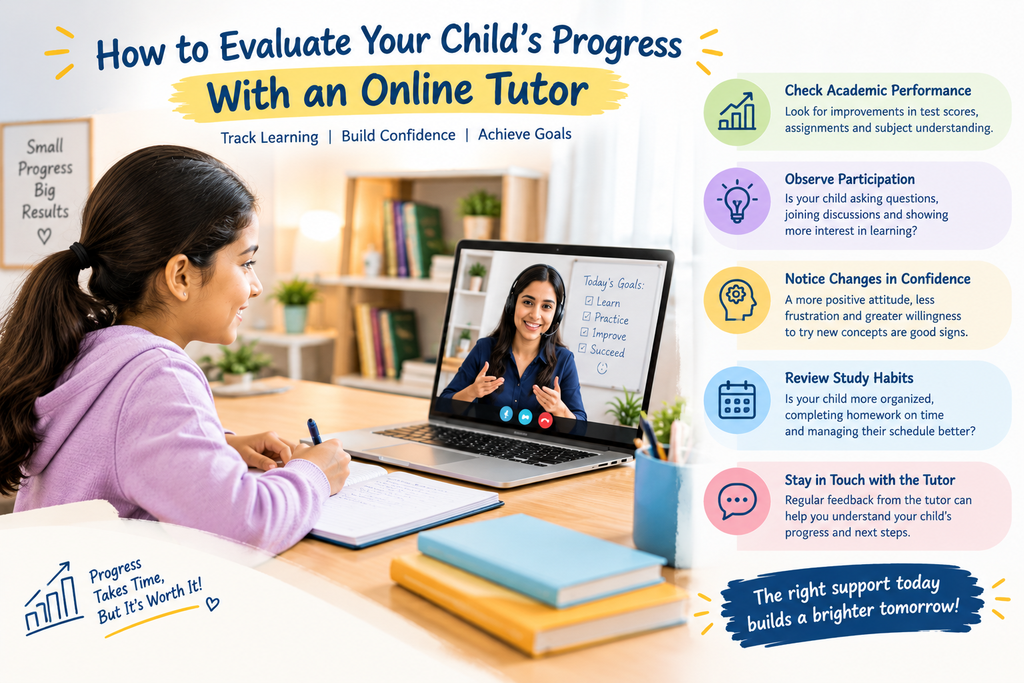
Choosing an online tutor is an important step toward supporting your child’s education, but how can you know whether the learning sessions are actually helping? Many parents focus only on examination marks to measure academic progress. However, real learning involves much more than scores. Improved understanding, increased confidence, better study habits, and the ability to solve problems independently are equally important indicators.
When parents choose the best online tuition class, they should also understand how to evaluate their child’s progress regularly. Monitoring progress helps parents identify strengths, recognise learning gaps, and work with tutors to improve the learning experience.
In this guide, we will explore practical ways to evaluate your child’s progress with an online tutor, which questions to ask, what signs to observe, and how to ensure that online tuition supports long-term academic development.
Quick Answer: How Can Parents Evaluate Progress With an Online Tutor?
Parents can evaluate their child’s progress by reviewing test results, checking homework performance, observing participation during lessons, discussing feedback with the tutor, and assessing how independently the child can apply newly learned concepts.
Regular communication between parents, students, and tutors is essential. Instead of relying on marks alone, parents should look for consistent improvements in understanding, confidence, problem-solving, and learning habits over several weeks.
1. Set Clear Learning Goals Before Starting Tuition
The first step in evaluating progress is understanding what your child wants to achieve.
Without clear goals, it can be difficult to determine whether online tuition is delivering the expected results.
For example, your child may need support to:
- Improve mathematics problem-solving skills.
- Understand difficult science concepts.
- Improve English grammar and writing.
- Complete homework more independently.
- Prepare for school examinations.
- Strengthen foundational concepts.
- Develop better study habits.
Discuss these goals with your child and the tutor before starting regular sessions.
For example, if your child struggles with fractions, an initial goal might be to understand basic operations involving fractions and solve related questions independently.
Clear goals provide a starting point against which future improvements can be measured.
2. Monitor Academic Performance Over Time
Academic performance is one of the most visible indicators of progress, but it should be evaluated carefully.
Parents can review school test results, quizzes, assignments, practice papers, and homework performance to understand whether the child is improving.
Look for patterns such as:
- Fewer mistakes in previously difficult topics.
- Better performance in class tests.
- Improved accuracy when solving questions.
- Greater understanding of examination questions.
- More consistent homework completion.
However, do not expect immediate improvements after only a few sessions. Some concepts require repeated explanation and practice before students become comfortable with them.
When choosing the best online tuition class, consider whether the teaching approach supports gradual improvement rather than focusing exclusively on short-term marks.
3. Check Whether Your Child Understands Concepts
A student may memorise answers without fully understanding the concepts behind them. This can create difficulties when questions are presented in a different format.
Parents should therefore evaluate understanding, not just the ability to reproduce information.
Try asking your child simple questions after a lesson:
- Can you explain what you learned today?
- Can you solve a similar question without help?
- Why did you use this particular method?
- Can you give an example of the concept?
- What part of the lesson was most difficult?
If your child can explain a concept in their own words and apply it to a new question, that is a useful sign of learning.
A good online tutor should encourage students to understand the reasoning behind answers rather than simply memorising them.
4. Observe Homework and Independent Learning Habits
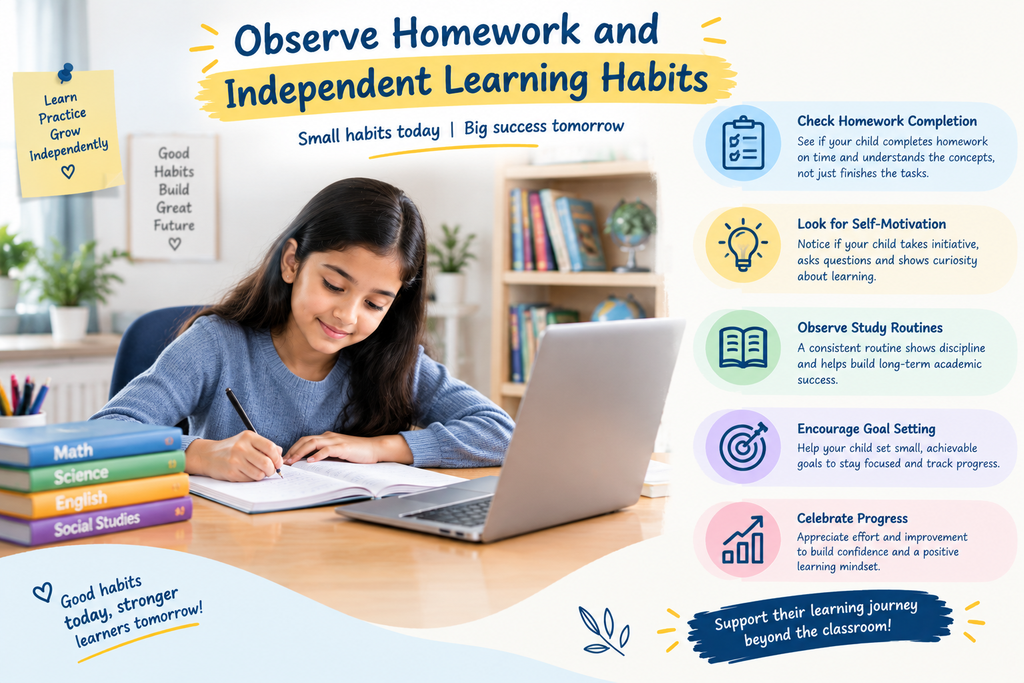
Homework can provide valuable information about how effectively a child is learning.
Parents should observe whether their child is becoming more independent after receiving additional academic support.
Positive signs may include:
- Starting homework with less prompting.
- Completing assignments more consistently.
- Attempting difficult questions before asking for help.
- Making fewer repeated mistakes.
- Revising lessons without constant reminders.
- Managing study time more effectively.
The purpose of tutoring is not to make a child dependent on a tutor for every answer. It should gradually help the student develop the skills needed to work independently.
If your child still requires extensive assistance with every assignment, discuss this pattern with the tutor and identify which concepts may need further attention.
5. Evaluate Confidence and Classroom Participation
Academic progress also includes emotional and behavioural changes.
A child who previously avoided a subject may begin participating more actively once concepts become clearer.
You may notice that your child:
- Asks more questions.
- Participates more confidently in school.
- Shows greater interest in difficult topics.
- Is less anxious about tests.
- Is willing to attempt unfamiliar questions.
- Talks positively about learning.
These changes can indicate that the child is becoming more comfortable with the subject.
However, progress varies from student to student. Some children need more time to develop confidence, particularly if they have struggled academically for a long period.
Parents should encourage effort and improvement rather than comparing their child with classmates.
6. Review Tutor Feedback Regularly
Parents should maintain regular communication with the online tutor.
A tutor who understands the student’s strengths and weaknesses can provide useful feedback about learning progress.
Ask the tutor questions such as:
- Which topics has my child understood well?
- Which concepts still need additional practice?
- Is my child participating actively during lessons?
- Has the child’s problem-solving ability improved?
- What should we focus on during the next few weeks?
- How can we support learning at home?
These discussions can help parents understand what is happening during online sessions, particularly when they are not present throughout the lesson.
When comparing options for the best online tuition class, consider whether the platform and tutor provide meaningful feedback and opportunities for parents to understand their child’s development.
7. Track Progress With Regular Assessments
Regular assessments help identify whether a student can apply what they have learned.
These assessments do not always need to be formal examinations. Short quizzes, practice worksheets, oral questions, and topic-based exercises can also be effective.
A simple progress-tracking table can help parents monitor development.
| Area | What to Observe |
|---|---|
| Concept understanding | Can the child explain topics clearly? |
| Accuracy | Are repeated mistakes decreasing? |
| Homework | Are assignments completed independently? |
| Participation | Does the child ask questions? |
| Confidence | Is the child more willing to attempt problems? |
| Revision | Can the child remember previously learned concepts? |
| Time management | Can the child complete suitable tasks within a reasonable time? |
Review these areas every two to four weeks, depending on the child’s needs and the tutor’s learning plan.
The goal is to identify patterns over time, not to test children constantly or create unnecessary pressure.
8. Identify Learning Gaps Early
Sometimes a student appears to understand a topic during a lesson but struggles to apply it independently later.
This may indicate that an underlying concept has not been fully understood.
For example, a child learning algebra may continue making mistakes because they are not confident with basic arithmetic operations.
A tutor can help identify these gaps and revisit foundational topics before moving forward.
Parents should discuss repeated difficulties rather than assuming that their child is not trying hard enough.
Early identification of learning gaps can make future lessons more productive and prevent confusion as the syllabus becomes more advanced.
9. Check Whether Learning Goals Are Being Achieved
After several weeks of tuition, review the goals established at the beginning.
Ask whether the student has made progress in the areas that originally required support.
For example:
- Has the child improved in solving mathematics problems?
- Can they now understand science concepts more easily?
- Are they completing homework with less assistance?
- Has their examination preparation become more organised?
- Are they more confident about asking questions?
If progress is limited, do not immediately assume that tutoring is ineffective.
The tutor may need to change the teaching method, revise foundational concepts, adjust the learning pace, or provide additional practice.
The important thing is to understand the reason and agree on a practical plan.
10. Make Sure Your Child Feels Comfortable With the Tutor
The relationship between a student and a tutor can influence the learning experience.
Children are generally better positioned to ask questions and communicate difficulties when they feel respected and supported.
Ask your child how they feel about the sessions.
For example:
- Is the tutor easy to understand?
- Do you feel comfortable asking questions?
- Are the lessons interesting and useful?
- Do you receive enough time to practise?
- Is there anything you would like the tutor to explain differently?
If the child consistently feels uncomfortable or confused, discuss the concern with the tutor.
Finding the best online tuition class involves more than selecting a qualified teacher. The learning environment should also suit the child’s needs and encourage active participation.
11. Understand the Role of Parents in Online Learning
Parents do not need to teach every lesson themselves to support academic progress.
Instead, they can create an environment that encourages consistency and communication.
Helpful actions include:
- Providing a quiet study space.
- Ensuring that the child attends sessions regularly.
- Encouraging the completion of assigned practice.
- Discussing what the child learned.
- Communicating concerns with the tutor.
- Recognising effort and improvement.
- Maintaining a balanced schedule with sufficient rest.
Avoid putting excessive pressure on children to show immediate results. Learning is a process, and progress may happen at different rates across subjects.
12. How GenieClasses Can Support Your Child’s Learning Journey
Finding appropriate academic support is an important part of helping children improve.
GenieClasses provides online tutoring options for students, including one-on-one live sessions and group classes. Its learning support includes customized worksheets, guided corrections, class recordings, and learning insights designed to support the learning process.
Parents can explore the available options and discuss their child’s requirements when selecting suitable tutoring support.
You can learn more about the platform through the GenieClasses About Us page, explore common questions on the FAQ page, or contact the team through the Contact Us page.
When evaluating the best online tuition class, choose a learning arrangement that matches your child’s academic goals and makes it easier to monitor progress consistently.
Frequently Asked Questions
1. How often should parents check their child’s progress with an online tutor?
Parents can review progress every two to four weeks, depending on the student’s needs. Regular feedback from the tutor and periodic assessments can help identify improvements and areas that require additional attention.
2. What are the signs that online tutoring is working?
Signs include better understanding of concepts, improved homework completion, fewer repeated mistakes, stronger problem-solving skills, increased confidence, and more independent learning habits.
3. Should parents judge tutoring success only by examination marks?
No. Examination marks are useful, but they do not show every aspect of learning. Parents should also consider conceptual understanding, participation, confidence, consistency, and the ability to solve questions independently.
4. What should parents do if their child is not improving?
Speak with the tutor to identify possible learning gaps, difficulties with the teaching approach, or unrealistic goals. Consider adjusting the learning plan, providing additional practice, or reviewing whether the tutor is a suitable match.
5. How can parents help children improve after online tuition sessions?
Parents can encourage revision, provide a quiet study environment, help maintain a consistent routine, and ask children to explain what they learned. Positive encouragement is generally more helpful than excessive pressure.
6. How do I choose the best online tuition class for my child?
Consider tutor qualifications, teaching methods, personalized attention, class flexibility, learning resources, progress feedback, and your child’s comfort. A demo session can help you assess whether the teaching style is suitable.
7. How long does it take to see results from online tuition?
The timeline depends on the child’s starting level, learning goals, consistency, and the complexity of the subject. Some students may show early improvements in confidence or understanding, while measurable academic changes can take longer.
Conclusion
Evaluating your child’s progress with an online tutor requires looking beyond examination scores. Academic understanding, independent problem-solving, confidence, homework habits, participation, and regular feedback all contribute to a more complete picture of learning.
Parents should establish clear goals, review progress regularly, communicate with tutors, and encourage children to take an active role in their education.
The best online tuition class is one that helps students understand concepts, address learning gaps, practise consistently, and gradually become independent learners.
With realistic expectations, regular communication, and the right academic support, parents can make more informed decisions and help their children build a stronger foundation for future learning.