Quick Answer
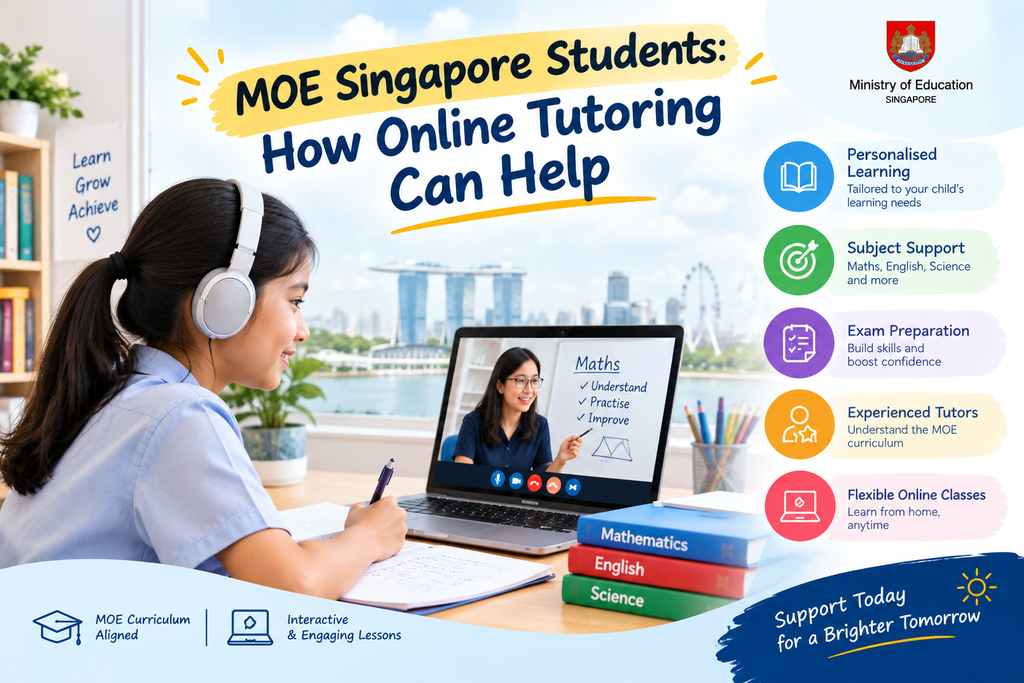
Online tutoring can help students following Singapore’s Ministry of Education (MOE) curriculum by providing personalised explanations, additional subject practice, structured revision, and individual academic guidance. With flexible scheduling and lessons tailored to their learning needs, students can strengthen their understanding, prepare for assessments, and develop greater confidence in school.
Key Takeaways
- Online tutoring provides additional academic support aligned with a student’s school learning needs.
- Personalised lessons help students understand challenging concepts at their own pace.
- Regular practice can support preparation for school assessments and major examinations.
- Interactive lessons and individual feedback can help identify learning gaps.
- Consistent revision and guidance encourage independent learning habits.
- Parents can choose a best online tuition class by considering tutor expertise, teaching methods, and the student’s specific requirements.
Introduction
Singapore’s education system places importance on strong subject knowledge, problem-solving, critical thinking, and consistent academic progress. Students following the Ministry of Education (MOE) curriculum may need to balance classroom lessons, homework, revision, projects, and examinations throughout the school year.
Although school teachers provide essential instruction, some students benefit from additional support outside regular classroom hours. They may need more time to understand a mathematical concept, practise English writing, revise Science topics, or prepare for an upcoming assessment.
This is where online tutoring can help. Through personalised lessons, interactive explanations, and structured practice, students can receive support based on their individual learning needs. Choosing the best online tuition class can also help families establish a more consistent learning routine that complements school education.
1. Personalised Support for Individual Learning Needs
Every student learns differently. Some understand a topic after one explanation, while others need additional examples, guided practice, and regular revision.
In a traditional classroom, teachers must manage the learning needs of many students at once. Online tutoring can provide an opportunity for more individual attention, allowing tutors to focus on specific areas where a student needs help.
For example, a tutor may:
- Identify concepts the student finds difficult.
- Explain challenging topics using simpler language and examples.
- Adjust the pace of lessons according to the student’s understanding.
- Provide practice questions to reinforce learning.
- Review mistakes and explain how to correct them.
This personalised approach helps students build a stronger foundation instead of simply memorising answers. It can be particularly useful when a student is moving to more advanced topics and needs to revisit earlier concepts.
2. Better Understanding of the MOE Curriculum
Students following Singapore’s MOE curriculum encounter different learning objectives as they progress through primary and secondary school. Their academic needs may change depending on their subjects, level, school programme, and upcoming assessments.
Online tutors can support students by reviewing relevant school topics, explaining difficult concepts, and providing additional practice connected to their current learning goals.
Parents should look for tutors who understand the student’s school level and can adapt lessons to the relevant syllabus and learning objectives. It is also helpful to share school assignments, topic lists, and teacher feedback with the tutor.
For official information about Singapore’s education system and curriculum, parents can visit the Singapore Ministry of Education website.
3. Stronger Subject Knowledge in Maths, English, and Science
Some students need extra help in particular subjects. Online tutoring can give them an opportunity to practise regularly and ask questions in a supportive learning environment.
Mathematics
Maths often requires a clear understanding of concepts before students can solve more complex problems. Online tutors can explain mathematical processes step by step, demonstrate different problem-solving methods, and provide practice questions.
Students can learn to understand why a method works rather than relying only on memorised formulas.
English
English lessons may focus on reading comprehension, grammar, vocabulary, sentence construction, and writing skills. Tutors can review written work, explain common mistakes, and help students organise their ideas more clearly.
Regular feedback can help students improve their writing and develop stronger communication skills over time.
Science
Science involves understanding concepts, applying knowledge, interpreting information, and explaining observations. Online tutors can use diagrams, examples, and guided questions to make difficult topics easier to understand.
They can also help students practise explaining scientific ideas in their own words and answering questions accurately.
4. More Structured Exam Preparation
Assessments are an important part of school learning. Students may sometimes feel overwhelmed when several subjects require revision at the same time.
Online tutoring can help make preparation more manageable by dividing topics into smaller, achievable learning goals.
A tutor may support exam preparation by:
- Reviewing important concepts from completed topics.
- Creating a revision plan based on the student’s needs.
- Practising suitable exam-style questions.
- Explaining incorrect answers and recurring mistakes.
- Helping students improve time management during practice.
- Revisiting weaker topics before an assessment.
The aim is not simply to complete as many questions as possible. Students should understand their mistakes and learn how to approach similar questions independently.
For major examinations, the tutor’s approach should reflect the student’s current school level and the relevant assessment requirements.
5. Flexible Learning from Home
Online tutoring allows students to attend lessons from home, reducing the need to travel to a physical tuition centre. This can make scheduling easier for families managing school, extracurricular activities, and other commitments.
A comfortable study environment can also help students focus on lessons and maintain a regular learning routine.
To make online lessons effective, students should have a stable internet connection, a suitable device, a quiet study area, and the materials required for each session.
Parents can help by choosing lesson times that allow students to rest and complete their schoolwork without becoming overloaded.
6. Building Confidence and Independent Learning Habits
Students who repeatedly struggle with a topic may become hesitant to ask questions or attempt difficult problems. Personalised tutoring can give them more opportunities to clarify doubts without feeling rushed.
When tutors recognise progress, explain mistakes constructively, and encourage students to try different approaches, learners can gradually become more comfortable with challenging work.
Effective tutoring should also encourage independence. Instead of immediately providing every answer, tutors can ask guiding questions and allow students to work through problems themselves.
Over time, this approach may help students develop better study habits, improve problem-solving skills, and take greater responsibility for their learning.
7. How to Choose the Right Online Tutor for an MOE Student
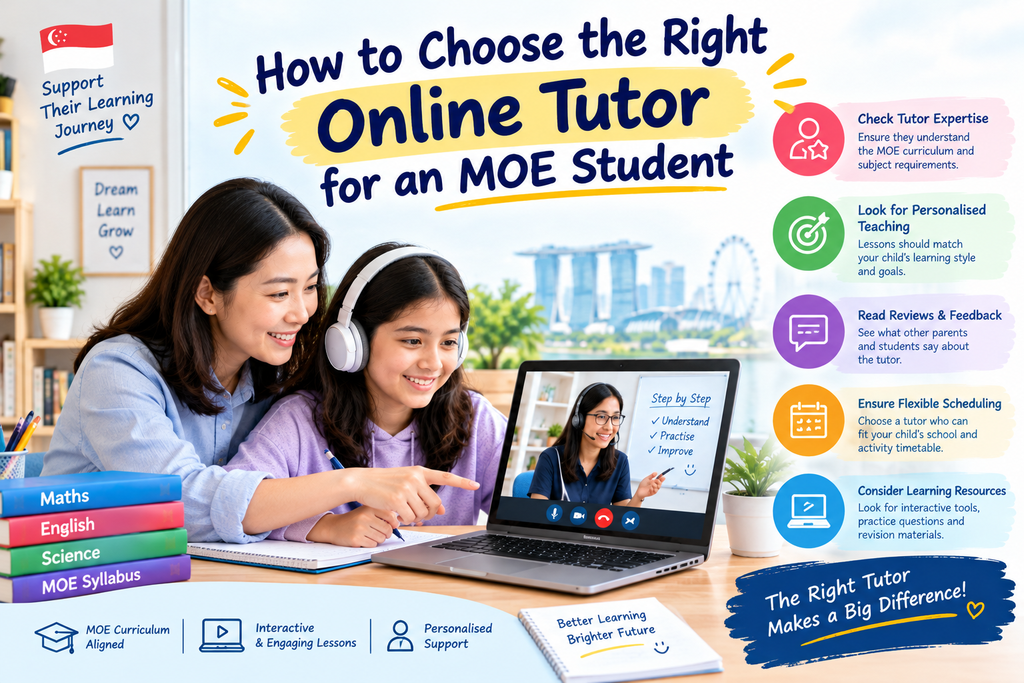
Not every tutoring programme will suit every student. Parents should consider the child’s current academic level, preferred learning style, subject requirements, and goals before choosing a service.
When comparing options, look for:
Relevant subject knowledge: The tutor should understand the subject and the student’s learning objectives.
Personalised teaching: Lessons should address the student’s strengths, weaknesses, and pace of learning.
Clear explanations: The tutor should be able to explain difficult concepts using examples and step-by-step guidance.
Regular feedback: Progress updates can help parents understand which areas are improving and which need further practice.
Flexible scheduling: Lesson timings should fit comfortably around school and family commitments.
Suitable learning resources: Practice questions, revision materials, and interactive tools should support the student’s learning goals.
Parents exploring the best online tuition class should also consider communication, lesson structure, and whether the student feels comfortable asking questions.
Learn more about GenieClasses or visit the About Us page to explore the service. Parents can also use the Contact Us page to enquire about suitable learning support.
Frequently Asked Questions (FAQs)
1. Can online tutoring help students following Singapore’s MOE curriculum?
Yes. Online tutoring can provide additional explanations, subject practice, revision support, and individual guidance based on a student’s school level and learning needs.
2. Which subjects can Singapore students study with an online tutor?
Depending on the tutor’s expertise and the programme offered, students may receive support in Mathematics, English, Science, and other school subjects.
3. Is online tutoring suitable for primary school students?
It can be suitable for primary school students when lessons are age-appropriate, interactive, and designed around their attention span and learning needs. Parental support may also help younger students stay focused.
4. Can online tutoring help students prepare for examinations?
Yes. Tutors can help students revise concepts, practise relevant questions, understand mistakes, and develop a more structured preparation routine. Results depend on several factors, including consistency and individual effort.
5. How often should an MOE student attend online tutoring?
The ideal frequency depends on the student’s goals, existing workload, and areas requiring support. Some students may benefit from weekly sessions, while others may need additional lessons during assessment periods.
6. What should parents look for when choosing an online tuition service?
Parents should consider tutor expertise, teaching methods, personalised attention, suitable learning materials, progress feedback, and scheduling flexibility.
7. Can online tutoring replace school lessons?
Online tutoring is generally best used as supplementary support. School lessons remain important for classroom instruction, curriculum delivery, school-based activities, and teacher guidance.
8. How can parents make online tutoring more effective?
Parents can help by providing a quiet study space, encouraging regular attendance, discussing learning goals with the tutor, and allowing enough time for independent practice and rest.
Conclusion
Online tutoring can be a useful source of additional academic support for students following Singapore’s MOE curriculum. From improving subject understanding and practising problem-solving to preparing for assessments and developing independent study habits, personalised lessons can address many common learning challenges.
The key is to select tutoring that matches the student’s needs and complements their school education. Parents comparing the best online tuition class should focus on teaching quality, individual attention, relevant learning resources, and a sustainable study routine.
With consistent practice, supportive guidance, and active participation, students can work towards stronger subject knowledge and greater confidence in their learning journey.
Explore GenieClasses: Visit www.genieclasses.com to learn more about available learning support and contact the team to discuss your child’s needs.