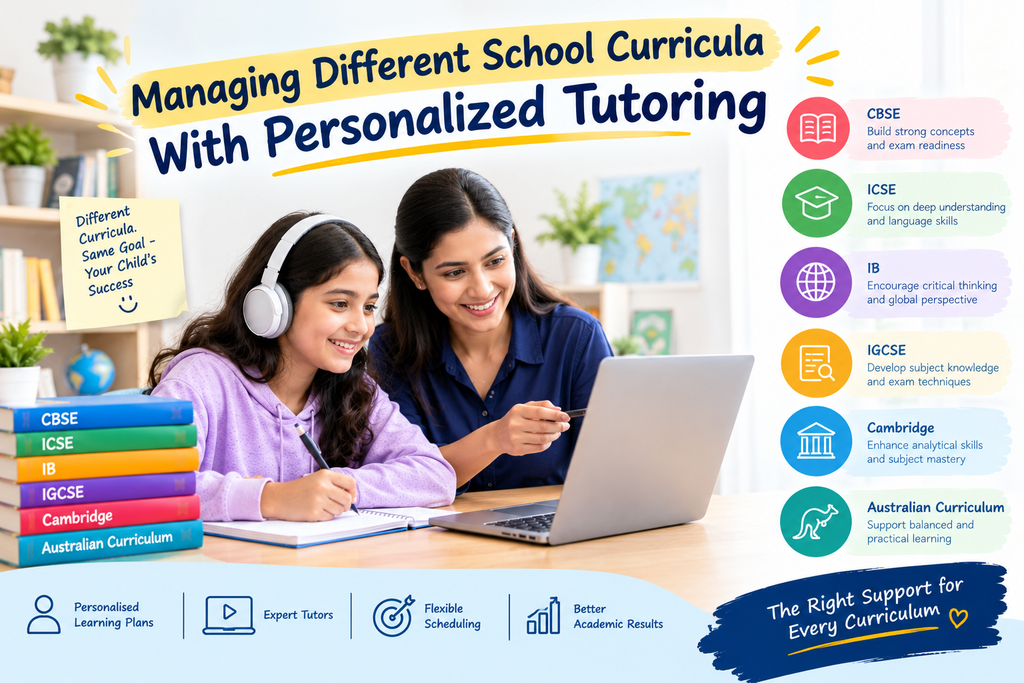
Personalised tutoring helps students manage different school curricula by adapting lessons to their syllabus, academic level, learning pace, and subject requirements. Whether a student follows CBSE, ICSE, IB, IGCSE, Cambridge, or the Australian Curriculum, individualised support can strengthen subject understanding, organise revision, address learning gaps, and prepare students for assessments.
Key Takeaways
- Every school curriculum has different learning objectives, teaching methods, and assessment requirements.
- Personalised tutoring adapts lessons to the student’s specific syllabus and academic needs.
- Online lessons can provide flexible scheduling and additional subject support.
- Regular feedback helps students identify weaknesses and monitor progress.
- Parents should choose tutors with relevant subject knowledge and curriculum familiarity.
Introduction
Today’s students may follow a variety of educational curricula depending on their school, location, and academic goals. Some study under CBSE or ICSE in India, while others follow international programmes such as IB, IGCSE, Cambridge, or the Australian Curriculum.
Each curriculum has its own learning objectives, subject structures, assessment methods, and expectations. As a result, students sometimes need different types of academic support to understand concepts, complete assignments, and prepare effectively for examinations.
This is where personalised tutoring can make a difference. Instead of following the same teaching approach for every learner, personalised lessons focus on a student’s individual syllabus, strengths, challenges, and learning pace. Choosing the best online tuition class can help families find additional academic support that complements school learning and fits their child’s needs.
1. Understanding the Differences Between School Curricula
Before selecting a tutor, parents should understand the main characteristics of their child’s curriculum.
CBSE and ICSE
CBSE students often need support with subject concepts, structured practice, and preparation for school assessments. ICSE students may need additional guidance with detailed subject content, written explanations, and language-based learning.
Tutoring should follow the student’s current syllabus and school expectations rather than relying on a generic study plan.
IB and IGCSE
IB programmes encourage inquiry, critical thinking, research, and connections between subjects. IGCSE courses emphasise subject-specific knowledge, application, and preparation for the relevant examination format.
Students may benefit from tutors who understand the requirements of their particular programme and can help them develop independent thinking and effective study strategies.
Cambridge and Australian Curricula
Cambridge programmes offer subject-based learning pathways with specific assessment requirements. The Australian Curriculum provides learning frameworks across key learning areas and year levels.
Students following these curricula may need support with applying concepts, developing subject skills, completing assignments, and preparing for school assessments.
Parents should consult the relevant school and official curriculum resources to confirm syllabus details and learning expectations.
2. Creating a Personalised Learning Plan
A personalised learning plan gives students a clear structure for their academic development. It starts with identifying what the student already understands and which topics require additional attention.
A tutor may review recent test results, homework, teacher feedback, and the student’s own concerns before planning lessons.
An effective learning plan can include:
- Subject-wise learning goals.
- Topics that require revision or further explanation.
- Weekly practice and homework targets.
- Assessment preparation milestones.
- Regular reviews of progress and learning gaps.
For example, a student who understands mathematical concepts but struggles to apply them to unfamiliar questions may need more problem-solving practice. Another student may understand Science lessons but need help writing clear, well-structured answers.
Personalised tutoring allows lessons to focus on these specific needs instead of spending equal time on every topic.
3. Adapting Teaching Methods to Different Learning Styles
Students do not all learn in the same way. Some benefit from visual explanations, while others learn more effectively through discussion, written examples, or repeated practice.
Tutors can adapt their methods by using diagrams, worked examples, interactive exercises, guided questions, and short revision activities.
For instance, a visual explanation may help a student understand a mathematical process, while discussion and written feedback may help another student improve English composition.
The purpose is not to label students permanently according to a learning style. Instead, tutors should use different teaching methods and assess which approaches help each student understand and apply concepts more effectively.
4. Managing Multiple Subjects and Academic Workloads
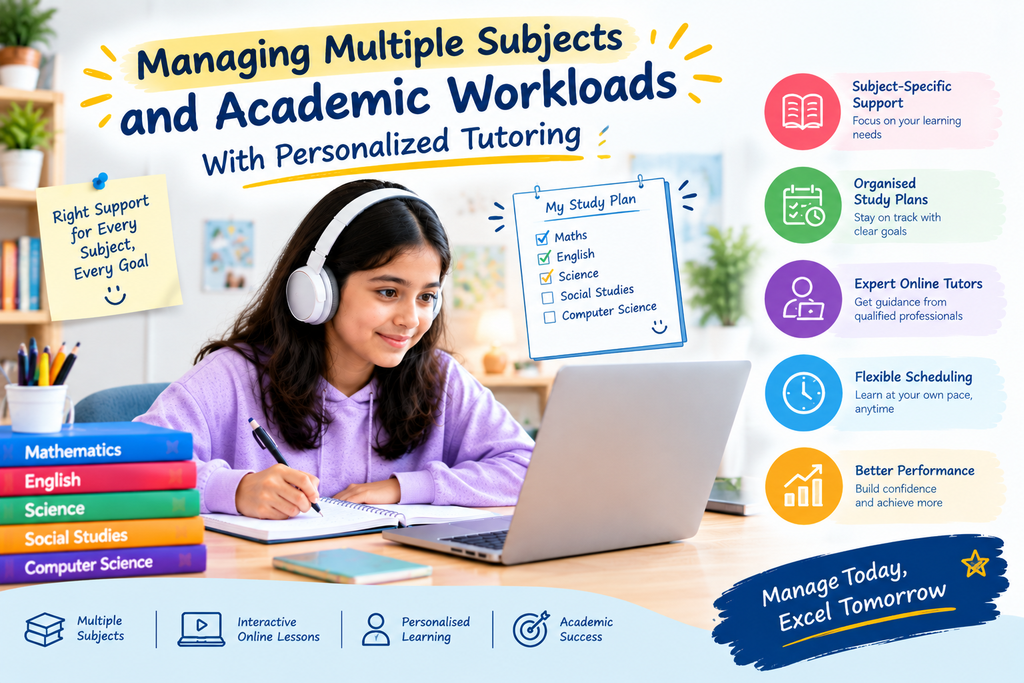
Students often need to balance several subjects, school assignments, extracurricular activities, and examinations. Without a clear plan, they may spend too much time on familiar topics while neglecting areas that need improvement.
Personalised tutoring can help students organise their workload by prioritising difficult topics, setting realistic goals, and dividing revision into manageable sessions.
A practical weekly plan might include:
- Reviewing challenging concepts early in the week.
- Completing subject-specific practice questions.
- Revising previously covered topics.
- Reviewing mistakes and asking follow-up questions.
- Preparing for upcoming school assessments.
This structure can help students use their study time more efficiently while leaving room for rest and other activities.
5. Supporting Exam Preparation and Assessment Skills
Different curricula may assess students through written examinations, coursework, projects, practical activities, or other subject-specific methods.
A tutor should understand the relevant assessment requirements and help students practise appropriate skills. This may include solving examination-style questions, explaining answers clearly, interpreting information, or organising project work.
Regular feedback is especially valuable. When students understand why an answer is incorrect, they can learn from the mistake and apply that knowledge to future tasks.
Families searching for the best online tuition class should look for a programme that supports both subject understanding and the skills required by the student’s particular curriculum.
6. How Online Tutoring Makes Learning More Flexible
Online tutoring gives students the opportunity to receive additional academic support from home. It can reduce travel time and make it easier to arrange lessons around school schedules and family commitments.
Depending on the programme, online lessons may include screen sharing, digital whiteboards, practice worksheets, revision materials, and interactive discussions.
To get the most from online tutoring, students should have a reliable internet connection, a suitable device, a quiet learning environment, and time for independent practice between lessons.
Parents should also ensure that lesson schedules remain realistic. Additional tuition is most useful when it supports learning without creating unnecessary stress or reducing time for rest.
7. How to Choose the Right Personalised Tutoring Service
Choosing a suitable tutor involves more than comparing prices or lesson timings. Parents should consider whether the tutor can support the student’s specific curriculum and learning goals.
Look for the following qualities:
Curriculum familiarity: The tutor should understand the relevant syllabus, subject expectations, and assessment approach.
Subject expertise: Strong subject knowledge helps tutors explain difficult concepts clearly and accurately.
Personalised instruction: Lessons should address the student’s learning gaps, academic strengths, and progress.
Regular feedback: Parents and students should receive useful information about completed topics and areas requiring more practice.
Flexible scheduling: Lesson timings should fit around school, homework, and extracurricular activities.
Suitable learning resources: Practice questions, revision materials, and interactive tools should match the student’s learning objectives.
The best online tuition class for one student may not be the right choice for another. Families should focus on teaching quality, curriculum relevance, and the student’s comfort with the learning approach.
Parents can explore GenieClasses to learn more about its learning support. Visit the About Us page to learn about the service, or use the Contact Us page to enquire about suitable options.
Frequently Asked Questions
1. Why is personalised tutoring useful for students following different curricula?
It allows lessons to focus on a student’s specific syllabus, learning needs, subject difficulties, and assessment requirements instead of relying on a one-size-fits-all approach.
2. Can one tutor support students from different school curricula?
Some tutors have experience with multiple curricula, while others specialise in particular programmes. Parents should confirm the tutor’s subject expertise and familiarity with the student’s exact curriculum and level.
3. Is online tutoring suitable for CBSE, ICSE, IB, and IGCSE students?
Online tutoring can support students across these curricula when lessons are tailored to their syllabus, subject requirements, and learning goals.
4. How often should students attend personalised tutoring sessions?
The ideal frequency depends on the student’s academic needs, workload, and goals. Some students may benefit from weekly lessons, while others may need more frequent support during assessment periods.
5. Can personalised tutoring help improve academic performance?
It can support stronger understanding, consistent practice, and better study habits. However, progress depends on factors such as attendance, effort, teaching quality, and independent revision.
6. What should parents ask before choosing an online tutor?
Parents can ask about curriculum experience, subject expertise, lesson structure, progress tracking, learning resources, scheduling, and how the tutor identifies and addresses learning gaps.
7. Does online tutoring replace regular school education?
No. It is generally intended to complement school learning by providing additional explanations, practice, revision, and individual attention.
Conclusion
Managing different school curricula can be challenging because each programme has its own learning objectives, subject requirements, and assessment methods. Personalised tutoring helps address these differences by adapting lessons to a student’s academic needs, learning pace, and goals.
With appropriate guidance, students can strengthen subject understanding, organise revision, develop problem-solving skills, and become more independent learners. Parents should prioritise curriculum familiarity, effective teaching methods, regular feedback, and a balanced study routine when choosing additional academic support.
Selecting the best online tuition class is ultimately about finding a suitable learning approach that complements school education and helps each student make steady progress.
Learn more about our teaching approach, educational values, and commitment to helping students succeed by visiting our About Us page.
Have questions or need help finding the right tutor for your child? Visit our Contact Us page to connect with the GenieClasses team and explore suitable learning options.