
Every student learns differently. Some understand new concepts quickly, while others need additional explanations, practical examples, or more time to practise. This is why one-on-one tutoring can be a useful way to provide personalized academic support.
During an individual session, the tutor focuses on one student’s learning needs, answers questions, explains difficult topics, and checks understanding throughout the lesson. Rather than following the same pace for an entire group, the tutor can adjust the teaching approach according to the student’s progress.
For parents considering online education, understanding what happens during a tutoring session can make it easier to choose the right learning support. A well-structured lesson should have clear objectives, active participation, useful practice, and constructive feedback.
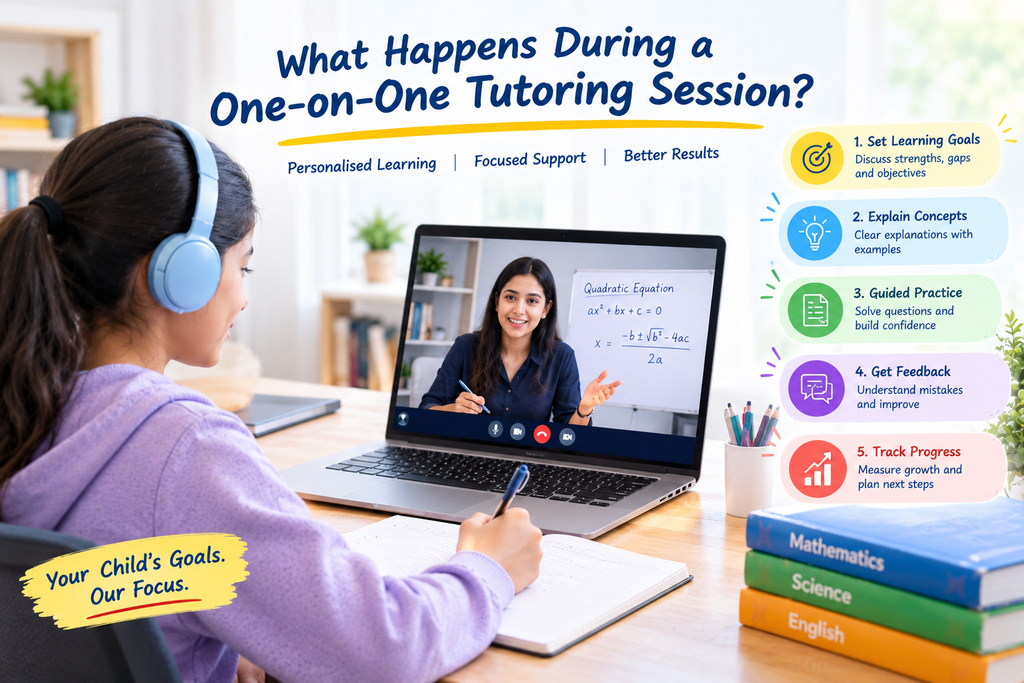
What Happens During a One-on-One Tutoring Session?
A typical one-on-one tutoring session includes a brief review, a discussion of learning goals, concept explanations, guided practice, and feedback. The exact structure depends on the student’s age, subject, academic level, and learning objectives.
Here are the main stages of an effective session.
1. Reviewing Previous Lessons and Learning Goals
Most productive sessions begin with a short review of previously covered material. The tutor may ask questions, revisit homework, or discuss topics the student found difficult.
This helps the tutor understand how much the student remembers and whether any concepts need further explanation.
For example, a Mathematics tutor might ask the student to solve two questions from the previous lesson. If the student struggles with a particular step, the tutor can address that difficulty before introducing a new concept.
The tutor may also establish a specific goal for the current class, such as understanding fractions, improving reading comprehension, or practising examination questions.
Why this matters: Reviewing previous lessons helps identify knowledge gaps and creates a clear direction for the session.
2. Understanding the Student’s Learning Needs
Every student has different strengths, challenges, and learning preferences. One-on-one tutoring gives the tutor an opportunity to understand these individual needs more closely.
An experienced online tutor may use questions, short assessments, homework reviews, and discussions to identify where the student needs support.
For example, a student may understand a Science concept but struggle to explain it in written answers. Another student may know a mathematical formula but find it difficult to apply it to word problems.
Identifying the actual challenge allows the tutor to focus on the skill that needs improvement rather than repeating material the student already understands.
Personalized instruction can also help students feel more comfortable asking questions and learning from mistakes.
3. Explaining Concepts With Examples
The main teaching portion of the session focuses on helping the student understand the topic. Depending on the subject, the tutor may use diagrams, worked examples, digital whiteboards, reading exercises, demonstrations, or real-life situations.
For example:
- Mathematics: Breaking down a problem into smaller steps and demonstrating the correct method.
- Science: Using diagrams and practical examples to explain scientific processes.
- English: Practising grammar, vocabulary, reading comprehension, and writing.
- Languages: Developing speaking, listening, pronunciation, and sentence construction.
A strong lesson involves more than simply giving information. The tutor should check whether the student understands the explanation and try a different approach when necessary.
This flexibility is one reason families consider the best online tuition class for students who benefit from focused attention.
4. Encouraging Questions and Active Participation
Students learn more effectively when they actively participate rather than listen passively throughout the lesson.
During an individual session, students can ask questions without worrying about speaking in front of a group. The tutor can encourage them to explain their thinking, attempt answers, and discuss mistakes.
For instance, instead of immediately correcting a wrong answer, the tutor might ask, “Can you explain how you reached that result?” This helps reveal whether the student misunderstood the concept, missed a step, or made a simple calculation error.
Active participation also helps students develop problem-solving skills and become more confident in expressing their ideas.
5. Practising Questions and Applying Knowledge
After explaining a topic, the tutor usually gives the student opportunities to apply what they have learned.
Practice activities may include worksheets, textbook exercises, quizzes, short written answers, problem-solving tasks, or examination-style questions.
The tutor can begin with simpler questions and gradually introduce more challenging ones as the student’s understanding improves.
This stage is important because recognising an explanation is not the same as being able to use the concept independently.
A student preparing for an examination, for example, may need to practise applying formulas under timed conditions. A student learning English may benefit from writing a paragraph and receiving guidance on sentence structure.
Regular practice helps reinforce learning and shows the tutor which areas need further attention.
6. Receiving Feedback and Correcting Mistakes
Feedback is an essential part of an effective tutoring session. Students need to understand not only whether an answer is correct but also why a particular method works.
A good tutor explains errors constructively, demonstrates the correct approach, and gives the student another opportunity to try.
Feedback may cover:
- Concepts the student understands well.
- Mistakes that occur repeatedly.
- Skills that require more practice.
- Improvements in accuracy or confidence.
- Recommended activities for further learning.
The goal is not to criticise mistakes but to use them as opportunities for improvement.
Parents can also benefit from regular updates about their child’s progress, especially when tutoring is intended to address specific academic challenges.
7. Summarising the Lesson and Planning Next Steps
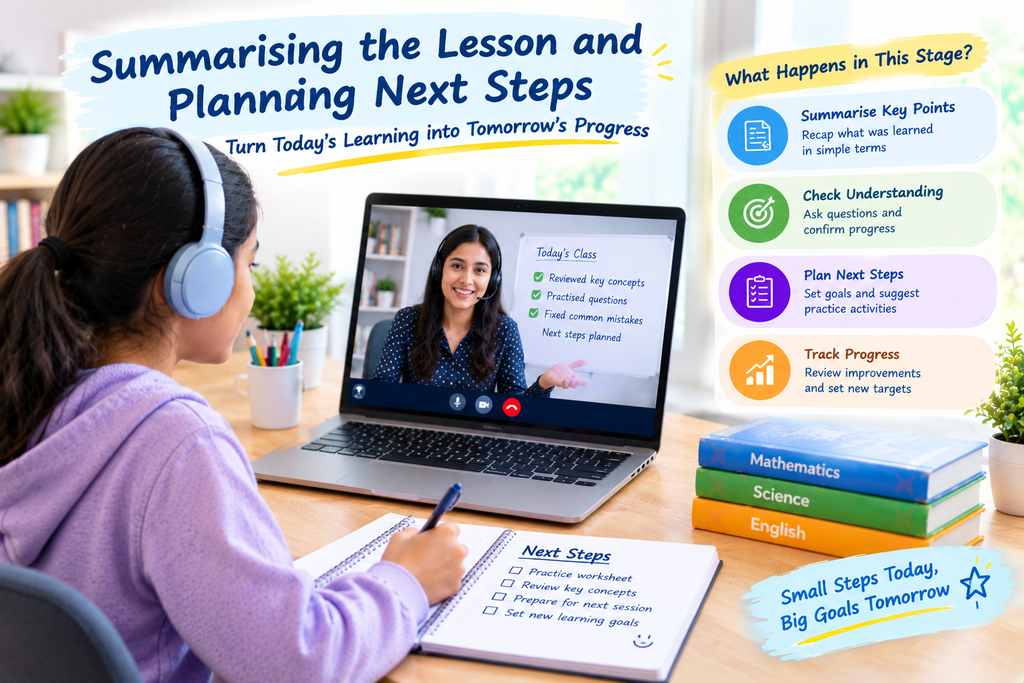
Before the session ends, the tutor should summarise the key concepts and review whether the learning objectives have been achieved.
The student may be asked to explain an idea in their own words, solve a final question, or identify the most important points from the lesson.
The tutor may also recommend homework, revision questions, or additional learning materials. These activities help students practise independently between sessions.
Some online learning platforms provide supplementary resources, such as customised worksheets, guided corrections, or class recordings. The availability of these features depends on the platform and the selected learning arrangement.
At GenieClasses, parents can explore the available learning features and tutoring options to understand how students can continue practising after live sessions.
What Are the Benefits of One-on-One Tutoring?
Individual tutoring can offer several advantages when lessons are planned around the student’s needs.
Personalized Attention
The tutor can focus on the student’s questions, academic challenges, and learning goals without dividing attention among multiple learners.
Flexible Learning Pace
Students can spend more time on difficult topics and move through familiar material more quickly when appropriate.
Improved Confidence
A supportive learning environment can encourage students to ask questions, attempt challenging tasks, and learn from mistakes.
Targeted Practice
Tutors can select exercises based on the student’s current understanding rather than assigning identical activities to everyone.
Clearer Progress Tracking
Regular practice, assessments, and feedback help students and parents recognise strengths and identify areas that still need work.
However, progress depends on several factors, including teaching quality, consistent attendance, independent practice, and the student’s individual circumstances. One-on-one tutoring does not guarantee immediate academic improvement.
How Can Parents Prepare Their Child for a Tutoring Session?
Parents can help make lessons more productive by creating a suitable learning environment and encouraging consistent study habits.
Before each session, consider the following steps:
- Choose a quiet space: Reduce distractions and make sure the student can concentrate.
- Check the technology: Ensure the device, microphone, and internet connection are working properly.
- Keep learning materials ready: Prepare notebooks, textbooks, assignments, and any questions the student wants to ask.
- Discuss learning goals: Let the tutor know about upcoming tests or topics the student finds challenging.
- Encourage participation: Remind the student that asking questions and making mistakes are normal parts of learning.
- Review feedback: Discuss progress with the tutor periodically and encourage the student to practise between sessions.
These simple habits can help students approach lessons with greater focus and make better use of their learning time.
How to Choose the Right Online Tutoring Option
When comparing tutoring services, parents should look beyond price and scheduling. Consider the tutor’s subject knowledge, teaching approach, ability to personalise lessons, communication practices, and methods for reviewing progress.
It is also useful to ask whether the tutoring service offers a demonstration class, suitable learning resources, and clear information about fees and policies.
The best online tuition class is one that aligns with the student’s learning needs and provides a supportive environment for consistent practice.
To understand the learning approach offered by GenieClasses, visit the About Us page. You can also explore GenieClasses to learn more about its tutoring options or visit the Contact Us page for further information.
For more guidance, read What Parents Should Expect From a One-on-One Online Class.
Frequently Asked Questions
1. What happens during a one-on-one tutoring session?
A typical session includes reviewing previous learning, setting goals, explaining concepts, practising questions, correcting mistakes, and summarising the lesson. The exact format varies according to the subject and student’s needs.
2. How long does a one-on-one tutoring session last?
Session length depends on the student’s age, subject, learning goals, and the tutor’s schedule. Parents should choose a duration that allows meaningful learning without causing unnecessary fatigue.
3. Is one-on-one online tutoring effective for school students?
It can be helpful for students who need personalised explanations, targeted practice, or additional support with particular subjects. Effectiveness depends on teaching quality, student participation, and consistent practice.
4. What should a student bring to an online tutoring session?
Students should have a suitable device, a stable internet connection, notebooks, pens, textbooks, assignments, and any questions they want to discuss. Specific requirements may vary by subject.
5. How can parents track progress after tutoring sessions?
Parents can review tutor feedback, observe changes in homework performance, discuss learning goals, and monitor results from practice exercises or assessments. Regular communication helps identify areas that need additional support.
6. Does a one-on-one tutoring session include homework?
Some tutors assign homework or practice exercises, while others focus on guided practice during the lesson. Parents can ask the tutor about the approach and ensure the workload is suitable for the student.
7. What makes a good online tutor?
A good tutor combines strong subject knowledge with clear explanations, patience, adaptability, and constructive feedback. They should encourage questions and adjust lessons to the student’s learning needs.
8. How do I choose the best online tuition class?
Compare tutor expertise, personalised teaching, lesson structure, learning resources, progress tracking, fees, and communication. A demonstration session can help you assess whether the teaching approach suits your child.
Conclusion
A one-on-one tutoring session is most useful when it combines clear learning goals, personalised explanations, active participation, guided practice, and constructive feedback. Each stage helps the student build understanding and identify what to work on next.
Parents can support this process by preparing a distraction-free learning space, communicating with the tutor, and encouraging regular revision. They should also review progress over time and adjust the learning plan when necessary.
Choosing the right tutor is not simply about completing more lessons. It is about finding a learning approach that helps the student understand concepts, practise independently, and build confidence step by step.
With consistent effort and appropriate support, individual tutoring can become a valuable part of a student’s learning journey.