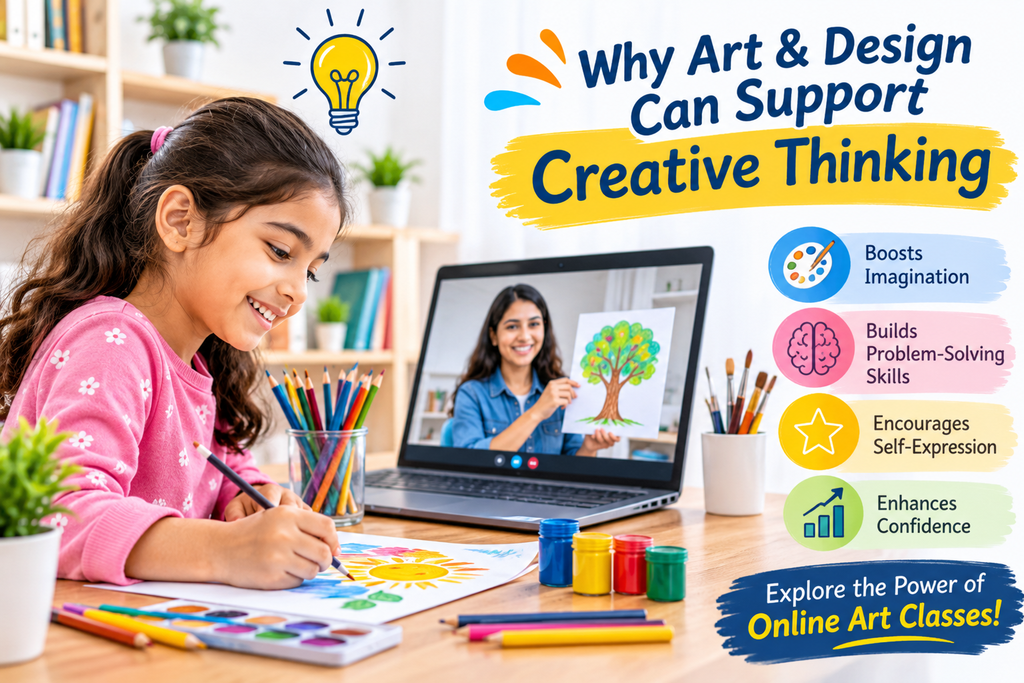
Creative thinking is an important skill that helps children explore ideas, solve problems, and express themselves in different ways. While traditional academic subjects build essential knowledge, creative activities give students opportunities to experiment, imagine, and discover their own approaches to learning. Through online art classes, children can explore colours, shapes, drawing techniques, and design concepts while developing their ability to think independently.
Art and design are not limited to creating attractive pictures or decorative objects. They encourage children to observe their surroundings, ask questions, make decisions, and turn their ideas into something meaningful. With the right guidance, online art classes can become a valuable part of a child’s overall learning journey.
Quick Answer: How Do Art and Design Support Creative Thinking?
Art and design support creative thinking by encouraging children to:
- Explore different ideas and possibilities.
- Express their thoughts through visual activities.
- Experiment with colours, shapes, patterns, and materials.
- Develop problem-solving and decision-making skills.
- Learn from mistakes and try new approaches.
- Build confidence in their own abilities.
- Improve observation and imagination.
These experiences help children become more curious, flexible, and independent thinkers.
Key Takeaways
- Art encourages children to think beyond familiar answers.
- Design activities develop planning and problem-solving abilities.
- Creative projects help students express their thoughts and emotions.
- Experimentation teaches children that mistakes are part of learning.
- Art-based activities can complement academic education.
- Regular creative practice can help build confidence and patience.
1. Art Encourages Children to Explore New Ideas
One of the biggest benefits of art is that it gives children the freedom to explore different possibilities. In many academic activities, students are expected to follow specific instructions or reach a particular answer. Creative activities, however, often allow several different outcomes.
For example, when children are asked to draw a garden, each student may imagine something different. One might create a colourful flower garden, while another may draw a garden filled with unusual plants, butterflies, and imaginative structures.
This freedom encourages students to think independently instead of simply copying an example.
Through online art classes, children can practise different drawing styles, explore creative themes, and gradually develop their own artistic ideas.
2. Design Activities Develop Problem-Solving Skills
Design is not only about appearance. It also involves understanding a purpose, planning an approach, and finding ways to make an idea work.
For example, when students create a poster, they must decide:
- What message should the poster communicate?
- Which colours will make it attractive?
- Where should the images and text be placed?
- How can the design be made easy to understand?
These decisions encourage students to analyse information and solve small problems throughout the creative process.
Such activities introduce children to practical thinking and help them understand that a challenge can have more than one possible solution.
3. Creative Activities Improve Imagination
Imagination allows children to think about things beyond what they see in everyday life. Art gives them an opportunity to turn those thoughts into visual creations.
Drawing imaginary characters, designing future cities, creating patterns, and illustrating stories can all encourage imaginative thinking.
Parents can support this process by giving children open-ended creative tasks rather than always providing step-by-step instructions.
For example, instead of asking a child to copy a picture, parents can suggest designing an imaginary animal or creating a new vehicle. This encourages children to develop original ideas and explain their choices.
4. Art Helps Children Express Their Thoughts and Feelings
Not every child finds it easy to communicate ideas through words. Some children may feel more comfortable expressing themselves through drawings, colours, paintings, or visual projects.
Art provides an alternative way to communicate thoughts and experiences. A child might use colours to represent a mood, create a picture about a favourite memory, or design something inspired by a personal interest.
This process can encourage self-expression and help children become more comfortable sharing their ideas.
Parents and teachers should focus on understanding the child’s creative choices instead of judging every artwork based on how realistic or perfect it looks.
5. Experimentation Teaches Children to Learn from Mistakes
Creative work rarely develops perfectly on the first attempt. A drawing may not look as expected, a colour combination may not work, or a design may need to be changed.
These situations teach children that mistakes are a normal part of learning.
Instead of giving up, students can try another technique, change their approach, or find a different way to complete the project.
This process develops patience, adaptability, and a willingness to experiment.
With regular practice, online art classes can provide guided opportunities for children to explore techniques, receive feedback, and improve their creative work step by step.
6. Art and Design Can Support Academic Learning
Creative activities can also complement learning in other school subjects.
For example:
- Mathematics: Drawing shapes, patterns, and symmetrical designs can help students explore visual relationships.
- Science: Creating diagrams and models can help children represent scientific concepts.
- English: Illustrating stories and designing characters can encourage storytelling and vocabulary development.
- Technology: Digital drawing and design activities can introduce students to creative uses of digital tools.
These connections show that creativity and academic learning do not need to be separate. Art can provide another way for children to understand and communicate what they learn.
7. Creative Projects Build Confidence and Independence
Completing a creative project gives children an opportunity to see the results of their own effort.
Whether they finish a painting, create a handmade design, or develop a digital illustration, the experience can help them feel proud of their work.
Creative projects also encourage independence because children gradually learn to make their own decisions about colours, materials, layouts, and techniques.
Parents can strengthen this confidence by appreciating the effort, originality, and progress behind each project rather than comparing one child’s work with another’s.
8. How Can Parents Encourage Creative Learning at Home?
Parents do not need an expensive art studio to support creativity. Simple activities and regular encouragement can make a meaningful difference.
Here are some practical ideas:
- Keep basic drawing and colouring materials accessible.
- Encourage children to create pictures based on their interests.
- Introduce simple craft and design projects.
- Visit art exhibitions or explore creative work online.
- Allow children to experiment with different materials.
- Ask them to explain the ideas behind their creations.
- Appreciate effort and improvement rather than perfection.
Parents can also explore structured art and design classes to help children learn techniques and develop their interests with guidance.
9. How Can Online Learning Support Art and Design Skills?
Online learning can make creative education more accessible by allowing students to explore subjects from home. With suitable guidance, children can learn drawing techniques, colour combinations, design principles, and different forms of visual expression.
When choosing art classes for kids online, parents should consider the child’s age, interests, learning goals, teaching approach, and opportunities for practical activities.
A supportive learning environment should encourage students to ask questions, experiment, share their work, and receive constructive feedback.
GenieClasses offers Art & Design among its popular subjects and provides personalized learning options, including one-to-one live sessions and group classes. Parents can explore the available subjects and learning options to understand what may suit their child’s interests.
Explore GenieClasses to learn more about its learning approach. You can also visit the About Us page to understand the platform and its educational vision.
Frequently Asked Questions (FAQs)
1. How do art and design support creative thinking in children?
Art and design encourage children to explore ideas, experiment with different materials, solve problems, and express themselves. These activities help develop imagination, independent thinking, and decision-making skills.
2. At what age should children start learning art?
Children can begin exploring simple creative activities from an early age. Drawing, colouring, painting, and basic crafts can be introduced according to their interests and developmental abilities.
3. Can art improve problem-solving skills?
Yes. Creative projects often involve making decisions, overcoming challenges, and trying different approaches. These experiences can help children develop practical problem-solving skills.
4. Are online art classes useful for children?
They can be useful when lessons include age-appropriate activities, clear demonstrations, practical projects, and constructive feedback. Parents should choose a learning format that suits their child’s needs and interests.
5. What skills can children develop through art and design classes?
Children can develop imagination, observation, visual communication, patience, creativity, decision-making, and confidence. They may also improve their ability to plan and complete projects independently.
6. How can parents encourage creative thinking at home?
Parents can provide drawing materials, introduce simple craft projects, encourage storytelling through pictures, and allow children to experiment without worrying about making mistakes.
7. Does art help children in academic subjects?
Art can complement academic learning by helping children represent ideas visually. For example, diagrams can support Science learning, patterns can connect with Mathematics, and illustrations can encourage storytelling in English.
8. How can parents choose suitable art and design classes?
Parents should consider the child’s age, interests, current skill level, class format, practical activities, tutor guidance, and opportunities for feedback before selecting a course.
Conclusion
Art and design play an important role in helping children become imaginative, confident, and independent thinkers. Through drawing, painting, crafting, and design projects, students learn to explore possibilities, communicate ideas, solve problems, and develop their own creative approaches.
Creative learning does not have to compete with academic education. Instead, it can complement school subjects and help children develop skills that are useful in everyday life.
By encouraging curiosity and providing opportunities to practise, parents can help children build a lasting interest in creativity. Exploring suitable learning opportunities through GenieClasses can be one way to support a child’s interest in Art & Design.
Encourage your child’s creativity and help them discover the joy of learning. Visit GenieClasses or Contact Us to explore available learning options.