Education is evolving as digital tools, artificial intelligence (AI), and personalised teaching methods become increasingly common. However, technology alone cannot meet every student’s learning needs. Children also benefit from human guidance, encouragement, explanations, and personal attention.
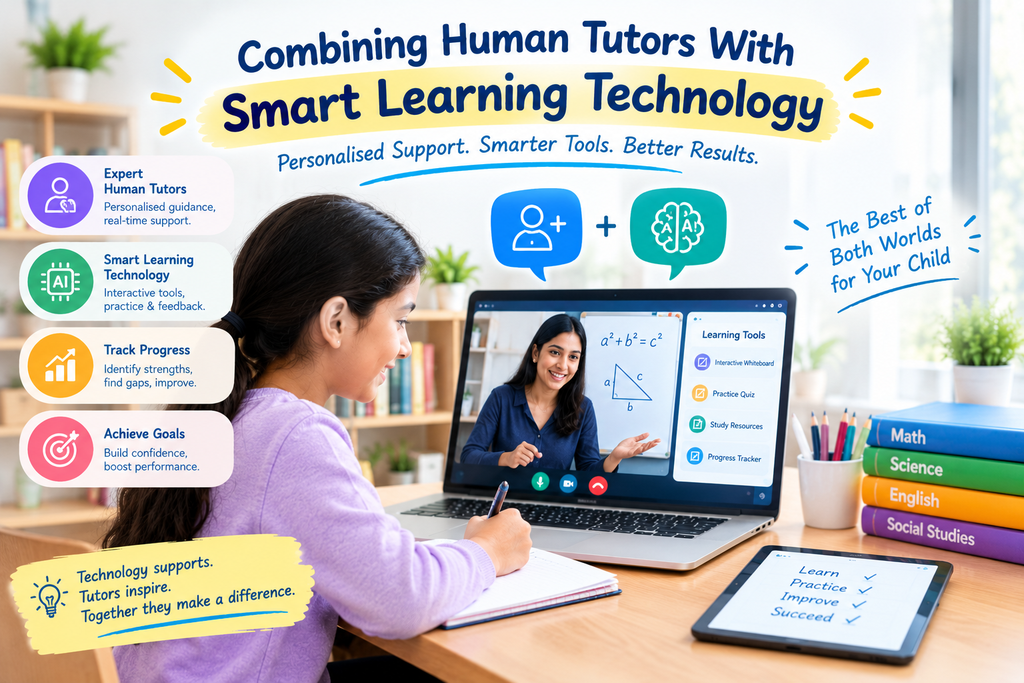
Combining Human Tutors With Smart Learning Technology offers a balanced approach that brings together the strengths of experienced educators and digital learning tools. Tutors can explain difficult concepts, understand a child’s challenges, and build confidence, while technology can support practice, organise learning activities, and help identify areas that need improvement.
For parents exploring the best online tuition class for their children, understanding this combination can help them make more informed decisions about their child’s education.
What Does Combining Human Tutors With Smart Learning Technology Mean?
Combining human tutors with smart learning technology means using digital educational tools to support, rather than replace, the work of a tutor.
A human tutor leads the learning experience by explaining concepts, answering questions, adapting teaching methods, and motivating the student. Technology can complement these activities through interactive exercises, digital worksheets, progress reports, educational videos, and AI-supported feedback.
For example, a student struggling with fractions might receive a clear explanation from a tutor, practise additional questions through a digital platform, and review mistakes with the tutor during the next session.
This approach combines personal instruction with opportunities for regular practice. The goal is not to use as much technology as possible, but to choose tools that help students understand and remember what they learn.
Why Are Human Tutors Still Important in Digital Education?
Technology can make learning resources more accessible, but children still need meaningful human interaction. A tutor can respond to a student’s questions, recognise frustration, and change an explanation when the first approach does not work.
1. Personalised Explanations
Every child learns differently. Some students understand mathematical concepts through visual examples, while others need step-by-step explanations or repeated practice.
A skilled tutor can identify these differences and adapt the lesson accordingly. Digital learning tools can then provide supplementary exercises based on the student’s current learning needs.
2. Motivation and Confidence
Students sometimes lose confidence when they make mistakes or struggle with a difficult topic. Human tutors can offer encouragement, celebrate improvement, and help children approach challenges positively.
This personal connection can also encourage students to ask questions rather than hide their confusion.
3. Critical Thinking and Problem-Solving
Learning involves more than finding the correct answer. Students need to understand why an answer is correct and how to apply a concept in a new situation.
Tutors can ask follow-up questions, encourage independent reasoning, and help children recognise errors in their thinking. Technology is most useful when it supports these learning goals instead of simply providing answers.
How Smart Learning Technology Supports Tutors
Digital tools can help tutors make lessons more organised, interactive, and responsive to student needs.
1. Identifying Learning Gaps
Online quizzes, practice exercises, and learning analytics can reveal patterns in a student’s performance. For example, repeated mistakes in fractions may suggest that the student needs to revisit equivalent fractions before moving to more advanced problems.
A tutor can interpret this information and decide what to teach next. Performance data should guide professional judgement rather than automatically determine a student’s ability.
2. Providing Additional Practice
Smart learning platforms can offer extra questions, revision activities, and practice at different difficulty levels. Students can use these resources between tutoring sessions to reinforce what they have learned.
This is particularly useful when children need more repetition before feeling confident about a topic.
3. Making Lessons More Interactive
Virtual whiteboards, diagrams, educational videos, polls, and interactive quizzes can make abstract concepts easier to understand.
For example, a science tutor can use an animation to explain a process and then ask the student to describe it in their own words. In mathematics, a shared digital whiteboard allows both tutor and student to work through a problem together.
4. Tracking Progress Over Time
Digital records can help tutors and parents review completed topics, quiz results, recurring mistakes, and areas for revision.
When these records are discussed with the student, progress tracking becomes more than a collection of scores. It can help children understand what they have improved and what they should work on next.
Combining Human Tutors With Smart Learning Technology: Key Benefits for Students
A thoughtful combination of teaching and technology can support several aspects of a child’s learning journey.
- More personalised learning: Lessons and exercises can reflect the student’s current understanding and learning goals.
- Better engagement: Interactive activities can break up lessons and encourage active participation.
- Timely feedback: Digital practice tools can identify mistakes quickly, while tutors explain how to correct them.
- More independent revision: Students can revisit concepts and practise outside scheduled sessions.
- Clearer progress monitoring: Tutors and parents can use learning records to identify strengths and areas for improvement.
- Improved confidence: Personal guidance and achievable practice goals can help students approach challenging subjects with greater confidence.
These benefits depend on the quality of teaching, the suitability of the technology, and how consistently students use the tools. Technology is not a guarantee of better results; it works best when it serves a clear educational purpose.
Can AI Replace Human Tutors?
AI can assist with explaining concepts, generating practice questions, providing hints, and summarising learning activities. However, it should not automatically be treated as a complete replacement for a qualified human tutor.
Students may need clarification when an AI-generated explanation is confusing or incorrect. They may also benefit from encouragement, emotional understanding, and the ability to discuss a problem in depth with a real person.
Research is exploring how human guidance can improve the use of AI-based learning tools. For example, the Stanford National Student Support Accelerator discusses the potential of human-led tutoring supported by AI, while also noting that evidence for fully autonomous AI tutoring remains more limited. Read more in its research brief on AI tutoring.
The practical takeaway for parents is simple: choose technology that strengthens teaching, encourages understanding, and keeps students actively involved in their own learning.
How Parents Can Choose the Right Technology-Supported Tutor
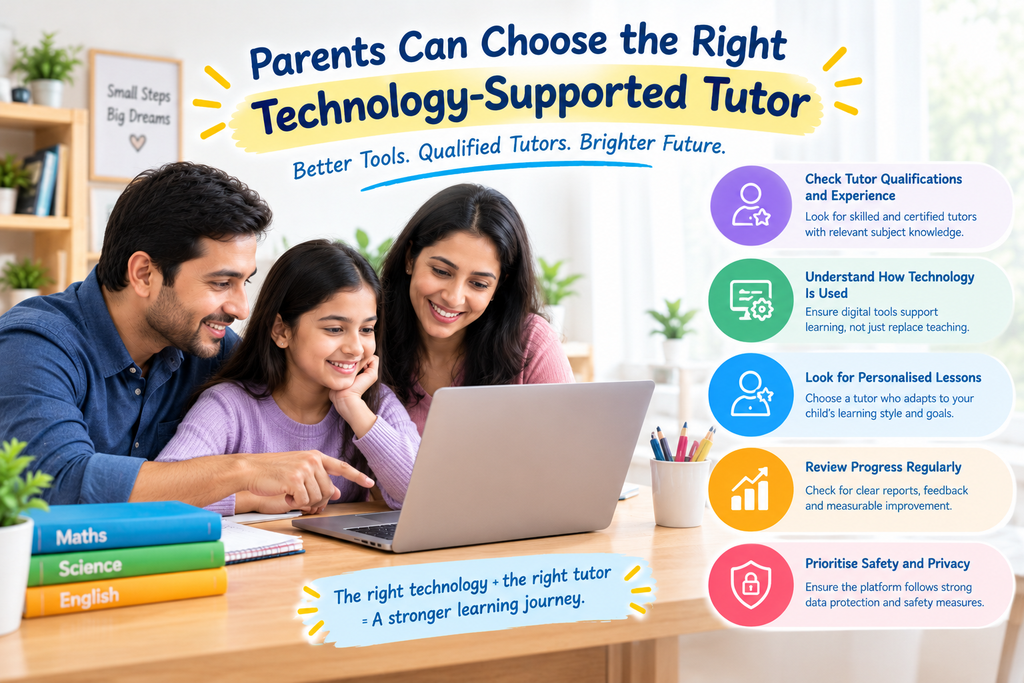
When comparing online tutoring options, consider the following factors:
1. Check Tutor Qualifications and Teaching Style
Look for tutors who understand the student’s curriculum, explain concepts clearly, and encourage questions. A tutor should be able to adapt lessons rather than rely entirely on automated activities.
2. Ask How Technology Is Used
Find out whether digital tools support meaningful learning through practice, feedback, lesson resources, or progress tracking. Technology should have a clear purpose in the teaching process.
3. Look for Personalised Lessons
A useful tutoring programme should consider the child’s existing knowledge, academic goals, and areas of difficulty. Avoid assuming that the same automated lesson plan will suit every student.
4. Review Progress Regularly
Ask how tutors measure improvement and communicate with parents. Progress should be assessed through a combination of practice, understanding, classroom performance, and the ability to apply concepts independently.
5. Prioritise Privacy and Safe Technology Use
Parents should understand what student information a platform collects, how it is used, and whether it is shared with third parties. Children should also be taught to check AI-generated information rather than accepting every answer as correct.
Choosing the best online tuition class involves evaluating the tutor, teaching approach, learning resources, and communication—not simply counting the digital features a platform offers.
How GenieClasses Can Support Modern Learning
GenieClasses brings online learning resources and tutor-led instruction together to support students across different subjects and learning needs.
Depending on the programme selected, students can benefit from live one-on-one sessions or group classes, customised worksheets, guided corrections, and recorded lessons for revision. The platform also offers AI-powered learning insights and session summaries to support the learning process.
These resources can help students revisit concepts, practise between sessions, and review their progress with their tutors. Human guidance remains important for explaining mistakes, answering questions, and deciding what the student should focus on next.
Parents can explore the GenieClasses website to learn about available learning options. Visit the About Us page to learn more about the platform, or use the Contact Us page to ask questions about suitable learning support.
Frequently Asked Questions (FAQs)
1. What is the combination of human tutoring and smart learning technology?
It is an approach that uses human tutors for explanations, guidance, and motivation while digital tools support practice, feedback, interactive lessons, and progress monitoring.
2. How does AI help human tutors?
AI may help tutors organise learning resources, identify patterns in student performance, generate practice activities, and review learning data. Tutors still need to verify information and make teaching decisions based on the student’s needs.
3. Can smart learning technology improve academic performance?
It can support learning by offering additional practice, timely feedback, and useful learning resources. Results depend on teaching quality, student engagement, the suitability of the tools, and consistent practice.
4. Is human tutoring better than AI tutoring?
They serve different purposes. Human tutors provide personal interaction, contextual explanations, and encouragement. AI tools can support practice and feedback. A well-designed combination may offer useful advantages, although outcomes vary by student and programme.
5. Is technology-supported online tutoring suitable for younger children?
It can be suitable when activities are age-appropriate, sessions are well supervised, and screen time is balanced with other activities. Parents should choose safe platforms and remain involved in their child’s learning.
6. How can parents track progress in technology-supported tutoring?
Parents can review tutor feedback, completed exercises, quiz results, topic mastery, and changes in the child’s confidence. Regular conversations with the tutor help put these indicators into context.
7. What should parents look for in the best online tuition class?
Look for qualified tutors, personalised lessons, clear communication, suitable learning resources, regular progress reviews, and responsible technology use. A demo session can help parents evaluate whether the teaching style suits their child.
8. Will smart learning technology replace teachers in the future?
Technology will likely continue changing how teaching and learning are delivered. However, human judgement, encouragement, and personal relationships remain important. Technology is best viewed as a tool that can support effective teaching rather than a guaranteed substitute for it.
Conclusion
Combining Human Tutors With Smart Learning Technology offers a practical way to bring personal guidance and digital learning resources into one educational experience. Tutors can help students understand difficult concepts, develop confidence, and build critical-thinking skills, while technology can provide additional practice, interactive activities, and useful progress information.
For parents, the priority should be finding a learning approach that puts the child’s understanding first. The best online tuition class is not necessarily the one with the most advanced technology, but one that uses appropriate tools alongside effective teaching, regular feedback, and individual attention.
Explore the learning options at GenieClasses and consider how tutor-led instruction and smart learning resources can support your child’s academic goals.
Learn more about our teaching approach, personalised learning solutions, and commitment to helping students succeed by visiting our About Us page. If you would like to know more about our online tutoring services or need help choosing the right learning support for your child, please visit our Contact Us page to connect with the GenieClasses team.