Every child learns differently. Some students understand mathematical concepts quickly but need extra support with writing, while others prefer visual explanations, practical examples, or repeated practice. Traditional classroom teaching may not always provide enough time to address every student’s individual needs.
This is where artificial intelligence (AI) is creating new opportunities in education. AI-powered learning tools can analyse student responses, identify learning gaps, recommend suitable practice activities, and help educators adapt lessons to individual progress.
The role of AI in personalized education is to support a more flexible and responsive learning experience, where students can receive additional practice, progress at a suitable pace, and develop a stronger understanding of challenging concepts.
However, AI works best when combined with experienced teachers, thoughtful guidance, and meaningful interaction. Technology can support education, but it should not replace the human connection that helps children build confidence and curiosity.
What Is Personalised Education?
Personalised education is an approach that adapts learning to a student’s abilities, interests, learning goals, and areas for improvement. Instead of expecting every child to follow exactly the same path, personalised learning provides different levels of support according to individual needs.
For example, a student struggling with fractions might receive additional visual examples and practice questions. Another student who understands the topic well could move on to more challenging problems.
AI can help educators identify these differences by analysing learning activity and suggesting relevant resources. According to UNESCO’s overview of artificial intelligence in education, AI offers opportunities to improve teaching and learning, but its use should remain inclusive, equitable, and centred on human needs.
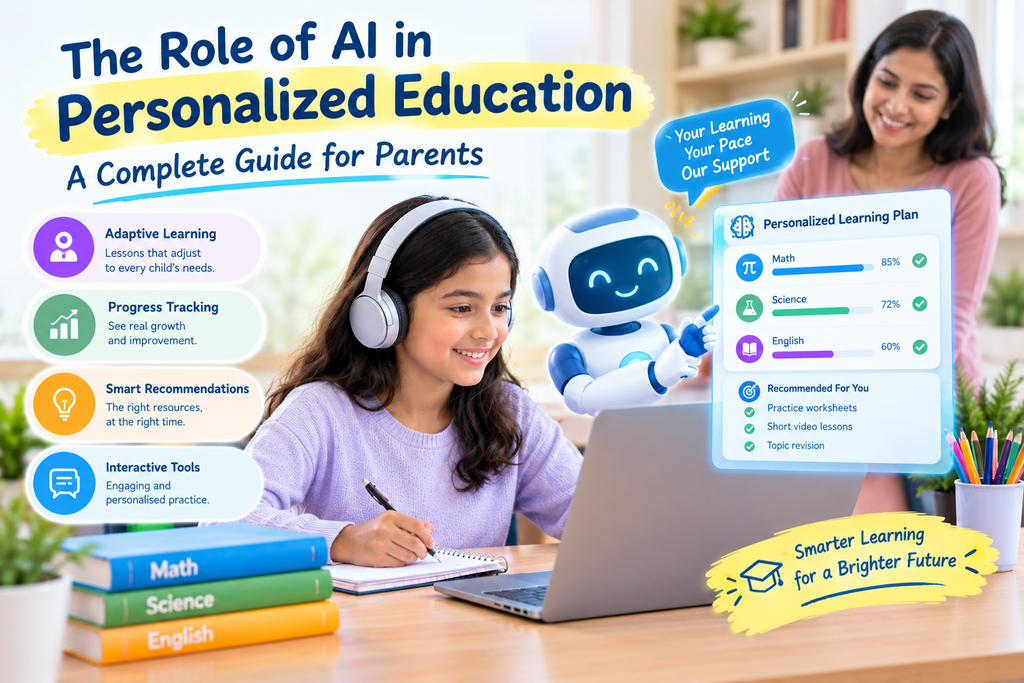
The Role of AI in Personalized Education
AI can contribute to personalised learning in several practical ways. Its effectiveness depends on the quality of the tools, the information available, and how educators use the resulting insights.
1. Adapting Lessons to Individual Learning Needs
AI-powered adaptive learning platforms can adjust the difficulty of questions and recommend resources based on student responses.
If a learner repeatedly makes mistakes in a particular topic, the system may suggest revision activities or simpler explanations. When the student demonstrates understanding, it may recommend more advanced exercises.
This flexibility can help children spend more time on concepts they find difficult without unnecessarily repeating material they already understand.
2. Identifying Learning Gaps Early
A student may perform well in some areas while quietly struggling with a foundational concept. AI-based learning analytics can help identify patterns in quiz answers, completed activities, and assessment results.
For example, a student who consistently struggles with multiplication may need additional practice before moving on to more complex algebra.
These insights can help parents and teachers address difficulties earlier. However, AI-generated assessments are not always accurate, so educators should review the evidence before deciding what support a child needs.
3. Providing Immediate Feedback and Practice
Feedback is essential for learning. When students understand why an answer is incorrect, they have a better opportunity to correct their mistakes.
Some AI learning tools can provide instant explanations, hints, and additional questions. This allows students to practise independently between lessons.
Parents should encourage children to understand the reasoning behind each answer rather than simply accepting AI-generated solutions. The goal is to develop independent thinking, not dependence on automated answers.
4. Supporting Different Learning Preferences
Some children benefit from diagrams, while others learn through reading, discussion, examples, or hands-on activities. AI tools can recommend different types of learning resources to make difficult topics easier to understand.
For example, a science concept might be explained through a diagram, a short video, or a series of guided questions.
These options can make learning more accessible, although no AI system can reliably determine every aspect of a child’s learning preferences without feedback and observation from the student and educator.
5. Helping Teachers Plan More Effective Lessons
AI can assist educators with routine tasks, such as preparing practice questions, organising assessment information, and suggesting revision activities.
Teachers can use these tools to plan lessons that focus on students’ specific needs. They can then devote more attention to explaining complex ideas, answering questions, motivating learners, and providing personal guidance.
The purpose is not to automate teaching completely. Instead, technology can help teachers make informed decisions while keeping professional judgement at the centre of education.
Key Benefits of AI-Powered Personalised Learning
When used thoughtfully, AI-supported education can offer several advantages.
- Individualised practice: Students can work on the topics where they need the most help.
- Flexible learning pace: Learners may revisit challenging concepts or progress to advanced material when ready.
- Timely feedback: Certain tools can provide immediate explanations and practice suggestions.
- Progress monitoring: Learning data can help teachers and parents identify patterns over time.
- Greater accessibility: Translation, text-to-speech, speech-to-text, and other assistive tools may help some students access educational content.
- More informed teaching: Educators can use learning insights to plan targeted support and revision.
For families exploring the best online tuition class, AI-supported resources may be one factor to consider. It is equally important to evaluate tutor qualifications, lesson quality, personalised attention, and the child’s comfort with the learning environment.
What Are the Challenges of Using AI in Education?
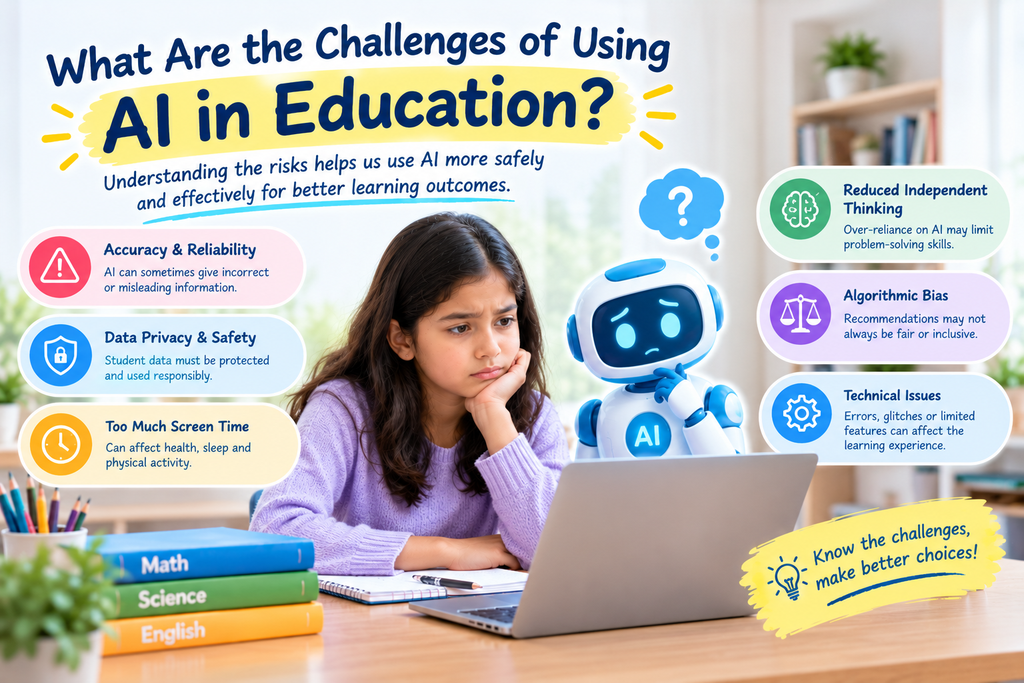
Although AI offers useful possibilities, parents should understand its limitations before introducing these tools into their children’s study routines.
Accuracy and Reliability
AI systems can generate incorrect answers, misleading explanations, or unsuitable recommendations. Students should verify important information with textbooks, teachers, and reliable educational resources.
Data Privacy and Online Safety
Some learning platforms collect information about student activity and performance. Parents should check privacy policies, age requirements, data permissions, and available safety settings before allowing children to use a tool.
Too Much Screen Time
Excessive screen use may interfere with physical activity, sleep, and other important parts of a child’s development. A balanced routine should include offline reading, writing, discussion, and recreational activities.
Reduced Independent Thinking
If students use AI to complete homework without understanding the material, they may miss important learning opportunities. Encourage children to attempt problems independently, ask questions, and explain concepts in their own words.
UNESCO also highlights the importance of a human-centred approach to AI in education. Read its guidance on artificial intelligence and education for further context on opportunities and risks.
How Can Parents Use AI to Support Their Child’s Education?
Parents do not need advanced technical knowledge to help children use educational technology responsibly. A few practical habits can make a meaningful difference.
- Choose age-appropriate tools: Select platforms designed for the child’s age, subject, and learning goals.
- Set clear learning objectives: Decide whether the child needs help with revision, practice, concept explanations, or organisation.
- Review AI-generated answers: Discuss answers together and check them against trusted learning materials.
- Encourage questions: Ask the child to explain what they learned instead of merely showing the final answer.
- Monitor progress regularly: Look for genuine improvements in understanding, confidence, and independent problem-solving.
- Maintain teacher involvement: Discuss persistent difficulties with the child’s teacher or tutor.
- Balance digital and offline learning: Include handwriting, books, practical activities, breaks, and face-to-face conversations.
Parents can also explore what makes a good online tutor for school students when deciding how to combine technology with personal teaching support.
How GenieClasses Can Support Personalised Learning
AI tools can support educational decisions, but students also need clear explanations, encouragement, structured practice, and opportunities to ask questions.
GenieClasses offers online tutoring support through live learning sessions, personalised teaching approaches, practice resources, and progress-related guidance. Depending on the student’s needs, families can explore individual sessions or group learning options.
The best online tuition class for a child is one that considers their curriculum, current abilities, academic goals, and preferred pace of learning. Technology can complement this experience by helping learners practise concepts and giving educators additional information to consider.
Parents can visit the GenieClasses homepage to explore available learning support. They can also read what parents should expect from a one-on-one online class to understand the value of individual attention.
Frequently Asked Questions
1. What is the role of AI in personalized education?
AI can help adapt practice activities, identify possible learning gaps, provide feedback, and recommend educational resources based on student performance. Teachers and parents should review these insights before making important learning decisions.
2. Can AI replace teachers in personalised education?
No. AI can assist with practice, feedback, and learning analysis, but teachers provide human understanding, motivation, classroom interaction, and professional judgement that technology cannot fully replace.
3. How does AI identify a student’s learning gaps?
Some AI systems analyse quiz responses, mistakes, assessment results, and activity patterns to identify topics that may require further attention. These findings should be checked against the student’s actual understanding.
4. Is AI-powered learning suitable for school students?
It can be useful when tools are age-appropriate, safe, and aligned with learning goals. Parents should supervise usage and ensure that students continue to develop independent thinking and problem-solving skills.
5. What are the main disadvantages of AI in education?
Potential concerns include inaccurate answers, data privacy risks, excessive screen time, algorithmic bias, and over-reliance on automated assistance. Appropriate supervision can help reduce these risks.
6. How can parents combine AI with online tutoring?
Parents can use AI tools for extra practice and revision while relying on qualified tutors for explanations, personalised guidance, feedback, and accountability. This balanced approach can support a more complete learning experience.
7. Does AI make education more personalised for every child?
AI can offer more tailored resources and practice, but its recommendations may not capture a child’s full needs, interests, emotions, or circumstances. Effective personalisation requires student feedback and human involvement.
8. How should parents choose an online tutoring service?
Look for qualified tutors, clear communication, suitable teaching methods, curriculum familiarity, progress updates, and a safe learning environment. Families considering the best online tuition class should also check whether the teaching approach suits their child’s individual needs.
Conclusion
AI is creating new opportunities to make education more flexible, responsive, and accessible. It can help identify learning gaps, recommend relevant practice, provide timely feedback, and support teachers in planning lessons.
However, effective personalised education requires more than technology. Children also need encouragement, meaningful discussion, creativity, independent thinking, and guidance from people who understand their individual needs.
The most effective approach combines the useful capabilities of AI with the experience of teachers and the involvement of parents. When these elements work together, students can receive more thoughtful support while continuing to develop the skills and confidence they need for long-term success.
Explore the About Us page to learn more about GenieClasses. For questions about learning support, visit the Contact Us page to connect with the team.